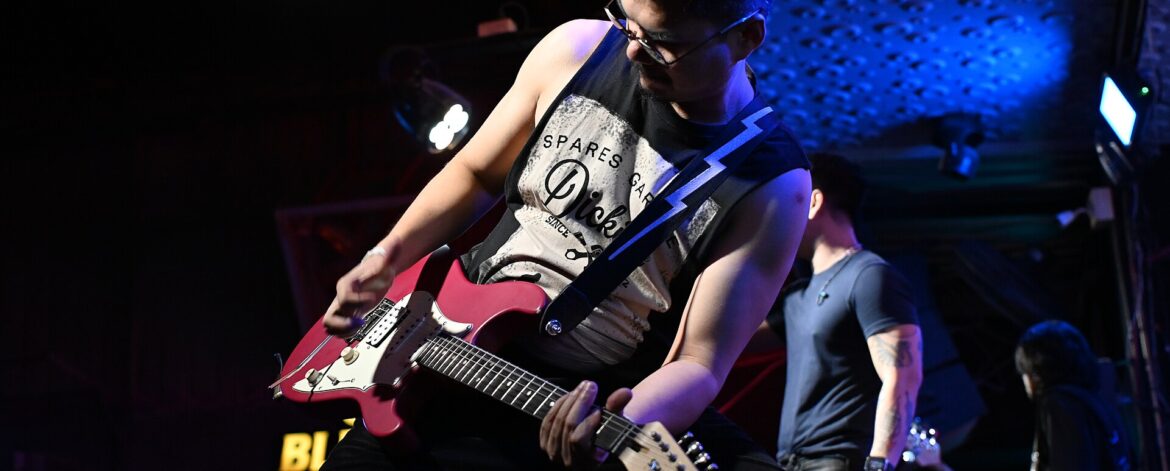
Guitarist online vs gigs is the question we hear most from players who have just got past the awkward first year: should you spend your evenings filming yourself, or loading the amp into the car and playing to a room? Our one line verdict is this: the evidence suggests playing live is the best route to real craft and your strongest income, with short video working as your marketing engine, live streaming as an optional extra, and streaming platforms as a calling card rather than a wage.
We teach guitar from Darwin, Australia, and many of our readers live elsewhere, so a word on the numbers. Where a figure is Australian we say so and use A$ for Australian dollars. We also found no study that compares these routes head to head, so what follows is a careful reading of separate sources plus our own judgement, which we label as such.
If you want pay rates, award wages and a worked income model, our guide on how to make money as a guitarist covers that ground, and we will not repeat it here. This post builds on it by asking a different question: with only so many hours in a week, where should they go?
The quick verdict on guitarist online vs gigs
Here is what the sources say, in plain terms:
- Gigs are still the biggest single income stream. Music Australia’s The Bass Line, second edition estimates live performance brought Australian artists A$410 million in 2024 to 2025. That is 47 per cent of their music income in the report’s own table, so about half. It covers all artists, not only guitarists.
- The pay is modest and the rooms are shrinking. The same report puts median artist income from music at A$14,800 a year. A federal inquiry heard that about 1,300 live music venues have closed since the pandemic.
- Online ad money is tiny for most people. vidIQ looked at more than a million channels sitting at 1,000 subscribers and found 89 per cent get under 5,000 views a month, which typically means under 20 US dollars a month in ads.
- Streaming platforms pay very little to unknown artists. Spotify does not pay for tracks under 1,000 plays in a year, and about 88 per cent of tracks fell at or below that line in 2025.
- The success stories mix both. Tash Sultana went from busking and viral videos to sold out rooms, and Plini grew through forums and Bandcamp before touring.
So, the evidence suggests this order of play. Gigs build the skill and the income that actually shows up in a bank account. Short video is the cheapest way to reach people beyond the room, so film your gigs and practice rather than treating video as a separate job. Live streaming suits players who enjoy a regular, chatty schedule. Spotify and Bandcamp are where a booker or new fan checks you out, not where you pay rent.
That is our judgement, not a finding, and a few players do very well online alone.
Online video: YouTube, Shorts, Instagram and TikTok
What is open to Australians, and what is not
YouTube is the one big platform with an open, published route to pay. Its Partner Programme help page asks for 1,000 subscribers plus either 4,000 public watch hours in 12 months or 10 million public Shorts views in 90 days, and the programme must be available in your country. YouTube says new creators will need 8,000 watch hours or 20 million Shorts views from 1 February 2027, as set out on its changes to the Partner Programme page. Fan funding, such as memberships and Super Chat, starts earlier, at 500 subscribers plus 3,000 watch hours or 3 million Shorts views. YouTube’s earnings page lists the shares: 55 per cent of net watch page ad revenue, 45 per cent of Shorts pool revenue, and 70 per cent of fan funding.
The others are narrower. 7NEWS reported in May 2026 that TikTok’s Creator Rewards is not available in Australia, with live gifts and memberships the main options, and that Instagram has no payment model based purely on views or engagement. Instagram’s own bonus page is contradictory, so we read it as closed to Australians and suggest you check the current wording. Facebook’s content monetisation is invite only, though Meta lists Australia among eligible countries. If you live somewhere else, check your own country’s list.
How much it pays
Ad money follows views, not followers. In the vidIQ study of 1,027,773 channels at about 1,000 subscribers, only 4.2 per cent pulled 20,000 or more views a month, and those earned an estimated 27 to 503 US dollars a month depending on niche. These are vendor estimates built on typical ad rates, not paid out figures.
Shorts are even harder to pin down. vidIQ puts the average at about 0.50 to 2 US dollars per 1,000 views, while Chartlex suggests 0.03 to 0.10. Rates vary widely, and anyone quoting one number is guessing.
The big names show the ceiling and the cost. A CNN profile of Rick Beato says he has almost 4 million followers and earns enough from ads, merchandise and online tutorials to support his family, after a long career as a producer and teacher. Mary Spender launched her channel in 2006 and now has over 700,000 subscribers, and Guitar.com reports she says she must earn GBP 13,459 a month, about GBP 450 a day, to break even, with a team of two full time staff and a part time finance assistant. Full time guitar YouTuber is a business, not a hobby with a bonus.
Effort, and the trade off with practice
Our own estimate, not researched, is 8 to 12 hours a week to be consistent: filming, editing, titles and posting. That time comes from somewhere, often your practice. If you worry about that balance, our post on how much practice famous guitar players did is worth a read, and rock guitar techniques today is a good source of clip ideas that also build skill.
There is a human cost too. A North American study of 542 creators, reported by Tubefilter, found 62 per cent experienced burnout and 58 per cent said their self worth fell when content underperformed. It came from a sponsored creator wellbeing initiative, and it covers all creators, not only guitarists, so read it as a caution rather than a measurement of us.
Pros and cons
Pros
- It can reach people far beyond your town, from a bedroom, with a phone and a light.
- A video keeps working after you post it, unlike a gig.
- It is the best marketing for lessons, gigs and releases. Beato’s advice in the CNN piece is to be “good at making videos with short form content to promote your brand and yourself as an artist.”
- YouTube fan funding opens at 500 subscribers, well before ads.
Cons
- Ad income is tiny until views are large, and the entry bar for new channels rises on 1 February 2027.
- Instagram and TikTok pay programmes are not open to Australians as far as we can tell.
- You depend on algorithms. Plini said in a 2016 interview that algorithms were limiting post reach.
- Burnout and lost practice time are real risks.
Live streaming for guitarists
Live streaming pays more directly than video, through subscriptions, tips and Super Chat, but it asks for a regular schedule. On Twitch, a May 2026 update opened tools such as subs, Bits and Channel Points to eligible streamers globally, though payouts still need Affiliate or Partner status and a 50 US dollar minimum. Twitch says it has eased the Affiliate rules to 25 followers, 4 hours streamed on 4 different days, and an average of 3 viewers. Twitch’s January 2024 announcement gives the sub split as 50 per cent as standard, or 60 or 70 per cent through its Plus Program, and those thresholds may have changed since. On YouTube Live, Super Chat and memberships fall under the 70 per cent fan funding share. Kick’s help page shows a 95 per cent share to streamers, but we found no income data for guitarists there.
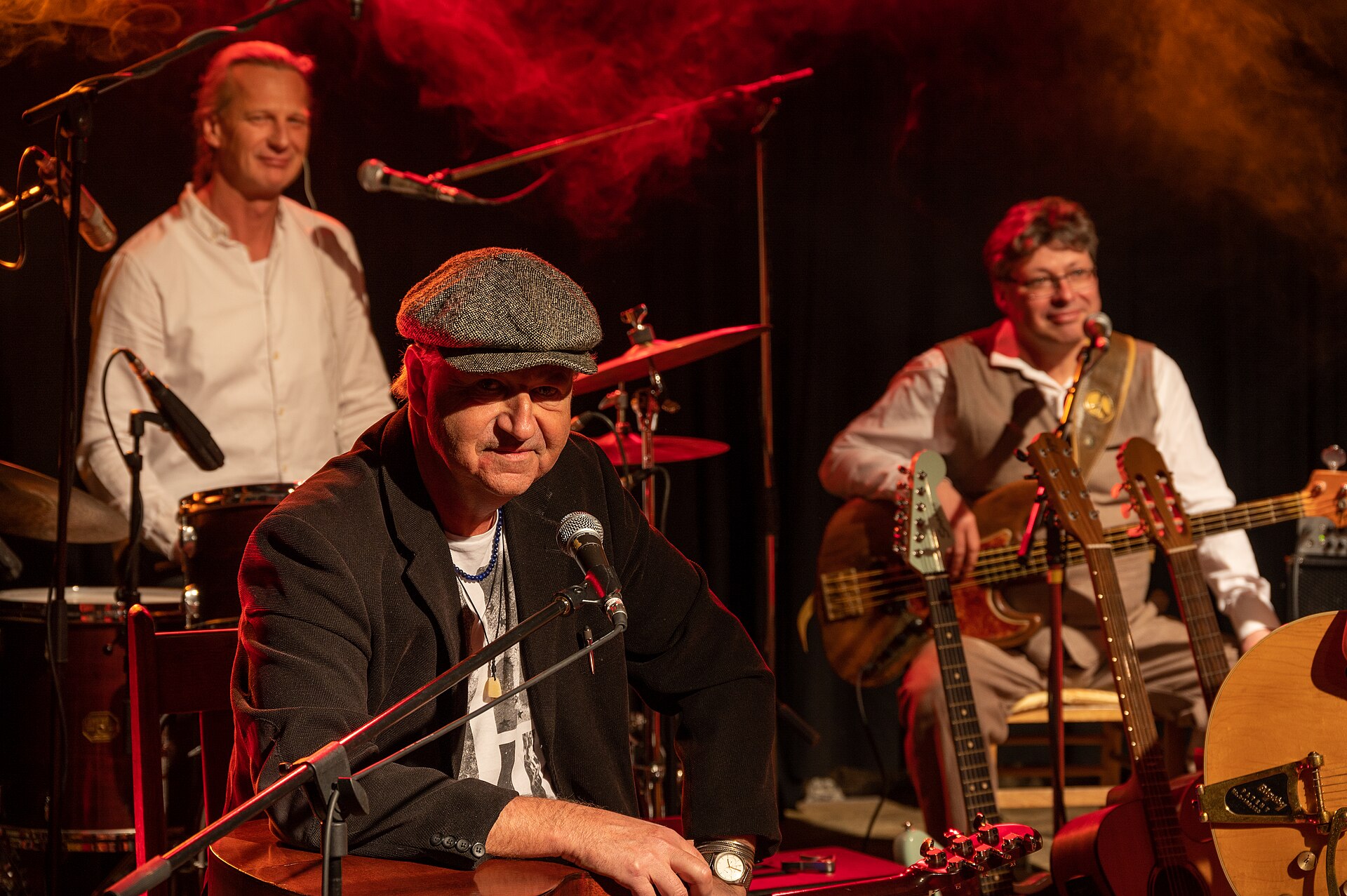
Two examples show the upside, and both came with an existing audience. In The Music Network in 2021, Nathan Cavaleri, a guitarist with a long public profile, reported over 3,000 followers and $950 from subscribers in his first month on Twitch after joining a big gamer’s stream. He then streamed two or three hours, two days a week, and said he earned over $20,000 in 12 months. The article does not name the currency. Trivium’s Matt Heafy said his Twitch channel made just under $10,000 a month in 2019 and 2020 (currency not named), according to Blabbermouth, from streaming weekdays at 9 am and 3 pm. His idea is neat: he streamed the practice he had to do anyway. Our rock and metal practice routine would suit that.
Pros
- Money is direct and does not depend on an ad algorithm.
- A loyal community can fund projects. Cavaleri said an album was funded by his community.
- Practice becomes content.
- Twitch has opened its tools to everyone, so the barrier to starting is low.
Cons
- It needs a steady schedule, sometimes for months, before income appears.
- Both examples are from 2021 or earlier and started with an audience, so they are not typical.
- Discovery is hard for a small channel, and we found no reliable data on how viewers are spread across channels.
- In our view, income can lean on a small group of supporters, which makes it lumpy.
Spotify, Bandcamp and distribution platforms
Spotify does not pay a fixed rate per stream. Viberate estimates 0.003 to 0.005 US dollars per stream, or 3,000 to 5,000 US dollars per million, and our earlier post covers what that means in practice. The bigger issue is the starting line. Music Business Worldwide, citing Luminate, reports that 223.8 million of 253 million tracks (about 88 per cent) had 1,000 plays or fewer in 2025, and Spotify excludes tracks under 1,000 plays in 12 months from royalties.
The Bass Line adds that an estimated 2.7 million new tracks reach streaming services every month, and that 80 per cent of Spotify royalties for Australian artists came from overseas in 2025. Spotify’s own Loud and Clear update says 13,800 artists generated at least 100,000 US dollars in 2025, and the 100,000th earning artist generated over 7,300 US dollars. That is company reporting on itself, covers total royalties rather than take home pay, and is the optimistic view. At the other end, folk musician Kimberley Wheeler told the ABC her streaming royalties for a year were about A$7.
Bandcamp is fairer per sale. Its fee page shows 15 per cent of digital sales, falling to 10 per cent after 5,000 US dollars, and 10 per cent on physical goods, plus payment processing. Plini called Bandcamp “the fairest modern distribution method.” Patreon takes 10 per cent plus fees, though it only pays if fans already exist.
Pros
- It is cheap, permanent and works as a calling card for bookers and fans.
- It reaches overseas listeners, which matters for an Australian player.
- Bandcamp and Patreon give a more direct line between fan and player.
Cons
- Pay is tiny without large play counts, and instrumental guitar rarely gets them.
- Discovery is hard with millions of new tracks a month.
- Royalties favour established artists.
We would budget one to three hours a week once a catalogue exists. That is our estimate, not a researched figure.
Old school gigs and what they still do best
In The Bass Line’s income table, live performance leads at 47 per cent, royalties follow at 23 per cent and teaching comes in at about 7 per cent. Income is also very uneven: the top quarter of artists earn about 82 per cent of the total. Artists surveyed reported about 59 performances a year, and hotels, pubs and registered clubs were the most frequent venue types, at 23 per cent of performances. A Musicians Australia survey cited in the report found 68 per cent were paid for every gig, up from 53 per cent in 2020, while 59 per cent of gigs paid no superannuation. For rates and award wages, see our earlier guide.
The rooms are the worry. Music Victoria’s audit shows weekly gig presenters in Victoria fell from 813 in 2019 to 655 in 2024, and Guardian Australia lists more closures in 2026, citing rent and falling alcohol sales. Wheeler said live music “costs you to go out and do a show”, with rehearsal and promotion time on top. RMIT’s Catherine Strong told the ABC that audiences often baulk at paying more than A$15 or A$20 for a local gig.
Yet gigs still do things a screen cannot. They teach you to read a room, recover from mistakes and keep time with other people, and they build contacts for session and teaching work. The Music Network’s oral history of Tash Sultana describes a busker drawing big crowds, viral videos, then sold out residencies and a European tour of 55,000 tickets. Her management said the plan was always to “build a formidable live following globally.” Need setlist material? Start with songs with common chord progressions.
Pros
- It is the largest single income stream in the Australian data.
- You build craft, stagecraft and real relationships.
- Fans who meet you in person tend to stay loyal. That is our view, not a measured finding.
- It can lead to teaching, session and support slot work.
Cons
- Pay is modest and often uncertain, and many gigs cost you money.
- Reach is limited to the room unless you tour.
- Venue numbers are falling, so you may need to create your own gigs. That is a suggestion, as we found no data on how well that works.
Money at a glance: platform rules and fees
| Route | What you need first | What the source says you keep or earn | Caveat |
|---|---|---|---|
| YouTube ads | 1,000 subscribers plus 4,000 watch hours or 10 million Shorts views (higher from 1 February 2027) | 55 per cent of net watch page ads, 45 per cent of Shorts pool revenue | 89 per cent of channels at 1,000 subscribers get under 5,000 views a month (vidIQ) |
| YouTube fan funding | 500 subscribers plus 3,000 watch hours or 3 million Shorts views | 70 per cent of net memberships and Super Chat | Needs an engaged audience |
| Instagram and TikTok | Pay programmes not open to Australians, as we read it | TikTok live gifts and memberships | Rules differ by country |
| Twitch | Affiliate: 25 followers, 4 hours on 4 days, average 3 viewers | 50 per cent of subs as standard, 60 or 70 per cent via the Plus Program (January 2024 rules) | Payouts need Affiliate or Partner status |
| Kick | Not checked | 95 per cent (a 5 dollar sub pays 4.75) | No guitarist income data found |
| Spotify | More than 1,000 plays per track a year to earn | No fixed rate; third party estimate of 3,000 to 5,000 US dollars per million streams | About 88 per cent of tracks had 1,000 plays or fewer in 2025 |
| Bandcamp | Nothing | You pay 15 per cent of digital sales (10 per cent after 5,000 US dollars) and 10 per cent of physical | Plus payment processing |
| Patreon | An existing audience | 10 per cent platform fee plus processing | Only pays if fans exist |
| Gigs (Australia) | Songs, gear, venues | 47 per cent of artists’ music income | Median artist A$14,800 a year, all genres |
Guitarist online vs gigs: side by side comparison
These ratings are our own judgement, based on the sources above, on a scale of 1 to 5 where 5 is best. For effort, start up cost and time to first income, 5 means least effort, lowest cost and fastest. They are not research findings.
| Criterion | Online video | Live streaming | Streaming platforms | Gigs |
|---|---|---|---|---|
| Money | 1: ads small until views are large | 2: direct pay once a community exists | 1: tiny per stream | 3: biggest single stream, modest pay |
| Fame | 4: best odds of wide recognition | 2: a loyal niche | 2: needs playlists or luck | 2: local, unless you tour |
| Reach | 5: global and long lasting | 2: mostly existing fans | 2: global but crowded | 2: limited to the room |
| Effort | 2: about 8 to 12 hours a week (our estimate) | 2: fixed schedule, 6 to 10 hours (our estimate) | 4: 1 to 3 hours (our estimate) | 2: 6 to 12 hours with travel (our estimate) |
| Sustainability | 2: burnout risk, algorithm swings | 2: schedule fatigue | 3: low upkeep | 2: shrinking venues, late nights |
| Start up cost | 4: phone, light, tripod | 3: add a decent mic and a stable connection | 4: low, though distribution fees vary | 3: gear, amp, transport |
| Time to first income | 2: months, with a rising bar | 3: tools open to all, payouts take time | 2: needs over 1,000 plays a track | 4: can be paid at a first gig, though many are not |
What we could not find
We want to be straight about the gaps. We found no study comparing these routes head to head, and no reliable data on what the typical guitarist earns on YouTube or Twitch, so the case studies above are examples, not averages. Some vendor figures, such as vidIQ and Chartlex, quote dollars without naming the currency, and we have assumed US dollars. Shorts rates conflict widely between sources. We could not confirm the exact date Twitch changed its Affiliate rules, and we could not verify how TikTok Live splits gift income, so we left that out. The Bass Line uses 47 per cent in its table and 49 per cent in one passage, so we say about half. Platform rules change often, so check each page before you commit.
Which path fits which guitarist: online or gigs
These weekly time budgets are our own judgement, not research, and assume ten hours a week for music work.
- Your goal is money. Lead with gigs, teaching and session work, and use video to feed them. A sample week: 4 hours on gigs and teaching, 2 on short video, 2 on practice, 1 on live streaming, 1 on releases.
- Your goal is fame or reach. Lead with short video, but keep playing live so you have footage and fans. A sample week: 4 on video, 2 on gigs, 2 on practice, 1 on streaming, 1 on releases.
- Your goal is craft. Practise first, then play in front of people as often as you can. A sample week: 4 on practice, 3 on gigs or open mics, 2 on short clips, 1 on releases.
- Your goal is the local scene. Go to gigs, play gigs and help others. A sample week: 5 on gigs and rehearsal, 2 on short clips to promote them, 2 on practice, 1 on live streaming.
FAQ
Can you make a living from YouTube as a guitarist?
A few people do, but they are the exception. CNN says Rick Beato earns enough from ads, merchandise and online tutorials to support his family, and Mary Spender runs a business that needs about GBP 450 a day to break even. For most players, vidIQ’s data suggests ad income at 1,000 subscribers is under 20 US dollars a month. YouTube works best as marketing for lessons, gigs and products.
Do gigs still pay?
Yes, but modestly. In Australia, live performance is about half of artists’ music income, yet the median artist earns A$14,800 a year from music and many gigs pay nothing towards superannuation. Venue closures also reduce the number of paid slots.
Is Spotify worth it for a solo guitarist?
Yes as a calling card, not as an income plan. Third party estimates suggest 3,000 to 5,000 US dollars per million streams, and tracks under 1,000 plays in a year earn nothing from Spotify. Bandcamp pays better per sale if you have fans who buy.
How many followers do you need before you earn?
It depends on the platform, and followers alone do not pay, as views drive ad income. YouTube fan funding opens at 500 subscribers plus 3,000 watch hours, and ads need 1,000 subscribers plus 4,000 watch hours, rising for new channels on 1 February 2027. Twitch Affiliate needs 25 followers and a few hours of streaming. Instagram and TikTok pay programmes are not open to Australians as far as we can tell.
Should I do both?
For most players, yes. The evidence suggests a hybrid, with gigs as the base and short clips as the reach. Even Tash Sultana and Plini used online and live together. Start small, with one clip a week and one gig a month.
Whether you gig, post videos or do both, solid fundamentals make everything easier. If you are starting out, have a look at our online beginner course.