
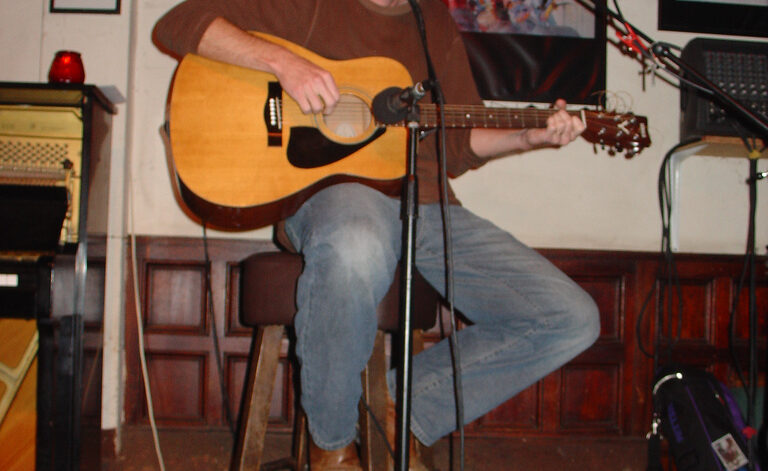
These open mic tips for guitarists are for anyone about to play on a stage for the very first time, whether that is a solo spot at an open mic or sitting in with strangers at a jam night.
The first time is nerve racking for almost everyone. The good news is that open mics and jams are usually some of the most forgiving rooms in music. Most people in the audience are players waiting for their turn, and they remember their own first night.
Quick answer
Prepare two or three songs you can play without stopping, know their keys, and have a backup. Bring a tuned guitar, spare strings, two leads, a tuner, a capo and earplugs. Arrive early, put your name down, keep your set short, be kind to the sound person and other players, and accept that small mistakes are normal. Nerves usually ease with repeated exposure.

Jam night vs open mic
At an open mic, you usually play your own short set, often solo or with a friend, and the house provides a PA and maybe a backing band. At a jam night, a house band or a rotating group of players backs whoever gets called up, and you might play with people you have never met. The open mic tips for guitarists below cover both, with a section on calling songs to a band.
| Open mic | Jam night | |
|---|---|---|
| Who plays with you | Usually just you or your duo | House band or other players |
| Typical slot | Two or three songs, or 10 to 15 minutes | One to three songs per rotation |
| Best song choice | Songs you know inside out | Simple forms like 12 bar blues or well known covers |
Before you go: two or three songs, keys and a backup
Pick two or three songs you can play from start to finish even if something goes wrong. One of the most practical open mic tips for guitarists is to choose songs slightly below your limit, because adrenaline tends to speed you up and make your hands less steady. Write down the key of each song and have one backup in case someone plays your song before you.
Rehearse standing up if you will stand, or on a stool if you will sit, and play the set for a friend or into your phone. Our guide on how to learn a song on guitar helps you get a song solid, and practising with a backing beat, as in practising guitar with drum loops, builds the steady time a band will expect.
For more on the bigger picture, read how to prepare for your first gig.
What to bring
Among the simplest open mic tips for guitarists: packing well removes a whole layer of stress. The essentials are a guitar with fresh strings, a clip on tuner, two leads, spare strings, several picks, a capo, a strap, earplugs and water. Leave the big pedalboard at home: most hosts want quick changeovers, so a guitar straight into the amp or PA, or one small pedal, is usually best.
Etiquette on the night
Good manners matter more than great playing. These open mic tips for guitarists on etiquette come from our teaching and gigging experience rather than any official rulebook:
- Arrive early and put your name on the list.
- Tune before you go up, off stage and quietly.
- Keep to your time or song limit.
- Thank the sound person and do not touch their desk.
- At a jam, do not play over other soloists; take turns and watch for a nod.
- Listen to and applaud other acts, then stay for a while after your spot.
Calling a song to a band you have never met

At a jam, you may have about 30 seconds to tell strangers what to play. Give them five things: the song, the key, the form (for example a 12 bar blues or verse and chorus), the tempo or feel, and who starts. Then agree on an ending signal, such as raising the neck of your guitar on the last bar.
The 12 bar blues is the shared language of many jams, so it is worth knowing well; see our 12 bar blues guide. Count in clearly and loudly enough for the drummer to hear. The free kit below includes song call cards you can fill in ahead of time.
Nerves and stage fright: what the evidence says
Performance anxiety is very common, and it does not mean you are not cut out for playing. The research is honest about its limits. A systematic review by Kenny (2005) found the studies on treatments were small and of mixed quality, but gave tentative support to cognitive behavioural therapy (CBT), behavioural approaches and rehearsal based methods.
A more recent meta analysis by Nicholl and Abbott (2026) in Psychology of Music pooled randomised trials and found treatments generally did better than no treatment, with CBT the most studied approach. If your anxiety is severe or affects daily life, a GP or psychologist is the right person to see.
Practical steps many players find useful, in our teaching experience: rehearse in conditions close to the real thing, play for small audiences first, use slow breathing before you go on, and focus on the band or the song rather than the crowd. If you make a mistake, keep the rhythm going; most listeners will not notice.
Playing for a live room also feels different from recording yourself at home; see the difference between playing live and playing in front of the camera, and our thoughts on online playing versus gigs.
Hearing protection
Jam nights can be loud, especially near drums and amps. The World Health Organization guide to safe listening explains that loud sounds over time can permanently damage hearing and recommends earplugs in noisy venues and taking breaks from the noise. Good open mic tips for guitarists always include earplugs: musician earplugs reduce volume fairly evenly, so you can still hear the band clearly.
After the gig
The last of our open mic tips for guitarists: write down what went well and one thing to change while it is fresh. Thank the host, swap details with players you enjoyed, and note when the next night is on. Going back regularly is how the nerves fade and the friendships form. If you started playing later in life, our post on learning guitar after 50 has encouragement for you too.
If you want to build your foundations before your first night, our online beginner course takes you through chords, strumming and timing at your own pace.
Free first timer checklist and open mic tips for guitarists
Our printable First Jam Night Kit puts these open mic tips for guitarists on paper: a what to bring checklist, song call cards for three songs, a 12 bar and common keys cheat strip, a nerves plan card and a reflection box for the next day.
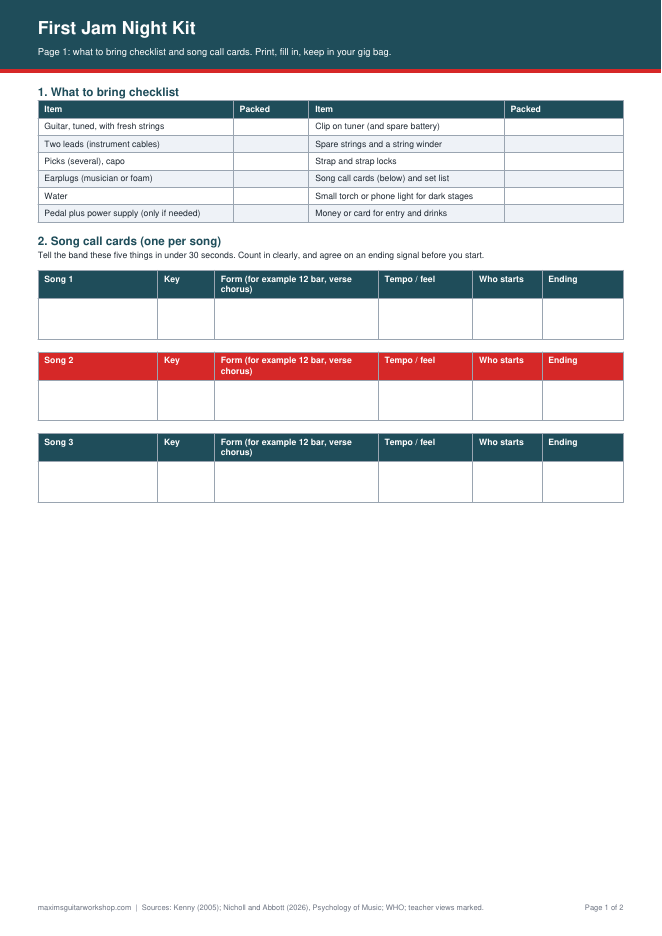
Download the free First Jam Night Kit (PDF)
FAQ
How many songs should I prepare for my first open mic?
Two or three, plus one backup. Check the host’s time limit, which is often around 10 to 15 minutes, but this varies by venue.
Do I need to be good to play at a jam night?
You need to know a few songs and keep steady time. Jams welcome a wide range of levels, though some are more advanced, so watch one first if you can.
What if I make a mistake on stage?
Keep going. Holding the rhythm matters more than every note, and audiences at open mics are generally supportive.
What is the most important jam night etiquette rule?
Listen. Watch the band leader, do not play over others, and keep your volume in balance with the room.
Should I bring my own amp?
Usually not. Most jams and open mics supply a backline or PA; ask the host beforehand.
Image credits
Open mic at the No Name Bar, Sausalito, by Tracy Ruggles, Wikimedia Commons, CC BY SA 2.0. Musician singing with acoustic guitar by PattayaPatrol, Wikimedia Commons, CC BY SA 4.0. Kit preview by Maxim’s Guitar Workshop.