Walk into any modern rock or metal rehearsal room and you will hear the same five ideas again and again. Distorted power chords. Two hand tapping. Sweep picking. Pinch harmonics. Downtuning that makes the riff sit in the basement. They feel like everyday vocabulary now, so it is easy to assume they arrived fully formed from one famous player each.
They did not.
This piece is myth busting with a practice point attached. For each technique you get a plain definition, why modern rock and metal still need it, the pioneer who made it stick in the rock and metal bloodstream, the competing claims worth teaching honestly, listening examples, a short Maxim’s Guitar Workshop practice cue, and a myth versus fact line. We soften the word invented on purpose. Music history rewards the player who popularised and codified a sound for millions of peers at least as much as the person who first brushed a similar idea in a quieter room.
If you want the older American root language behind a lot of this craft, our history of blues guitar and roots of modern popular music pieces sit beside this article naturally. Rock and metal did not appear from nowhere. They stand on blues, rhythm and blues, and popular song craft that later players thickened, sped up, and turned down.
Distorted power chords
A power chord is usually a root plus a perfect fifth, often with the octave doubled, and with the third left out so the harmony is neither major nor minor. In rock and metal it is usually played with distortion on the lower strings. It is the basic harmonic brick of riffs. Palm muted chugging is related but distinct: same shapes, different rhythmic job. James Hetfield later turned that muting layer into a thrash engine, which we park under honourable mentions.
Why modern rock and metal need it is obvious once you listen with a teaching ear. From Sabbath and Judas Priest through Metallica, Pantera, nu metal, metalcore, and modern low tuned riffing, the language is built from power chord shapes or close cousins. They cut through gain without muddying chord quality. They lock with bass in octaves or unison. They scale from punk to doom without needing a jazz harmony degree.
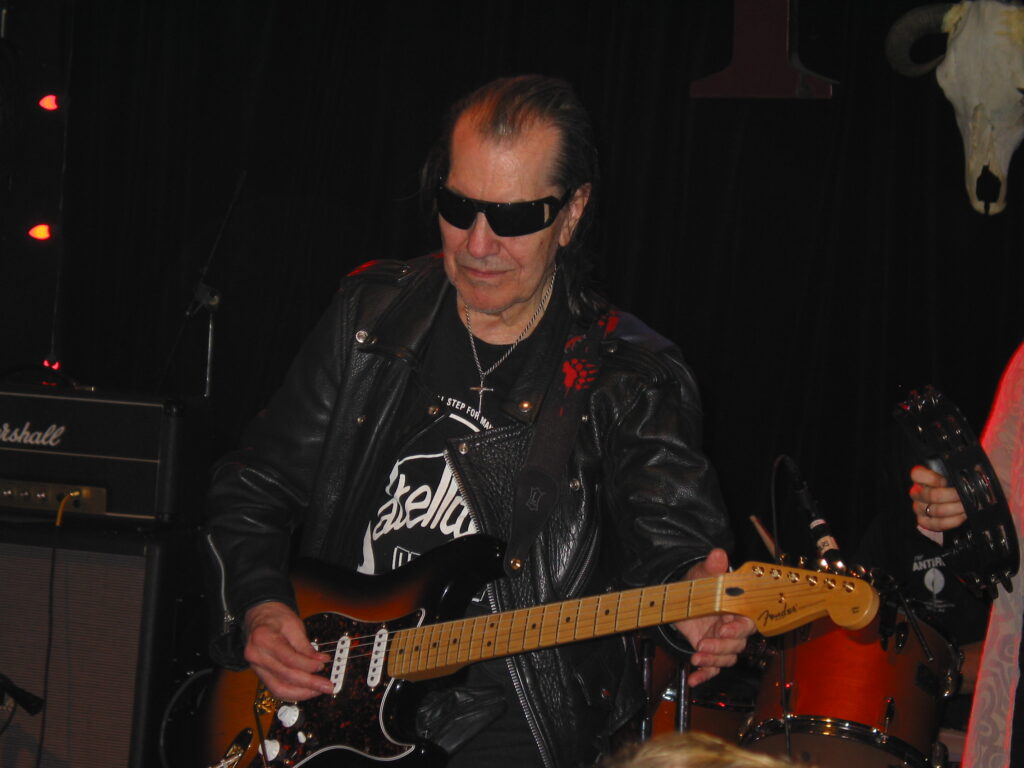
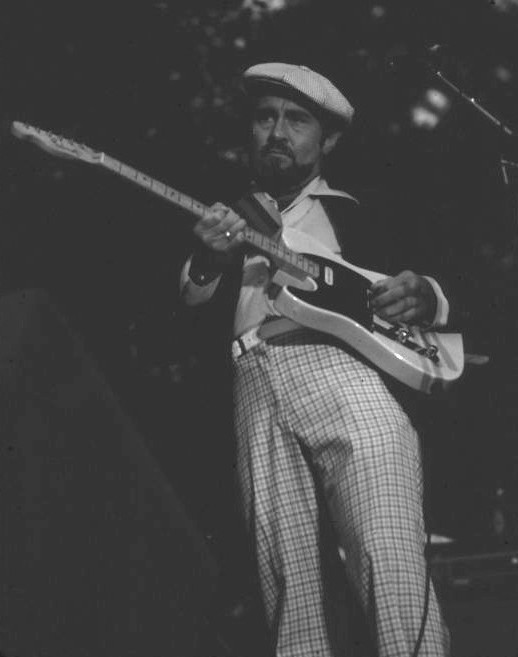
The primary name historians and peers keep returning to is Link Wray. Britannica and NPR both frame Wray as the figure most credibly associated with introducing the distorted power chord sound into rock via the 1958 instrumental “Rumble”. Wray reportedly punctured amp speakers for a raw, menacing tone and built the track around throbbing root fifth figures. Radio stations in cities including New York, Boston, and Detroit temporarily banned it for fear it would incite violence. It still reached the US pop charts at No. 16 in 1958. Pete Townshend repeatedly credited “Rumble” as the reason he picked up guitar. Jimmy Page and Neil Young are among other high profile admirers. Wray was inducted into the Rock and Roll Hall of Fame in 2023.
Competing claims matter for honest teaching. Root fifth intervals and stripped harmony existed in blues and early rock and roll before 1958. Saying Wray invented the interval is false. What he is credited with is the distorted, menacing, electric rock packaging that became rock grammar. Pete Townshend and The Who popularised high volume, theatrical power chord rock and helped push Marshall stack culture, but Townshend himself pointed back to Wray. Tony Iommi later codified power chords as metal low string diads and dark riff architecture. He did not invent the power chord itself.
Listening: Link Wray and His Ray Men, “Rumble” (1958). Then The Who in the mid to late 1960s for volume culture. Then early Black Sabbath for metal’s default harmonic unit.
MGW practice cue: Master clean fretting of root five and root five octave shapes on the bottom strings before you add gain. Learn the difference between ringing open power chords and palm muted chugs. Credit Wray when you tell the story. Rock’s simplest chord is also one of its most consequential inventions of sound, not of theory.
Myth versus fact: Myth says Pete Townshend invented the power chord. Fact says Townshend popularised and theatricalised it, while historians and peers widely credit Link Wray’s “Rumble” as the breakthrough distorted power chord statement. Myth says power chords are uniquely metal. Fact says they are rock’s shared harmonic DNA. Metal specialised them with tuning, muting, density, and darkness.
Two hand tapping
Two hand tapping means using one or more fingers of the picking hand to hammer notes on the fretboard, often the high note of a figure, combined with fretting hand hammers and pull offs. The result is cascades of notes without continuous picking. The classic hard rock form is the tapped triplet climax of “Eruption”. Tapped harmonics are related but distinct. Eddie Van Halen popularised those too.
After 1978 the technique became mandatory shred vocabulary. Randy Rhoads, George Lynch, Joe Satriani, Steve Vai, Nuno Bettencourt, John Petrucci, progressive metal, and countless modern metal leads absorbed it. Even players who reject shred still use occasional tapped climaxes or hooks.
Eddie Van Halen is the primary populariser and hard rock codifier, not the absolute inventor. Van Halen’s debut album, released 10 February 1978, included “Eruption”, whose tapped climax rewired lead guitar worldwide. EVH consistently said he did not invent tapping. He credited watching Jimmy Page’s one handed hammer and pull off work in “Heartbreaker” live in the early 1970s, then moving the nut with a picking hand finger. He emphasised composing musical pieces with the technique, not only the mechanic.
The precursor list is essential teaching material. Jimmie Webster published a touch method for electric guitar in 1952. Vittorio Camardese demonstrated two hand tapping on Italian television in 1965. Jazz players such as Tal Farlow explored related hammer concepts earlier. Harvey Mandel’s Shangrenade in 1973 is heavily tapping based, and club lore places Mandel in Los Angeles rooms where later rock guitarists watched. Steve Hackett of Genesis has described early 1970s live and recorded tapping figures and has framed EVH as the player who named and globalised the idea. Ace Frehley’s influence claim is less widely accepted than the Mandel, Hackett, and Page narratives.
Listening: Van Halen, “Eruption” (1978) as the inflection point. For precursors, seek Mandel and Hackett with a historian’s ear. For aftermath, any major 1980s shred climax will show how fast the idea became default.
MGW practice cue: Teach the Page story and the precursor list before the ego myth. Mechanically you want a strong tap, a clean flick or pull off, synchronised left hand hammers, and muting of idle strings. Musically, make phrases, not only fireworks. That was EVH’s own standard.
Myth versus fact: Myth says Eddie Van Halen invented tapping. Fact says precursors exist in instructional touch method, jazz, and 1960s to 1970s rock. EVH popularised, dramatised, and standardised two hand tapping as hard rock and metal vocabulary and wrote iconic pieces around it. He publicly denied inventing it. In popular music history, first prominent mass media use that changes peer practice often outweighs absolute chronological firsts. EVH wins that test decisively.

Sweep picking
Sweep picking means dragging the pick across adjacent strings in a single continuous motion while fretting one note per string, usually arpeggio tones, and muting so the notes do not ring as a strummed chord. It is distinct from alternate picking every note and from blues rake scrapes. It overlaps with economy picking when sweeps are integrated into scalar motion, which is Frank Gambale’s domain more than Yngwie Malmsteen’s.
Neoclassical metal, shred, power metal, progressive metal, and many modern metal lead vocabularies use triad and diminished sweeps as stock climaxes and connective tissue. Even mid level exam and repertoire culture now treats three and five string sweeps as intermediate milestones.
For rock and metal vocabulary, Yngwie Malmsteen is the primary populariser. Guitar World and shred historiography consistently name him as the player who made sweeping synonymous with neoclassical heavy metal: Paganini inspired fluidity on a Strat, popularised globally via Rising Force in 1984 and pieces such as “Far Beyond the Sun”. The influence chain toward Tony MacAlpine, Jason Becker, Marty Friedman, Vinnie Moore, later Petrucci, Synyster Gates, Alexi Laiho, and others is well documented.
Competing claims keep the myth box honest. Jazz and country players in the 1950s, including Les Paul, Chet Atkins, Tal Farlow, and Barney Kessel, developed early sweep like motions. Ritchie Blackmore is an important rock bridge. Deep Purple’s “April” (1969) and Rainbow’s “Kill the King” use sweep arpeggios, and late 1960s live footage shows ascending and descending attempts. Frank Gambale is the most complete systematiser of sweeping and economy picking beyond triads, with instructional landmarks in the late 1980s. If your angle were who codified the picking system, Gambale would be the lead name. If your angle is who put it in metal’s bloodstream, Malmsteen is the lead name.
Listening: Malmsteen, “Far Beyond the Sun” and the Rising Force album era (1984). Blackmore for the rock bridge. Gambale instructional examples if you are studying economy systems rather than metal tone.
MGW practice cue: One fretted note at a time. Mute like a snare drummer. Start with two string sweeps, then three string major and minor triads in the Malmsteen school, only then five and six string shapes. Separate who invented (history module) from who to emulate for metal tone and phrasing (Malmsteen toward Becker and Petrucci).
For a different Malmsteen story about injury, patience, and return to playing, see our piece on the Yngwie Malmsteen 1987 accident. Technique history and recovery history teach different lessons. Both belong in a serious guitar education.
Myth versus fact: Myth says Yngwie invented sweep picking. Fact says he popularised a Paganini fluent, high gain, metal facing sweep language that became standard. Invention credit belongs earlier in jazz and country. Rock priority debates often start with Blackmore. Myth says sweep picking equals economy picking. Fact says they are related. Gambale’s economy system is broader than arpeggio sweeps alone.

Pinch harmonics
A pinch harmonic, also called an artificial harmonic squeal, is produced by picking a string so that the flesh of the thumb or the side of the picking hand simultaneously brushes a harmonic node. That emphasises an overtone squeal above the fretted fundamental. It is distinct from natural harmonics and from Eddie Van Halen style tapped harmonics. Metal slang includes squeals, squealies, and pinchies.
Pinches became a signature accent in blues rock solos, then a rhythmic and lead punctuation mark in metal. Zakk Wylde, Dimebag Darrell, and modern groove and metalcore riffs that sandwich squeals between chugs all use them. They cut through dense mixes and read as aggressive even on single notes.
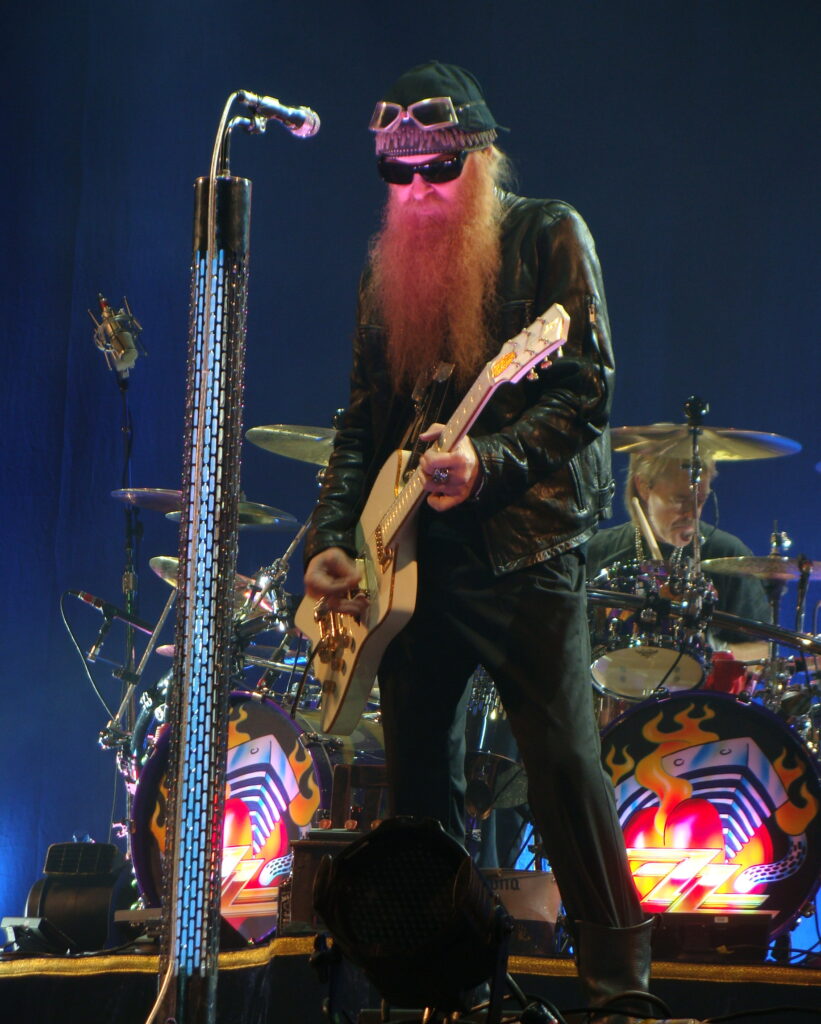
Billy Gibbons is the primary rock populariser. Press and peer testimony, including Zakk Wylde in a Guitar World roundtable reported by Loudwire, treat Gibbons and ZZ Top as the forefather of the rock pinch harmonic sound that later metal players copied. “La Grange” from Tres Hombres (1973) is the canonical teaching example: expressive pinches in the solo, often with picking hand position changes to select different harmonic pitches.
Competing claims are part of the lesson. Roy Buchanan holds the earliest widely cited recording claim for a trademark pinch overtone on “Potato Peeler” from a Bobby Gregg session in 1962. Buchanan called related sounds overtones. Jeff Beck and others admired his harmonic and volume swell language. Country and jazz figures are sometimes named for earlier similar effects. Absolute first ever is unverifiable. Eddie Van Halen further cemented pinches inside hard rock vocabulary. Zakk Wylde did not invent the technique. He maximised and codified it as a heavy metal signature with lower string girth and controlled squeals, and he explicitly credits learning from “La Grange” and Gibbons. Dimebag Darrell took extreme metal application further and is also famous for related dive bomb harmonic bar theatre, better filed under whammy honourable mentions even though teachers often introduce it beside pinches.
Listening: ZZ Top, “La Grange” (1973) for musicality. Buchanan’s early recording claim for history. Wylde era Ozzy or Black Label Society clips for metal maximising. Pantera for extreme punctuation.
MGW practice cue: Start with Gibbons for musicality, then Wylde and Dimebag for metal aggression. Drill node hunting above the pickups. Practise on B and G strings before low E squeals. Separate pinch harmonics from natural harmonics and from dive bomb harmonics in lessons. Gain helps, but attack and node location matter more than simply adding more distortion. Gibbons famously produces them with comparatively restrained amp drive.
Myth versus fact: Myth says Zakk Wylde invented pinch harmonics. Fact says Wylde is the metal populariser and maximiser. He credits Gibbons. Buchanan holds the early recording claim. Myth says pinch harmonics require huge gain. Fact says pick attack and node location matter more than gain alone.
Downtuning and low riff architecture
Downtuning means lowering the pitch of the guitar, whole instrument or selected strings, below concert standard to thicken tone, ease fretting tension, and write riffs that speak in a lower register. It includes C sharp standard, drop D, drop C, and later extended range low tunings. Low riff architecture here means composing around that lowered fundamental: sparse, weighty, often power chord or single note figures reinforced by bass unison.
From doom and stoner through thrash variants, groove metal, nu metal, metalcore, and modern low tuned pop metal, downtuning is default practice. Seven and eight string guitars are partly an institutionalisation of Tony Iommi’s insight. Heaviness lives in the basement.
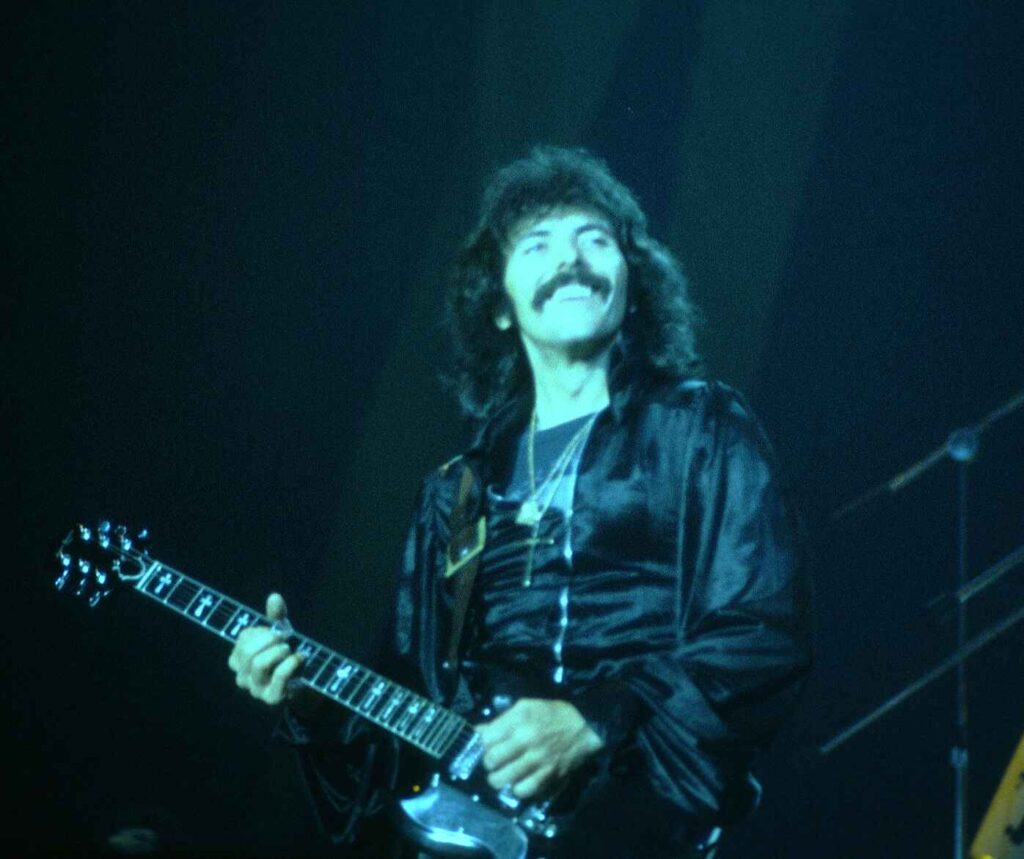
Tony Iommi of Black Sabbath is the primary pioneer for metal. After a shop accident costing fingertips on his fretting hand, Iommi used a lighter touch, prosthetic thimbles, and progressively lower tunings. Early Sabbath albums are largely associated with standard tuning or less extreme live detunes. From Master of Reality in 1971 he is widely documented tuning to C sharp standard (C sharp, F sharp, B, E, G sharp, C sharp), with Geezer Butler matching on bass. You hear it on landmarks such as “Children of the Grave”, “Lord of This World”, and “Into the Void”. Guitar Player and multiple Sabbath histories describe this as seeking a bigger, heavier sound and reducing finger pain. Eddie Van Halen publicly called Iommi a master of riffs. Metal historians treat Sabbath as genre defining. Iommi’s low string power chord diads plus tritone writing on the debut’s title track completed the metal harmonic toolkit beside downtuning.
Competing claims again keep ego myths in check. Baroque and classical scordatura, folk and blues drop D, pedal steel, and slack key cultures all prove downtuning as a general idea is ancient. Iommi’s claim is specifically codifying downtuned heaviness as metal’s architectural default. Drop D in rock was used before and beside Sabbath and exploded again in 1990s grunge and alternative. That is a different story from Iommi’s full instrument C sharp lowering. Later doom, death metal, djent, and eight string pioneers extend the Iommi principle. They do not replace his priority in metal historiography. Sources also note earlier live whole step detunes and later Sabbath periods returning toward milder detunes. The Master of Reality C sharp moment remains the canonical heaviness template citation.
Listening: Black Sabbath, Master of Reality (1971), especially “Children of the Grave” and “Into the Void”. Earlier Sabbath for riff language and tritones with tuning closer to standard on early studio lore. Downstream, any major doom or modern extended range metal record will show the principle industrialised.
MGW practice cue: Teach setup. Heavier gauge strings when tuning down. Intonation and neck relief checks. Matching bass. Compositionally: fewer notes, more space, tighter unison with bass. Iommi’s lesson is architecture, not only pitch. History hook: necessity from injured fingers became a genre’s body feel.
Myth versus fact: Myth says Iommi invented downtuning. Fact says he popularised and codified downtuned heavy metal riff architecture under mass influence. Scordatura and drop tunings predate him. Myth says Sabbath was downtuned from day one on every recording. Fact says the Master of Reality C sharp chapter is the key documented studio escalation. Verify song by song if you publish detailed tuning charts.
Honourable mentions
Three near misses deserve a short bow because students ask about them every week.
James Hetfield’s palm muted, predominantly downpicked chugging is the modern metal rhythm engine. Gallops, chromatics, and accented open hits on low strings sit on top of power chords rather than replacing them. Hetfield cites influences including Johnny Ramone for fast downpicking and Black Sabbath for riff primacy. Metallica landmarks from Kill ‘Em All through Master of Puppets, including “Battery” and “Master of Puppets”, codified thrash articulation. Essential for any MGW metal pathway. Not a separate Top 5 harmonic invention.
Dive bombs and whammy flutter split credit across Jimi Hendrix for expressive Strat tremolo drama, Floyd Rose for a locking bridge that made extreme dives return stable, and Eddie Van Halen for hard rock standardisation. Later Satriani, Vai, and Dimebag theatre belong here too. Hardware dependent and multi parented, so it stays an honourable mention.
Frank Gambale’s economy picking system combines alternate picking with sweeps for minimal pick travel. It is critical for advanced students and less of a single metal anthem inflection than Malmsteen sweeps. If you are building a serious picking pathway, Gambale belongs on the reading list beside Blackmore and Malmsteen.
Soft close
These five rock guitar techniques still used today are not museum pieces. They are weekly lesson material. Power chords from Wray’s menace. Tapping from EVH’s musical cascades after a longer precursor chain. Sweeps from Malmsteen’s metal popularisation after jazz, country, and Blackmore. Pinch harmonics from Gibbons’ musicality, Buchanan’s early recording claim, and Wylde’s metal maximising. Downtuning from Iommi’s necessity and architecture.
Australian rock music history has its own export story for groove, space, and power. Our australian rock music history timeline sits beside this technique map if you want local industry context. Technique and scene are different teachers. Both make better players.
If you want help turning any of these five into clean, musical habits rather than myths, book a free consultation or check tuition fees with Maxim’s Guitar Workshop in Darwin. Bring a riff you love. We will work the right hand, the tone, the setup, and the song sense that made these tricks stick.