How much to charge for a gig in Australia is one of the first money questions every working guitarist faces, and in 20 years of teaching and gigging we have seen most players answer it with a guess. This page gives you a free calculator, the two official reference figures and a printable quote checklist, so your price has reasons behind it.
Quoting is awkward, especially early on. Charge too little and you are paying to play once petrol, strings and rehearsal time are counted. Charge without a reason and a venue can easily talk you down. Build the quote line by line, in Australian dollars, and you can explain every part of it.
How much to charge for a gig in Australia: the quick answer
Quick answer
Musicians Australia recommends at least $250 per musician for a gig of 3 hours or less. For comparison, the Live Performance Award casual rate for a musician is $200.49 per 3 hour call from 1 July 2026, though the award only binds employers of employees. Start from your hours times a fair hourly rate, never go below $250 per player, then add travel, hire costs and 10 percent GST only if you are registered. Put the price, deposit and cancellation terms in writing.
The two official reference lines: the $250 minimum and the award call rate
Any honest answer to how much to charge for a gig in Australia starts with two public figures. Both were checked on the official pages on 16 November 2026, and we will update this post and the calculator with a new date if either changes.
| Benchmark | Figure (checked 16 Nov 2026) | What it is |
|---|---|---|
| Musicians Australia minimum fee | $250 per musician, per gig of 3 hours or less | A recommended floor set by the musicians’ union, not a law for commercial gigs |
| Live Performance Award 2020, casual musician | $66.83 an hour, $200.49 per 3 hour call (from 1 July 2026) | A legal minimum, but only for musicians employed under the award |
| Live Performance Award 2020, weekly musician | $53.46 an hour, $160.38 per 3 hour call (from 1 July 2026) | The rate before the 25 percent casual loading |
Musicians Australia, part of the Media, Entertainment and Arts Alliance (MEAA), says its $250 figure is based on the award’s 3 hour call plus about $50 to $100 in allowances for things like setup, meals, instruments and travel. It calls the $250 a floor that you add your own “artist fee” to. The South Australian, Queensland, Western Australian, Victorian and ACT governments have endorsed it for publicly funded gigs.
The award rates come from clause 40.1 of the Live Performance Award 2020 on the Fair Work Ombudsman site. Musicians Australia itself notes that the award is not strictly enforceable when you play as a contractor or small business, but it is a useful guide to industry fees. That is how the gig fee calculator uses it: as a reference line, not a rule.
The $250 floor is not universal in practice. A 2025 Musicians Australia survey of more than 300 musicians found 44 percent reported earning less than $250 per gig. Knowing the benchmark gives you something concrete to point to when you negotiate.
How the gig fee calculator works
Enter your lineup, your hours (playing, setup and pack down, and rehearsal for this gig), your hourly rate, the return kilometres, any hire or other costs, and whether you are registered for GST. The calculator multiplies each player’s hours by your rate, lifts the result to $250 if it falls short, adds travel and costs, then adds GST only if you tick the box. It also splits the total into a deposit and a balance.
Please treat the number as a starting point, not a union quote and not financial advice. Your experience, the market where you play and the type of event all move the real figure.
Gig fee calculator (AUD)
Change any box and the quote updates. Nothing you type leaves your device. Benchmarks checked 16 November 2026.
The $250 figure is the Musicians Australia recommended minimum per musician for gigs of 3 hours or less. The award figure is the Live Performance Award 2020 casual musician rate (clause 40.1, from 1 July 2026), which legally applies to employees, not to contractors quoting their own fee.
Below the quote, two reference lines show the Musicians Australia minimum and the award casual rate for your lineup, so you can see how much to charge for a gig in Australia against both benchmarks at a glance. If your playing time is longer than 3 hours, the tool reminds you that the $250 minimum only covers gigs of 3 hours or less.
Worked examples
These use an example rate of $50 an hour per player and the ATO car rate of 91 cents per kilometre. Swap in your own numbers in the calculator above.
Solo pub or club gig
One guitarist plays 3 hours, with 1 hour of setup and pack down and no extra rehearsal. Four hours at $50 is $200, so the calculator lifts the fee to the $250 minimum. Add a 20 km round trip ($18.20) and the quote is $268.20 without GST. These are the default numbers in the calculator. For a solo player, how much to charge for a gig in Australia often comes down to the floor itself, plus travel.
Four piece wedding
A four piece band plays 4 hours, needs 2 hours to set up and pack down, and rehearses 3 hours for a first dance and requests. That is 9 hours, or $450 per player, and $1,800 for the band. Add a 60 km round trip ($54.60) and an example PA hire of $300, and the quote is $2,154.60, or $2,370.06 with GST. A 25 percent deposit on the GST free figure is $538.65.
Because the playing time is over 3 hours, the $250 floor alone would undersell this gig, which is why counting every hour matters.
Theatre show or dep call
If a theatre company or production employs you, the award applies as a legal minimum: $200.49 per 3 hour call for a casual musician, or $160.38 for a weekly musician, from 1 July 2026. As an employee you do not add GST, and the employer handles super. If you are depping in a covers band as a contractor, quote it like the solo gig above. So for deps, how much to charge for a gig in Australia depends first on whether you are an employee or a contractor.
Travel, unpaid rehearsal, gear hire and other hidden costs
Hidden costs are where most players get how much to charge for a gig in Australia wrong. A gig is more than the time on stage, so count every hour and dollar it costs each player:
- Setup, soundcheck and pack down. Often an hour or more, longer if you bring your own PA.
- Rehearsal. Learning a first dance, a special request or a new set list takes real, usually unpaid, hours.
- Travel. Kilometres in your car, parking, tolls and, for regional gigs, a bed for the night.
- Gear. PA or backline hire, plus the wear on strings, cables and your own instrument.
The calculator uses 91 cents per kilometre as a starting point because it is the ATO cents per kilometre rate for the 2026 to 27 income year. The ATO says that rate is meant to cover all car running costs, including fuel, servicing, registration, insurance and depreciation. It is a tax deduction rate, not a rule about what you charge, but it is a published, independent estimate of what a kilometre really costs.
Distances add up fast outside the capital cities. In Darwin and across the Top End, a regional booking can mean hundreds of kilometres of driving, so enter the real return distance rather than a guess, and add accommodation if you cannot safely drive home the same night.
GST, ABN and when to add 10 percent
GST is the one part of how much to charge for a gig in Australia that depends on your tax status rather than your playing. Only add it if you are registered. The ATO says you need an ABN before you can register, and you must register once your GST turnover reaches $75,000 or more a year, within 21 days of reaching the threshold. Below that, registering is optional, and if you choose to register you generally stay registered for at least 12 months.
If you are not registered, do not add GST to an invoice. If you are, tick the box and the quote adds 10 percent on top. Say on your quote whether the price includes GST, so nobody argues about it on the night. For your own situation, talk to a registered tax agent.
What about super?
Under the super guarantee law, a person paid to perform music is treated as an employee for super purposes of whoever is liable to pay them. The ATO page for performers says this can apply even if the musician has an ABN, sends an invoice, is a hobbyist or is booked one off, with some specific exceptions.
The super guarantee rate is 12 percent. The ATO says the payer and the performer should agree whether a fee includes super or has super on top, and super has to go into the musician’s fund, not their hand. Who is liable can change when a band is paid through a company, so ask the venue how they handle it. The same Musicians Australia survey found 59 percent of gigs did not pay super. The calculator does not add super, because the payer, not you, usually owes it.
Quote and booking checklist
In our experience, most pay disputes come from things nobody wrote down. A short email that both sides reply to is far better than a handshake. Confirm the date, venue, set times, fee, whether GST is included, the deposit, when the balance is paid and what happens if either side cancels.
A deposit is common for private events like weddings and parties, and it protects you if the date falls through after you have turned down other work. The percentage is up to you; the calculator offers 20 to 50 percent. Musicians Australia found one in four performances in its survey involved broken contract terms, which is a good reason to be specific.
Our printable Gig Quote and Booking Checklist turns your answer to how much to charge for a gig in Australia into a written quote. Page one is a quote sheet with every line from the gig fee calculator, the benchmarks and their check dates. Page two is a booking checklist covering times, PA and backline, deposit, payment date, GST, super and cancellation, plus a short confirmation email you can copy.
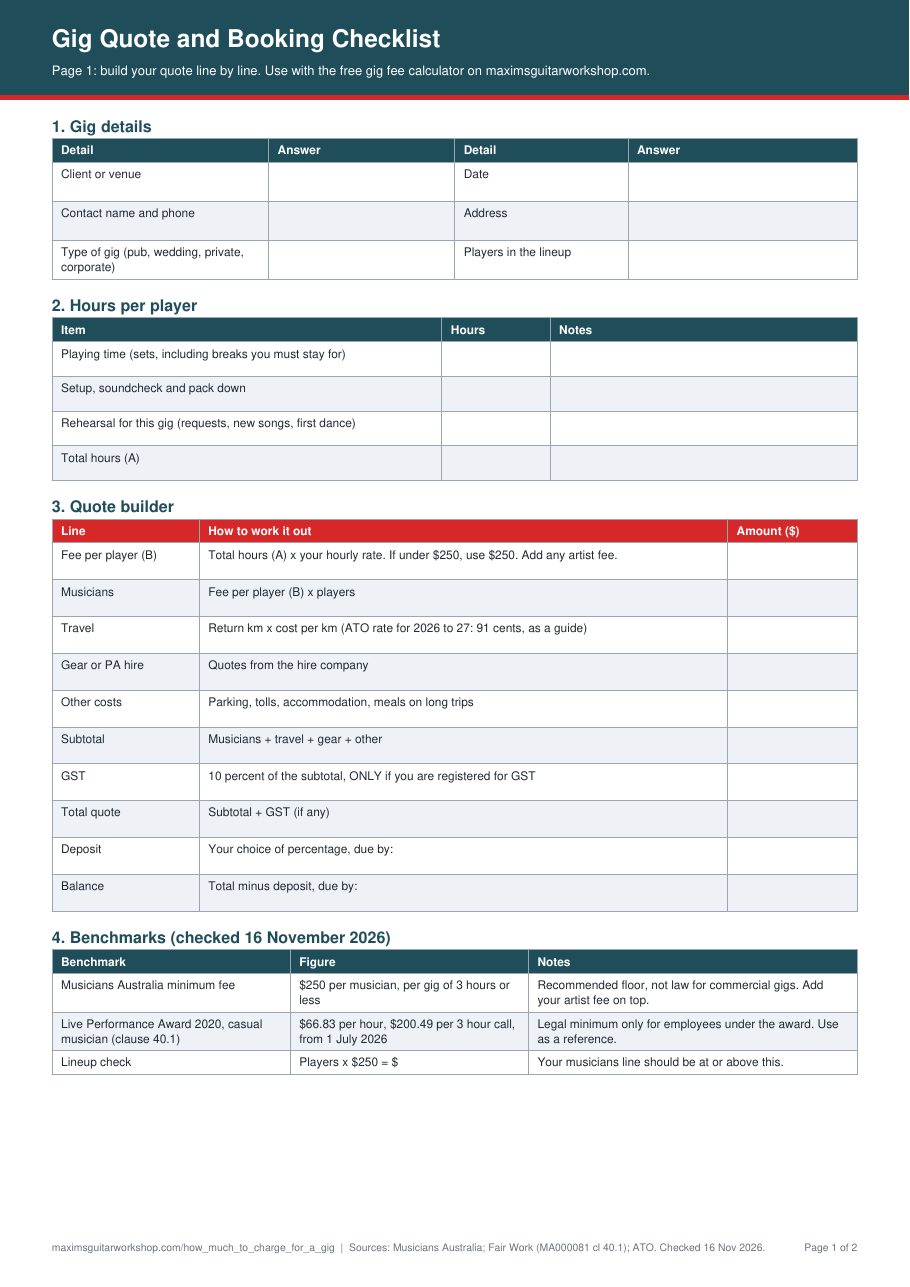
Download the free Gig Quote and Booking Checklist (PDF)
If you are newer to gigging, read how to prepare for your first gig before you quote, and our open mic tips for guitarists if you are still building up stage time.
FAQ
What is the minimum I should charge for a gig?
Musicians Australia recommends at least $250 per musician for a gig of 3 hours or less. Build up from your hours, travel and costs, and add an artist fee for experience, demand or a longer gig.
Is the $250 minimum fee a law?
No. It is a recommended floor, endorsed by several state and territory governments for publicly funded gigs. The award rates are legally binding only for musicians employed under the Live Performance Award.
Should I add GST to my gig fee?
Only if you are registered for GST. Registration is required once your GST turnover reaches $75,000 a year and optional below that.
Does a venue have to pay super to a band?
In many cases, yes. The ATO treats people paid to perform music as employees for super purposes of whoever is liable to pay them, even if they invoice with an ABN. It can change when the band is paid through a company, so confirm it in writing.
Do I charge per player or per band?
Quote the band a single total, but work it out per player so every member gets at least the $250 minimum and the leader is not quietly paying the travel.
Beyond one gig: the bigger money picture
One well priced gig is a good start, but most guitarists earn a living by stacking gigs with teaching and studio work. Our guide on how to make money as a guitarist shows how those streams fit together over a year in Australia, with typical market ranges for pub, wedding and theatre work. If you are weighing up live work against building an audience online, read guitarist online vs gigs.
If you are still building the skills to get gig ready, our online beginner course takes you through chords, strumming and timing at your own pace.
Image credits
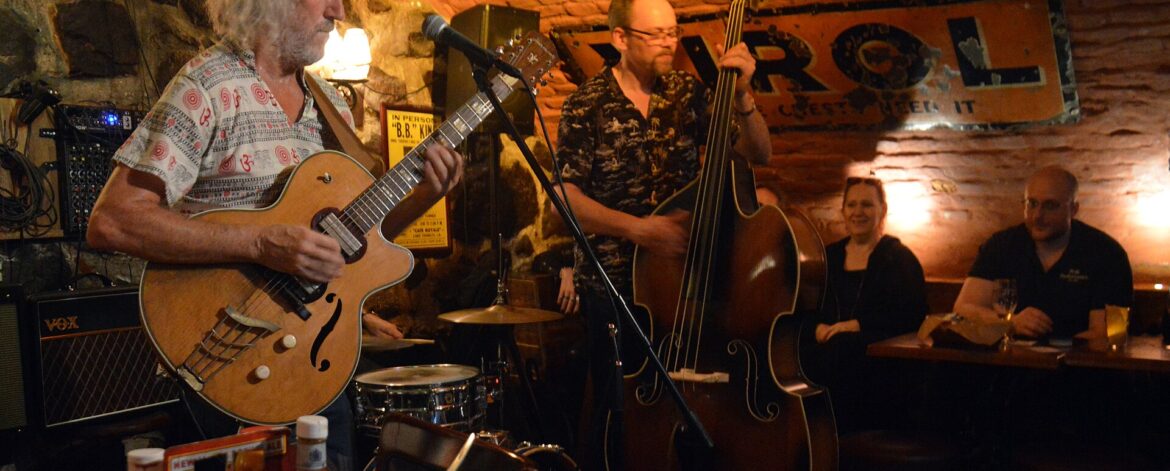
Blues band in the cellar of Wirströms Pub, Stockholm, by DimiTalen, Wikimedia Commons, CC0. Plush at The Jameson Pub by Zeddawg02, Wikimedia Commons, CC0. Checklist preview by Maxim’s Guitar Workshop.