

Hubert Sumlin guitar technique is the sound of a man who threw away his pick and found his voice: thumb and fingers, sharp lines dropped into the gaps of Howlin’ Wolf’s singing, and hypnotic one chord riffs that British rock players studied closely. This post covers his life, his years with Wolf, how his playing works, Smokestack and Killing Floor style licks with tab, and a free printable fingers only lick chart.
Quick answer: what is Hubert Sumlin guitar technique? No pick, just thumb and fingers, with sharp, spaced out lines dropped between Howlin’ Wolf’s vocal phrases. He built hypnotic one chord riffs over an open low string, answered with two note shapes and sixths, and knew exactly when to stop playing.

I teach guitar in Darwin, and I flag my own teaching opinions as mine. This is the fourth post in my series on influential guitarists who deserve more attention, after Clarence White guitar technique, Wilko Johnson guitar technique and Franco Luambo guitar style. Like Wilko and Franco, Sumlin played with his fingers and no pick.
Who was Hubert Sumlin?
Hubert Charles Sumlin was born on 16 November 1931 near Greenwood, Mississippi, and grew up across the river in Hughes, Arkansas, according to Wikipedia. The Mississippi Blues Trail marker in Greenwood places his birth on the Pillow plantation near the marker site, and says his mother was a churchgoer and that he first played in church. As a teenager he played local functions, sometimes with the harmonica player James Cotton.
Sumlin told Living Blues magazine in 1989, quoted in the Guardian obituary by Tony Russell, that the first time he saw Howlin’ Wolf he was too young to get into the club, so he stacked soft drink crates outside and watched through a window. In a 1992 Guitar World interview he said he wanted to be a jazz player like Charlie Christian as a kid, but he loved the blues, and he named Charley Patton, Lonnie Johnson, Robert Johnson and Peetie Wheatstraw as influences.
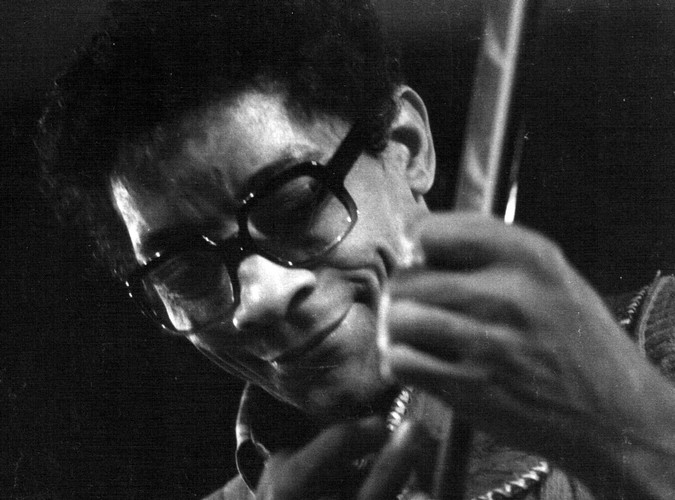
Howlin’ Wolf’s band and Chess Records
Wolf moved from Memphis to Chicago in 1953, and his guitarist Willie Johnson stayed behind, so Jody Williams played guitar for him in Chicago, according to the Wikipedia entry on Howlin’ Wolf. In 1954, a year after Wolf moved to Chicago, he sent for the young guitarist to play second guitar. Williams left in 1955 and Sumlin became the main guitarist. It was the start of his long run as the Howlin’ Wolf guitarist.
It did not start smoothly. Sumlin told Guitar World that Wolf first said he was not ready and should come back when he could play Wolf’s music. Wolf sent him to a teacher at the Chicago Conservatory of Music, and Sumlin said he studied there for about six months with an older player from the Chicago Symphony Orchestra.
The pick stories
Sumlin told the story several ways over the years, but every version ends the same: Wolf wanted him quieter and more expressive, and he dropped the pick for good. In a MusicRadar interview he said Wolf told him to put the pick down because he was too loud, then fired him, and he went home and practised without it. In the 1992 Guitar World interview he said he had used a pick for eight or nine years, then woke one morning, played Smokestack Lightnin’ with bare fingers and never used a pick again.
The Independent’s obituary tells a third version: Wolf ordered him off the bandstand for being too loud and sent him to a classical guitarist, and as a result he stopped using a plectrum. Whichever version you believe, the change shaped everything that followed.
Fights, firings and more than two decades
The Mississippi Blues Trail marker says Wolf fired his young guitarist on numerous occasions, only to rehire him every time. Their fights were legendary; Sumlin said Wolf once knocked his teeth out, though his accounts of whether he hit back changed over the years. He told Guitar World and the Chicago Tribune, quoted in the Los Angeles Times obituary, that he hit back, but in a 1993 interview with the writer Trevor Hodgett, recalled in a reader’s letter to the Guardian, he said he never hit Wolf at all.
He left briefly to play for Muddy Waters around 1956, then came back. He played beside Wolf for more than two decades, from 1954 until Wolf’s death in 1976, with a few short breaks. Sources give the length as anything from 22 to 25 years, so I will not pick one number.
The records
Smokestack Lightnin’ was recorded in January 1956 and released that March, reaching No. 11 on the Billboard R&B chart and entering the Grammy Hall of Fame in 1999, according to the Wikipedia entry on Smokestack Lightning. Sumlin is credited with the record’s hypnotic guitar line; Willie Johnson also played guitar on the session.
On Spoonful, Freddie Robinson played second guitar. The 1962 album known as the rocking chair album, simply titled Howlin’ Wolf, was named the third greatest guitar album by Mojo in 2004. Killing Floor was recorded in August 1964, with Buddy Guy on acoustic guitar.
The marker lists sessions beyond Wolf’s band, with Muddy Waters, Chuck Berry, Jimmy Reed, Willie Dixon, Sonny Boy Williamson (Rice Miller), Eddie Taylor, Sunnyland Slim, Carey Bell, Eddie Shaw and James Cotton. His first recordings under his own name came on the 1964 American Folk Blues Festival tour of Europe.
In 1969 Wolf had a heart attack while Sumlin was driving, and Sumlin revived him by thumping his chest with a piece of timber, Wikipedia says. At the 1970 London Howlin’ Wolf Sessions, Sumlin told Guitar World that Eric Clapton refused to record without him; MusicRadar says Clapton had wanted Sumlin to play lead. He stayed until the end, playing on Wolf’s last album, The Back Door Wolf (1973), and the Guardian notes that Wolf’s funeral programme named him as a son.
After Wolf
After 1976 he played with former Wolf band members as the Wolf Gang until about 1980. The Guardian says he spent time in Texas, where he left an impression on Jimmie and Stevie Ray Vaughan. His album About Them Shoes (2005) featured Eric Clapton, Keith Richards, Levon Helm and James Cotton, peaked at No. 7 on Billboard’s Top Blues Albums chart and was Grammy nominated.
He had a lung removed in 2004 and spent his last years in New Jersey. He died of heart failure on 4 December 2011 in Wayne, New Jersey, aged 80, according to the Los Angeles Times.
Hubert Sumlin guitar technique: fingers, space and call and response
In my reading of the sources, Hubert Sumlin guitar technique comes down to five things: bare fingers, space, one chord riffs, small two note shapes and expressive bends and slides. None of it depends on speed, which is good news if you are learning it.
Thumb and fingers, no pick
“I don’t need anything but my fingers,” Sumlin told Guitar World in 1992, and he said his tone and sound came together right after he dropped the pick. A Guitar World lesson on Sumlin says ditching the pick gave him a lighter, softer but more expressive sound, and let him turn the amp up so the guitar sang with sustain. A Guitar DVD Reviews write up of his Homespun lesson describes him using his thumb and forefinger for both strumming and melody notes.
Space and call and response
“I know when to get in and when to get out,” he told Guitar World. That is the core of his playing with Wolf: short lines dropped between the vocal phrases, often pentatonic, mixing major and minor and leaning on chord tones, as the Guitar World lesson puts it. Wikipedia describes his understated solos and surprisingly subtle phrasing, and Rolling Stone speaks of an almost telepathic connection with Wolf. Jimmy Page told Rolling Stone, “He always played the right thing at the right time.” My post on the basics of syncopation helps with placing notes off the beat like this.
One chord stomp riffs
Guitar World’s In Deep lesson on Wolf and Sumlin points out that Smokestack Lightnin’, Spoonful, Wang Dang Doodle and others sit on one chord and build tension through repetition. The lesson’s Smokestack style figure strikes the open low E throughout while a melody runs on the higher strings. The writer James Segrest, quoted on Wikipedia, calls the song a one chord vamp nominally in E major, with flatted blue notes that make it sound minor, and Robert Palmer described it as a hypnotic drone on one chord. Sumlin told MusicRadar the lick came from Charley Patton.
Two note shapes, sixths and clusters
The Guitar World pioneer lesson describes cluster chord shapes that outline dominant seventh and ninth chords, mixed with melodic hooks; my post on major 7th, minor 7th and dominant 7th chords explains those sounds. The In Deep lesson shows two note lines on the top three strings built from small changes to the I, IV and V triads (Shake for Me), and two note barres with the index and middle fingers in E minor pentatonic that stay almost the same over all three chords (Who’s Been Talkin’). If that scale is new to you, start with my guide to the modes of the minor pentatonic scale.
Bends, vibrato, long slides and no capo
Guitar World notes his bends, quick vibrato and slides that run the length of the neck, and suggests aiming for as high as you can go rather than an exact pitch. He also never used a capo, which he called a clamp. “You got five different Es, you got five different As, and you got to use them all,” he told Guitar World. In my teaching, that is a great reason to learn each chord in more than one place on the neck.
How to play like Hubert Sumlin: Smokestack and Killing Floor style licks
These Hubert Sumlin licks are exercises in his style, not transcriptions of his records. They put Hubert Sumlin guitar technique into small steps: a thumb pulse, a drone with a melody, an answer after silence, thumb brushed shapes, sixths and a bend and slide. Everything is in standard tuning; no source I found gives him a special tuning. The records are loose and swinging in ways tab cannot show, so use the tab as a map and the records as the teacher.
How to read the tab
Each tab shows only the strings used. Numbers are frets, dots mean nothing is played, and the top line counts eighth notes (1 & 2 & 3 & 4 &). The lines underneath show the picking hand: T is the thumb, i is the index finger and P is a pinch, two strings plucked at once. On the bottom line, s is a slide into the note, b is a small bend (a quarter step curl), ~ is vibrato and > is an accent. Start with a click at 60 to 70 bpm on each beat. A gentle swing on the eighth notes is fine.
Exercise 1: the stomp pulse
Play the open low E with your thumb on every beat, then on every eighth note. Aim for a steady pulse that feels like a heartbeat, a little softer on the “and” in bar 2. Loop it until it is relaxed.
   1  &  2  &  3  &  4  &   1  &  2  &  3  &  4  &
G |........................|........................|
D |........................|........................|
A |........................|........................|
E |0.....0.....0.....0.....|0..0..0..0..0..0..0..0..|
   T     T     T     T      T  T  T  T  T  T  T  T
   >           >            >           >
Smokestack Lightnin’ style riff: our simplified version
This is Exercise 2: a one chord drone with a high melody, in the style of Smokestack Lightnin’ (also spelled Smokestack Lightning). It is our own simplified teaching layout, not the record’s part. The thumb keeps the open E on every beat while the index plucks melody notes on the “and”: G, E, D, B, then G, E, A, G. Vary how hard you pluck, as the In Deep lesson suggests for this style.
   1  &  2  &  3  &  4  &   1  &  2  &  3  &  4  &
e |...3.....0..............|...3.....0..............|
B |...............3.....0..|........................|
G |........................|...............2.....0..|
D |........................|........................|
A |........................|........................|
E |0.....0.....0.....0.....|0.....0.....0.....0.....|
   T  i  T  i  T  i  T  i   T  i  T  i  T  i  T  i
For the real thing, the best Smokestack Lightning guitar lesson I know comes from the man himself. On the official Homespun channel, Sumlin plays the riff up to speed and then slowly.
Exercise 3: leave space, then answer
Bar 1 is silent: sing or hum a line there, as Wolf would. Bar 2 answers with index barres on the top two strings at the 15th and 12th frets, sliding into each 15th fret pair from one fret below and adding vibrato to the last one. The silence is the hard part. Count it out loud.
   1  &  2  &  3  &  4  &   1  &  2  &  3  &  4  &
e |........................|15....12....15....12....|
B |........................|15....12....15....12....|
G |........................|........................|
                            i     i     i     i
   (sing or hum)            s           s     ~
Killing Floor style intro: thumb brushed shapes
Killing Floor is a 12 bar blues in A with A7, D7 and E7 chords, according to a Guitar Control lesson; my 12 bar blues post explains the form. Guitar Control describes the intro starting on the turnaround with one four note shape, the top four strings of an E chord shape, moved from the 12th fret (E) to the 10th (D) and the 5th (A), brushed with the thumb. The pinky adds the flat seventh on the B string for the dominant sound.
- E at the 12th fret: D14, G13, B12, e12. For E7, move the B string note to 15.
- D at the 10th fret: D12, G11, B10, e10. For D7, move the B string note to 13.
- A at the 5th fret: D7, G6, B5, e5. For A7, move the B string note to 8.
This is Exercise 4. Brush the top four strings down with the side of the thumb. The pinky adds the seventh on beat 2, the “and” of 2 and beat 3, then lifts.
   E     E7                 D     D7
   1  &  2  &  3  &  4  &   1  &  2  &  3  &  4  &
e |12....12.12.12....12....|10....10.10.10....10....|
B |12....15.15.15....12....|10....13.13.13....10....|
G |13....13.13.13....13....|11....11.11.11....11....|
D |14....14.14.14....14....|12....12.12.12....12....|
   T     T  T  T     T      T     T  T  T     T

   A     A7
   1  &  2  &  3  &  4  &
e |5.....5..5..5.....5.....|
B |5.....8..8..8.....5.....|
G |6.....6..6..6.....6.....|
D |7.....7..7..7.....7.....|
   T     T  T  T     T
The Killing Floor guitar riff: our simplified version
Exercise 5 is our simplified take on the famous sixths riff. Jon MacLennan’s lesson describes sixths on the G and high E strings sliding into the 9th fret, walking down to the 7th, then resolving to the root and third of A at the 5th and 6th frets, with the open A string in between. Pinch the two note sixths and thumb the open A between them. Slide into the 9th fret pair from a fret or two below.
   1  &  2  &  3  &  4  &   1  &  2  &  3  &  4  &
e |9.....9.....7.....5.....|9.....9.....7.....5.....|
B |........................|........................|
G |9.....9.....7.....6.....|9.....9.....7.....6.....|
D |........................|........................|
A |...0.....0.....0........|...0.....0.....0........|
   P  T  P  T  P  T  P      P  T  P  T  P  T  P
   s           s     s      s           s     s
Homespun also has a clip of Sumlin demonstrating Killin’ Floor with Jimmy Vivino, which is worth watching once your thumb and pinch feel steady.
Exercise 6: get in, get out
Bar 1: a small curl on the B string at the 8th fret, then the high E string at the 5th fret with a wide vibrato, then rest. Bar 2: slide the index up the G string from the 2nd fret to the 14th, aiming as high as you can go as Guitar World suggests, add vibrato and stop. The rests are part of the exercise.
   1  &  2  &  3  &  4  &   1  &  2  &  3  &  4  &
e |......5.................|........................|
B |8.......................|........................|
G |........................|2........14.............|
   i     i                  i
   b     ~~~      rest      s  ..... ~~    rest
Look after your fingers
No pick means your thumb and index take the wear. Keep sessions short, and stop if the skin gets sore. My guide to sore fingertips from guitar covers building up calluses safely, and my guitar practice routine post shows how to fit a short technique block like this into your week.
Gear and tone
In the 1950s he mostly played a Gibson Les Paul, and for a time a Kay. Sumlin told Guitar World he believed the Les Paul was a 1956 model, and that he and Jody Williams both played Kay guitars at one stage. Sumlin remembered getting his grit from a Wabash amp with 15 inch speakers and, later, an Echoplex. He did not invent the distorted blues guitar sound, though: Willie Johnson was already playing distorted power chords on Wolf’s 1951 recordings, as the Wikipedia entry on Moanin’ in the Moonlight notes.
He played many guitars over the years, including a Goldtop Les Paul and an Italian Bartolini, he told MusicRadar, and Eric Clapton gave him one of his own Stratocasters. Photos show him with a red Stratocaster in 2003 and a Telecaster style guitar in 2006. If you are weighing up those two classic shapes, my Stratocaster vs Telecaster comparison will help.
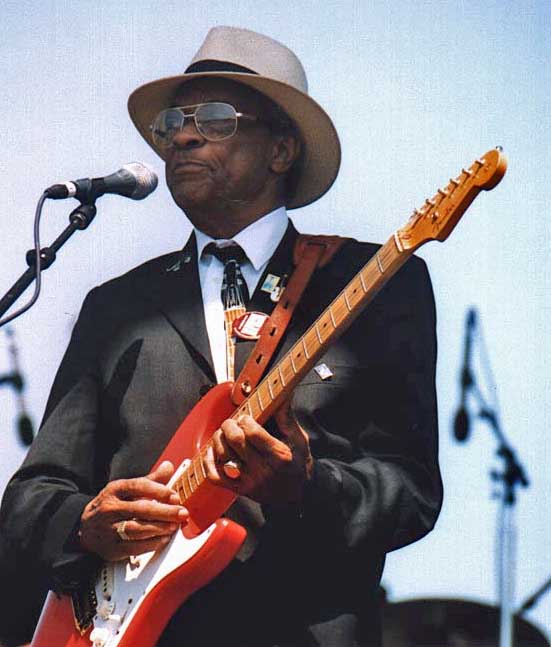
For your own tone, the Guitar World pioneer lesson suggests a bright sound that is just breaking up, the guitar volume rolled back slightly, a light first finger brush and some reverb. Its suggested amp settings are gain 2, bass 3, middle 4, treble 6 and reverb 4. Every amp is different, so treat those numbers as a starting point. My post on understanding tube amps explains how a valve amp breaks up as you turn it up.
Free printable lick chart (PDF)
The free sheet puts Hubert Sumlin guitar technique on one A4 page: the shape chart, all six exercises in tab, a tempo log, tips and a short listening list. Print it, keep it on your music stand, and write your tempo down each session so you can see steady progress. Only move the metronome up when every bar is clean and relaxed.
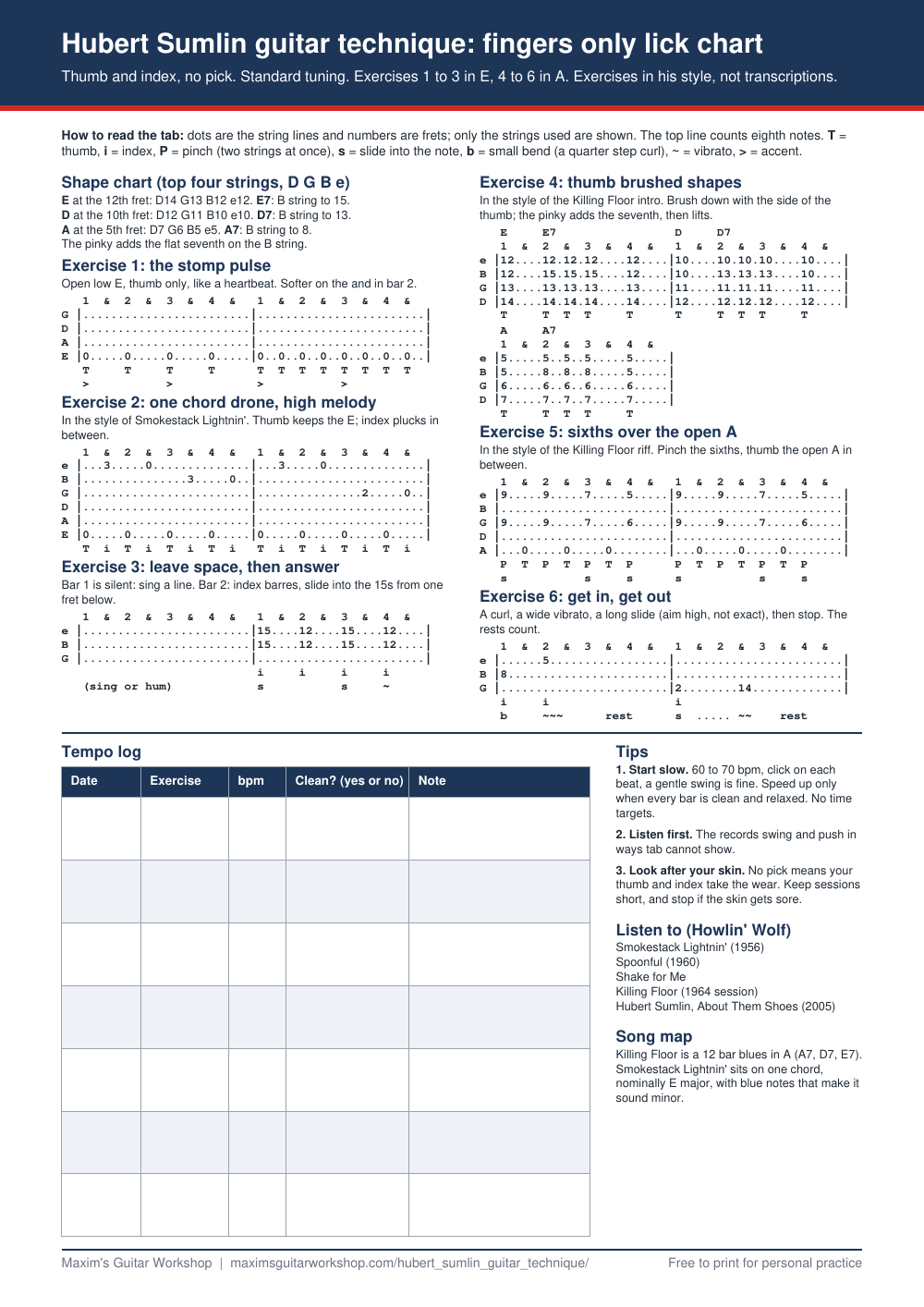
Download the free Hubert Sumlin guitar technique lick chart (PDF)
Essential listening
Listening matters more than any tab with this music. Start with the original 1956 Smokestack Lightnin’, from the official Howlin’ Wolf channel on YouTube, and listen for how little the guitar line changes and how much it says.
- Smokestack Lightnin’ (1956): the one chord drone at its most hypnotic.
- Evil: listen for how the guitar answers the voice.
- Spoonful: the open E pedal again, with Freddie Robinson on second guitar.
- Wang Dang Doodle: one chord, endless tension.
- Back Door Man: listen for the space around the voice.
- Shake for Me: two note lines over a 12 bar in B.
- Who’s Been Talkin’: two note barres in E minor pentatonic.
- Killing Floor (recorded 1964): thumb brushed shapes and sixths over an open A.
- Forty Four: listen for the riff under the vocal.
- About Them Shoes (2005): Sumlin’s own late album with Clapton, Richards and friends.
Guitar World’s official channel also has a short Hubert Sumlin blues lesson in which he talks about getting his first tone ideas from John Lee Hooker, and the Guitar World video lesson page has more.
Hubert Sumlin’s legacy
Rolling Stone included him in its 2003 list of the greatest guitarists, the Mississippi Blues Trail marker notes. He was No. 43 in Rolling Stone’s 2011 list of the 100 greatest guitarists, according to the Guardian, and No. 73 in its 2023 list of the 250 greatest. He entered the Blues Hall of Fame on 7 May 2008, the day after his Mississippi Blues Trail marker was unveiled. He was four times Grammy nominated but never won.
The Guardian says Eric Clapton, Keith Richards and Jimmy Page listened closely to Wolf’s records. Jimi Hendrix covered Killing Floor, and Wikipedia notes that Led Zeppelin’s The Lemon Song draws on it. The marker says Hendrix and Stevie Ray Vaughan named Sumlin as a favourite. My history of blues guitar timeline puts him among the Chicago players who gave electric blues its attack.
For guitarists today, Hubert Sumlin guitar technique is a lesson in restraint and surprise: a few notes, played with bare fingers, at exactly the right moment. In my teaching, his music fixes a common problem, which is players who fill every gap. Spend time with these exercises and the records, and your blues playing will start to breathe.
If you are newer to the guitar and want a structured path to playing blues licks like these, my online beginner course starts from the very first chord.
Hubert Sumlin FAQ
Did Hubert Sumlin use a pick?
Early on, yes. He dropped it in his first years with Howlin’ Wolf and played with his thumb and fingers from then on, though he told the story of why in several different ways.
Who played guitar on Smokestack Lightnin’?
Sumlin is credited with the record’s main guitar line. Willie Johnson also played guitar on the session.
What key is Killing Floor in?
A. It is a 12 bar blues with A7, D7 and E7 chords.
What guitar did Hubert Sumlin play?
Mostly a Gibson Les Paul in the 1950s, which he believed was a 1956 model, and many guitars later, including a Stratocaster that Eric Clapton gave him.
How long did Hubert Sumlin play with Howlin’ Wolf?
From 1954 until Wolf died in 1976, with short breaks. Accounts range from 22 to 25 years.
Did Hubert Sumlin win a Grammy?
No. He was nominated four times but never won.
Can a beginner learn Hubert Sumlin guitar technique?
Yes, at a slow tempo. The thumb pulse and the drone exercise suit anyone who can fret a few notes cleanly. The brushed shapes, sixths and slides take longer, and there is no deadline for sounding like him. Treat the sheet as a starting point, not a shortcut.
Sources
- Guitar World, classic 1992 interview with Hubert Sumlin
- Mississippi Blues Trail, Hubert Sumlin marker, Greenwood
- The Guardian, obituary by Tony Russell, 5 December 2011
- The Guardian, letters on the obituary, 20 December 2011
- Los Angeles Times obituary, 10 December 2011
- The Independent obituary
- MusicRadar, classic interview with Hubert Sumlin
- Guitar World lesson, Hubert Sumlin, blues guitar pioneer
- Guitar World lesson, In Deep: Howlin’ Wolf and Hubert Sumlin
- Rolling Stone Australia, 250 greatest guitarists, Hubert Sumlin
- Guitar Control, Killing Floor lesson
- Jon MacLennan, Killing Floor guitar lesson
- Guitar DVD Reviews, The Blues Guitar of Hubert Sumlin
- Wikipedia: Hubert Sumlin, Howlin’ Wolf, Smokestack Lightning, Killing Floor, Spoonful, Howlin’ Wolf (album), Moanin’ in the Moonlight, About Them Shoes