Sore fingertips from guitar are one of the first things almost every new player notices, usually within the first few days of playing. The good news: it is normal, it is temporary for most people, and it is a sign your skin is adapting. The short answer is that the tenderness usually settles within a few weeks of short, regular practice. That is a typical timeline, not a promise, and everyone’s skin is a little different.
This guide to sore fingertips from guitar explains why your fingertips hurt playing guitar, how guitar calluses form, what actually helps, what to avoid, and when to stop and get it checked. There is also a free printable 2 week fingertip plan you can tick off each day.
This is general information, not medical advice. If something feels wrong, talk to a GP or physio.

Sore fingertips from guitar: why it happens
When you fret a note, a small patch of skin on each fingertip presses a thin metal or nylon string down onto the fretboard. Your fingertips are packed with nerve endings and the skin there is soft, so a few minutes of that focused pressure is enough to leave them tender, red or slightly dented. That is why sore fingertips from guitar are something almost all beginners go through, and it does not mean you are doing something terribly wrong.
Over time the skin protects itself by thickening. A callus is a build up of the tough outer layer of skin in response to repeated pressure and friction. A 2004 review of skin problems in musicians in BMC Dermatology describes calluses as a protective thickening of that outer layer, and notes that building them is exactly what string players aim for. The NHS page on corns and calluses even lists playing a musical instrument as a common cause.
You are not alone with sore fingertips from guitar. In a 2008 survey of 412 musicians in the journal Contact Dermatitis, 21.6% reported a skin problem related to their instrument, and calluses made up 58.4% of those cases. String and plucking players reported calluses more than any other group, and the problems were linked with practising often. In other words, guitar calluses are a normal part of the job.
How long it lasts (typical timeline, labelled)
Different sources give slightly different numbers, which is honest: skin, guitar, strings and practice habits all vary. Here is what the guitar makers and health writers say.
- Fender says fingertip soreness is temporary and can last a week or more, and suggests starting with around 10 to 15 minutes a day.
- Gibson says the pain typically subsides within a few days or weeks of consistent practice.
- Healthline says that on average it takes 2 to 4 weeks for calluses to form.
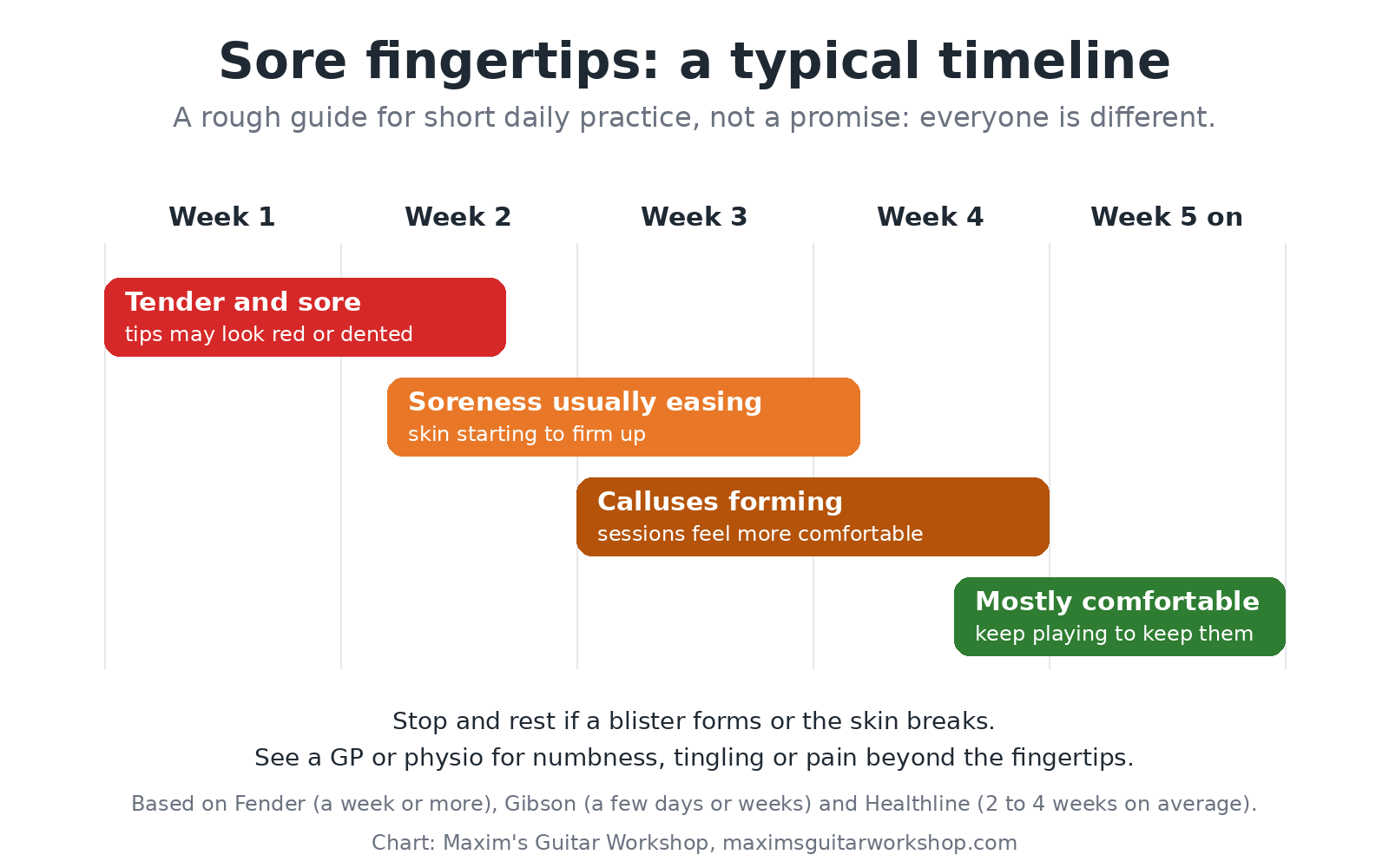
Putting those together, a typical pattern for sore fingertips from guitar with short daily sessions looks like the chart below. Treat it as a rough guide. If you play only once a week, it will take longer, because the skin keeps softening again between sessions.
Learning the guitar as a whole takes much longer than toughening your fingertips, of course. If you want the bigger picture, our guide on how long it takes to learn guitar sets out realistic milestones.
One more thing to know about sore fingertips from guitar: calluses are use them or lose them. Guitar World says there is no quick fix, and quotes Steve Cropper saying his calluses peel off if he is off the road for too long.
What actually helps sore fingertips from guitar
If you are wondering how to toughen guitar fingertips without hurting yourself, the answer is mostly boring and steady. These are the habits that make the biggest difference in our lessons.
Short, frequent sessions
Several short sessions beat one long one. Ten to fifteen minutes, once or twice a day, gives the skin a regular reason to toughen up while leaving time to recover. Fender’s beginner advice is about 10 to 15 minutes a day at first, so you do not push your fingertips too hard early on. Healthline suggests spreading practice into short blocks across the day. If you want structure for longer sessions later, our guitar practice routine guide shows how players split their time.
A light touch: press only as hard as needed
Most beginners press far harder than they need to, which only makes sore fingertips from guitar worse. Try this: fret a note, then slowly ease off until it starts to buzz, then add just enough pressure to make it ring clean again. That is your real target.
Gibson also recommends fretting close to the fret wire rather than in the middle of the gap, because the note needs less pressure there. Keep your fretting hand fingernails short, as Healthline suggests, so the nails do not take the pressure and you can press cleanly with the tip.
Setup and action height
Action is the height of the strings above the frets. If it is high, every note takes more force, and your fingertips pay for it. Fender explains action and why a lower, properly adjusted action is easier to play. A cheap guitar straight out of the box can be set high: one Australian guide to guitar action says budget guitars frequently leave the factory with the action set too high, which is why a basic setup helps. A professional setup from a local music shop or tech can change how a guitar feels more than you would expect.
The same issue comes up with barre chords, and our barre chords guide covers what to check when your hand aches.
Lighter strings and string gauge
String gauge changes how much tension you are pushing against. D’Addario publishes the tension of every string in its sets, and the totals vary a lot. A light acoustic set such as the EJ16 12 to 53 adds up to about 161 lb, while a common electric set such as the EXL110 10 to 46 is about 103 lb.
Moving to a lighter set, and having the guitar adjusted to suit, is a fair option on any guitar if sore fingertips from guitar are putting you off. For a look at what the pros actually use, see our post on famous guitarists’ string gauges.
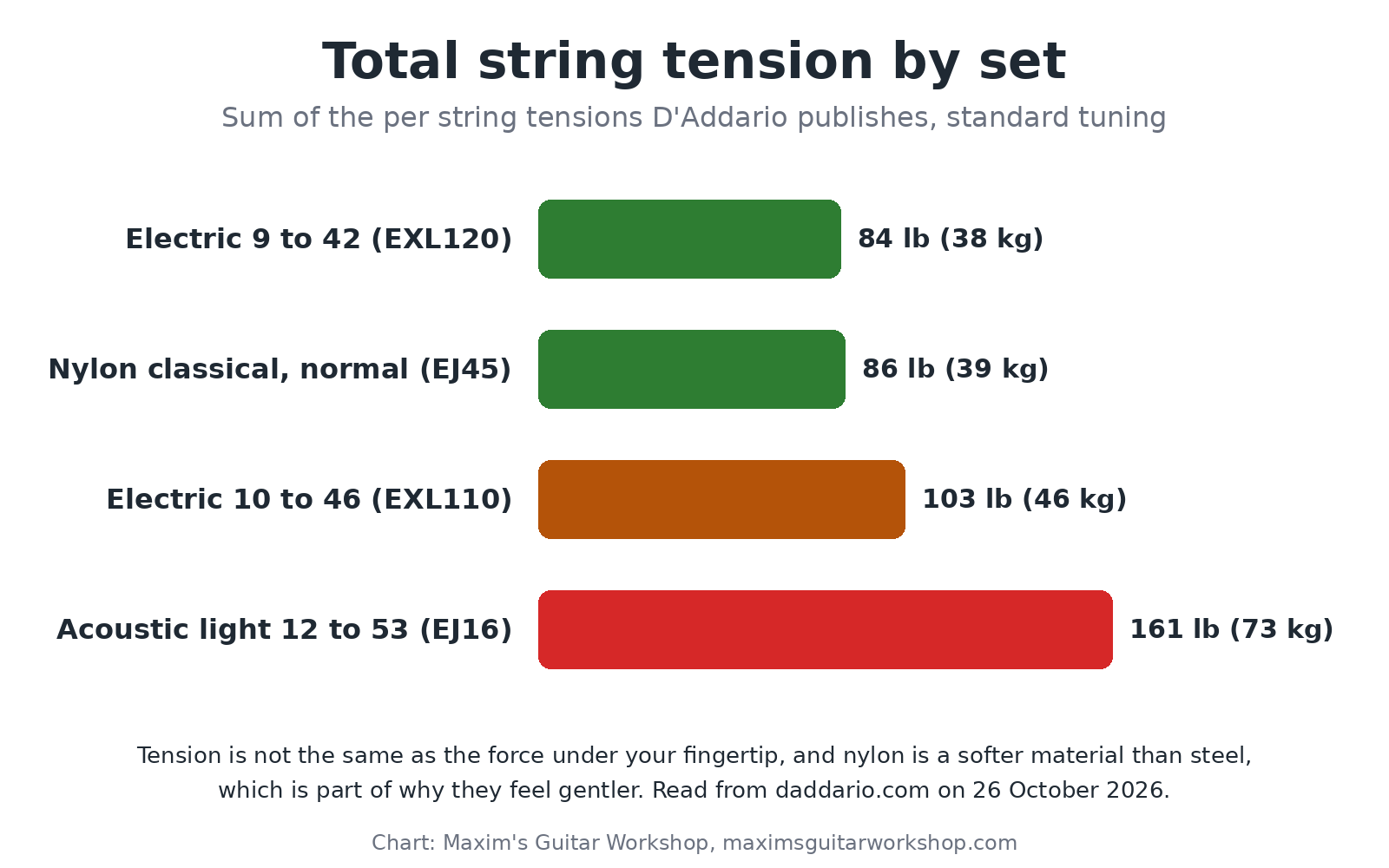
One honest trade off: Healthline suggests the opposite if your main goal is building calluses sooner. It recommends starting on a steel string acoustic with thicker strings, which it says build calluses rather than cutting into the fingertips, then moving to lighter strings once your calluses have formed. Lighter strings and a good setup are the more comfortable choice now, while thicker strings may toughen the skin sooner but can be more uncomfortable at first. Pick whichever keeps you playing a little every day. This is general advice, not medical advice.
Nylon vs steel strings
Fender notes that nylon strings are easier on the fingers. Interestingly, it is not mainly about tension: a normal tension nylon set like the D’Addario EJ45 totals about 86 lb, close to a light electric set. Nylon feels gentler because it is a softer material than steel. Many players find steel string acoustics the hardest on new fingertips, and Fender also points out that electric guitars use lighter gauge strings than steel string acoustics, which makes fretting a little easier. If you are starting on a steel string acoustic, expect the tender phase to feel a bit stronger.
What not to do
There are plenty of shortcuts floating around online and in forums such as Reddit. Most of them either do not work or can make things worse.
- Superglue on your fingertips. Some string players do use cyanoacrylate glue to make a temporary finger cap. Wikipedia’s cyanoacrylate entry notes that the glue can cause chemical burns in large amounts, its fumes can irritate, and some people react to it. It also covers the very skin you are trying to toughen. We do not recommend it.
- Needles, pins or picking at blisters. The NHS blisters page says not to burst a blister yourself or peel the skin off, and to avoid whatever caused it until it heals. The NHS corns and calluses page also says not to cut calluses off yourself.
- Pushing through blisters. Gibson warns that blisters truly hurt and heal slowly. Playing on a blister usually sets you back further than a few days off would.
- Over soaking right before you play. The NHS advises soaking calluses in warm water to soften them, which is the opposite of what a guitarist wants. A long bath, a swim or a sink of dishes just before practice can leave your tips soft and sore. Practise before, or give your hands a while to dry out after.
- Home remedies with no evidence. You will see vinegar and rubbing alcohol suggested, even by Healthline, but Healthdirect says vinegar is not effective on blisters. Healthdirect, Australia’s government health information service, says not to use home remedies such as green tea or vinegar on blisters because they are not effective.
- Numbing the pain so you can play longer. Fender mentions that icing and numbing creams can give short term relief from soreness, which is fine. Numbing your fingers so you can push through a long session is different. As general practical advice, not medical advice, we would not do it, because sore tips are the signal that you have done enough for the day, and numb skin can hide a blister forming.
Comparison table: remedy, how it helps, caution
| Remedy | How it helps | Caution |
|---|---|---|
| Short daily sessions | Builds calluses steadily with time to recover | Skipping days lets skin soften again |
| Light touch, fret near the fret | Less pressure on each fingertip | Takes conscious practice at first |
| Professional setup, lower action | Less force needed for every note | Too low can cause buzzing, so let a tech set it |
| Lighter strings | Less tension to press against | Guitar may need adjusting after a gauge change |
| Nylon string guitar | Softer material is gentler on new skin | Wider neck and a different sound to steel |
| Ice or a cool pack after playing | Short term relief | Not a reason to play longer |
| Rest days | Lets sore or blistered skin recover | Too many and calluses fade |
| Superglue, needles, vinegar | No reliable benefit | Risk of burns, infection or slower healing |
When to stop and see a professional
Ordinary sore fingertips from guitar feel tender, look a little red or dented, and are fine again by the next day. Stop playing and rest if a blister forms, and see a pharmacist or GP if any of the following happen.
- Blisters that break or look infected. Healthdirect says a minor blister usually heals in a week or two, and you should leave the roof on and cover it. See a GP if it becomes swollen, red, increasingly painful or has pus. Healthdirect also suggests checking with a pharmacist before puncturing a large, painful blister.
- Numbness or tingling. Tingling or numbness in the fingers or hand, a weak grip, or pain that travels up the arm are not callus problems. Healthdirect lists these as symptoms of conditions such as carpal tunnel syndrome that need assessment.
- Pain beyond the fingertips. Aching in the wrist, forearm, thumb or shoulder is a different issue from tender skin. A 2026 systematic review that included 42 clinical studies in Medical Problems of Performing Artists found about 56 percent of guitarists with musculoskeletal pain in the pooled estimate, with wide uncertainty (95 percent confidence interval 26 to 84 percent). The authors say the pain was potentially related to long practice sessions and inappropriate posture.
See a GP or physio if pain lasts more than a few days after resting, keeps coming back, or affects anything other than the skin of your fingertips. In Australia you can also call the healthdirect helpline on 1800 022 222 for advice. For wider hand, wrist and arm problems, see our guide to guitar injuries and how to prevent them.
A simple 2 week fingertip plan
This plan keeps sessions short and builds slowly. Minutes are a guide only. If your tips are very sore, take the easier option or a rest day. If a blister appears, stop and let it heal.
| Days | Daily playing | Focus |
|---|---|---|
| 1 to 3 | 2 sessions of 5 to 10 minutes | Single notes and easy chords, find the lightest pressure that rings clean |
| 4 | Rest or 5 easy minutes | Check tips: tender is fine, blisters mean rest |
| 5 to 7 | 2 sessions of 10 minutes | Fret close to the fret, relax the thumb |
| 8 to 10 | 2 sessions of 10 to 15 minutes | Chord changes with a light touch |
| 11 | Rest or 10 easy minutes | Note how your tips feel compared with day 1 |
| 12 to 14 | 2 sessions of 15 minutes | Short songs, short breaks between them |
The printable version has a daily tick box log, a 1 to 5 soreness score and a notes space, so you can see your progress on paper.
Download the free 2 week fingertip plan (PDF)
FAQ
How long do sore fingertips from guitar last?
For most beginners playing a little each day, the worst of it eases within the first week or two, and calluses form over roughly 2 to 4 weeks, according to Healthline. That is typical, not guaranteed. Playing less often, or on a steel string acoustic with high action, can make it take longer.
Do calluses go away?
Yes, if you stop playing for a while. The skin only stays thick while there is pressure to protect against. Even professionals lose them after a break, as Steve Cropper told Guitar World. Many players find they come back faster the second time around, but that is a common experience rather than something we have found measured in studies, so ease back in with short sessions.
Is it ok to practise with sore fingers?
Mild tenderness is fine, and short sessions are how you get past it. Keep the sessions brief and the touch light. Stop if the skin blisters, splits or bleeds, or if the pain is sharp rather than a dull tenderness, and give it a day or two.
Do lighter strings help?
Usually, yes, for comfort. Lighter gauges mean less tension, so each note needs less force. Fender lists lighter strings as an option on any guitar. Pair a gauge change with a setup so the guitar still plays in tune and without buzzing.
Why does it hurt more on acoustic?
Steel string acoustics usually use heavier strings than electrics, so the total tension is higher. A light acoustic set is around 161 lb compared with about 103 lb for a regular electric set, using D’Addario’s published figures. Acoustics are also usually set up with a little more string height than electrics. StewMac’s suggested settings at the 12th fret are about 0.070 to 0.090 inch for a steel string acoustic and about 0.063 to 0.078 inch for an electric, so the difference is small, but it can add to the effort.
Sore fingertips from guitar are a short phase, not a sign that guitar is not for you. Keep the sessions short, the touch light and the guitar well set up, and most players find the tenderness fades into firm, useful calluses. If you would like a clear, step by step path through those first weeks, have a look at our online beginner course.