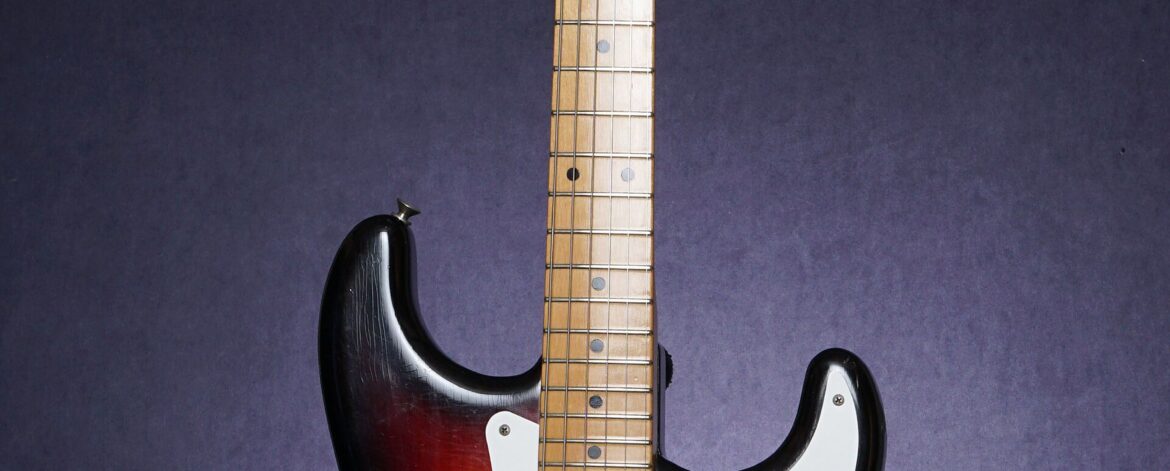
The Fender Stratocaster and Telecaster come from the same workshop, share the same scale length and use the same kind of bolt on maple neck. Yet pick one up after the other and they feel like two very different personalities. If you are weighing up stratocaster vs telecaster for your next (or first) electric guitar, this guide walks you through the history, the hardware, the sound, the feel, the price and the players, then finishes with four simple profiles to help you choose. Fender also has its own overview of the basic differences if you want the maker’s view. New to electric guitars in general? Start with our guide to the different kinds of guitars.
Featured photo: Lightburst, CC BY SA 4.0, via Wikimedia Commons
Stratocaster vs Telecaster at a glance
| Feature | Stratocaster | Telecaster | Edge |
|---|---|---|---|
| Debut | 1954 (full production from October 1954) | 1950 as the Esquire and Broadcaster, renamed Telecaster in 1951 | Tele is older |
| Scale length | 25.5 inches (648 mm) | 25.5 inches (648 mm) | Tie |
| Neck | Bolt on maple, 22 frets on modern models | Bolt on maple, 22 frets on modern models | Tie |
| Body | Double cutaway, contoured | Single cutaway, flat slab | Strat for comfort |
| Bridge | Vibrato (two point or vintage six screw); fixed on some models | Fixed, strings through the body | Tele for stability, Strat for expression |
| Pickups | Three single coils (HSS and other options exist) | Two single coils (humbucker options exist) | Strat for variety, Tele for bridge punch |
| Switching | Five way | Three way | Strat for options |
| Controls | One volume, two tone | One volume, one tone | Tele for simplicity |
| Typical sound | Glassy, chimey, funky, "quack" | Twangy, biting, cutting | Depends on your music |
| Tuning stability | Good when set up well | Excellent | Tele |
| Upper fret access | Easier | Adequate | Strat |
| Price | Same as the Tele at each tier | Same as the Strat at each tier | Tie |
A little history
Leo Fender was a radio repairman, not a guitarist, yet he built the first commercially successful, mass produced solid body electric guitar. Earlier solid body experiments did exist (Rickenbacker had a Bakelite guitar in 1935), but Fender was the one who made the idea work on a production line, as Fender’s own look at the company in the 1950s explains.
In 1950 Fender released the single pickup Esquire, followed late that year by a two pickup model called the Broadcaster. Gretsch objected, because it already sold "Broadkaster" drums. Gretsch’s objection forced the Broadcaster name out in early 1951, and the Telecaster name was announced in February 1951. Guitars made in between carried only the word "Fender" on the headstock, and collectors now call them "Nocasters". Sources differ on exactly when the new Telecaster decals appeared, with some placing it later in 1951, so the safest summary is that the Tele arrived between 1950 and 1951.
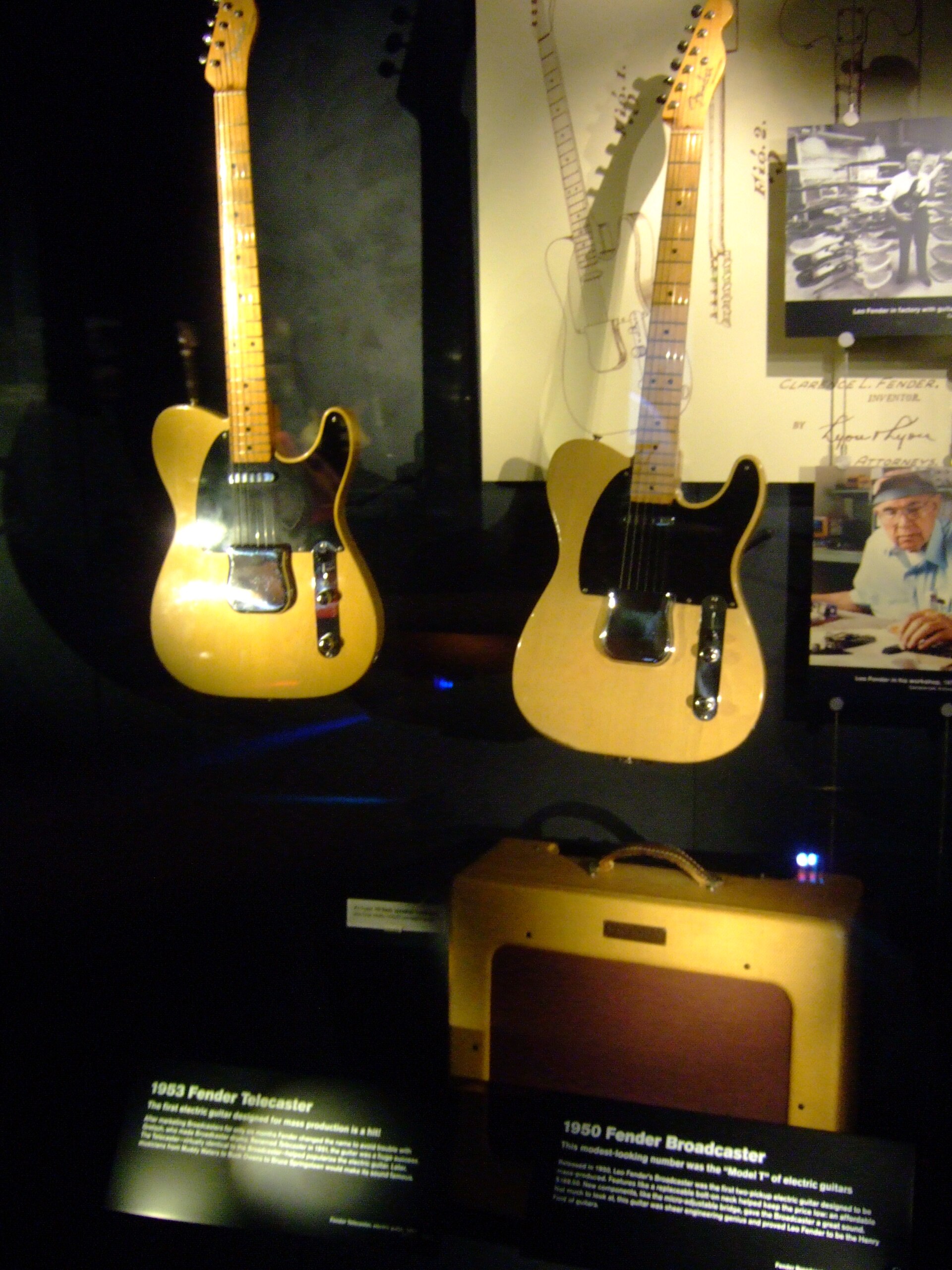
The Stratocaster followed in 1954. Its first known advertisement ran in April 1954, a small early run was built from that month, and full scale production began in October 1954. Leo Fender designed it with Bill Carson, George Fullerton and Freddie Tavares, and sales manager Don Randall chose the name. Fender’s history of the Stratocaster in the 1950s covers that launch in more detail. Leo expected the Strat to replace the Tele. It never did: both are still in production more than 70 years later.
How they work: the mechanics
For the bigger picture on how construction shapes tone, see our article on guitar design and its effect on the tone.
What they share
Both guitars use a 25.5 inch (648 mm) scale, a maple neck held on with screws and, on modern versions, 22 frets (the originals had 21). Because the neck is bolted on, a tech can adjust, shim or swap it far more easily than a glued in neck. Fender says both bodies are mostly made from alder, with ash, mahogany and other woods also used. Current Player II models of both share a Modern C neck profile and a 9.5 inch fingerboard radius. Nut widths can differ slightly from model to model, so check the spec sheet if that matters to you.
The bridge
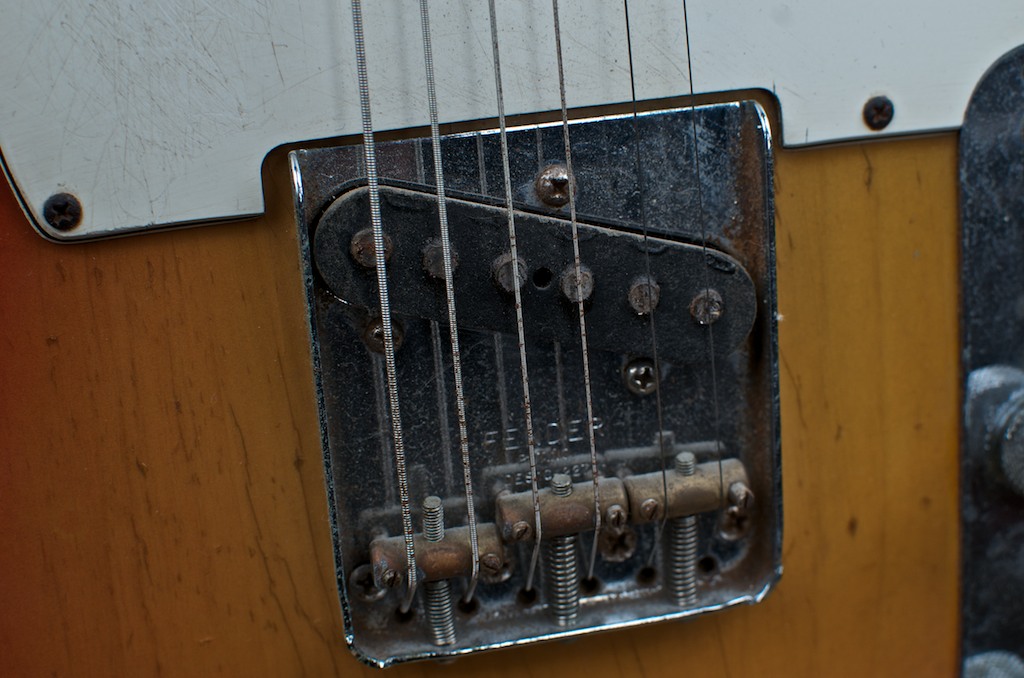
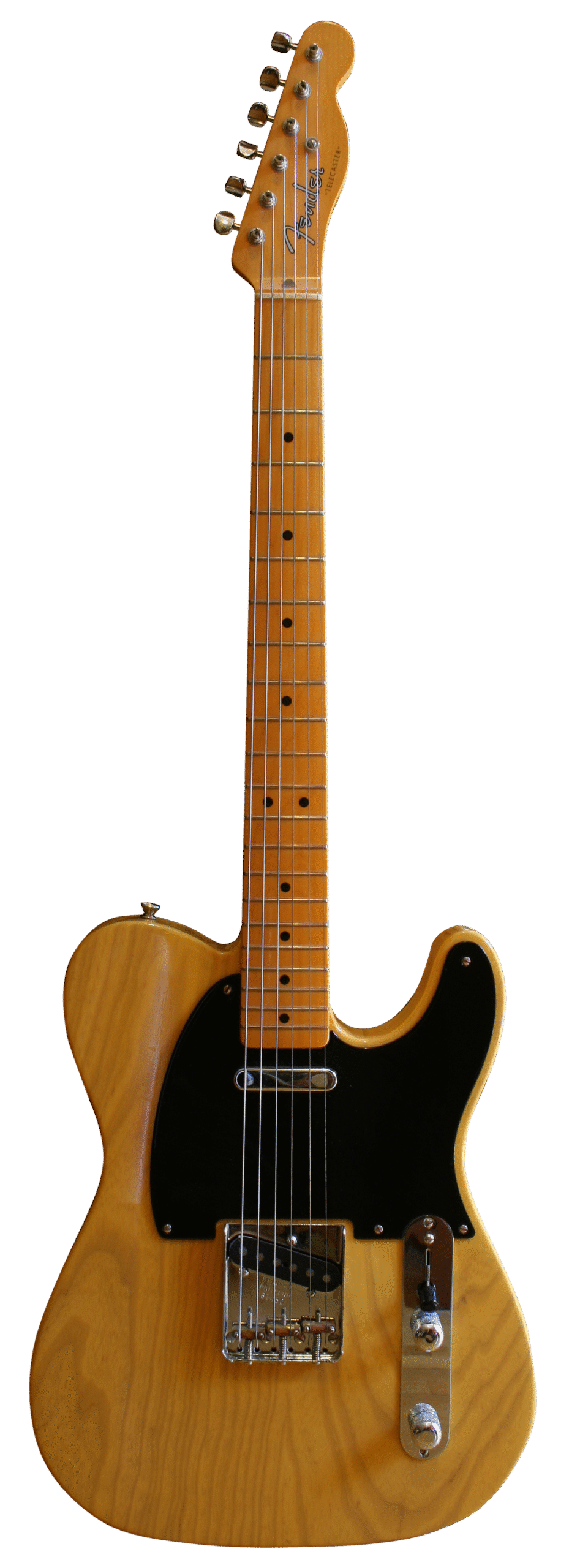
The classic Telecaster has a steel bridge plate, nicknamed the "ashtray", with the strings loaded through the back of the body. Vintage Teles had three saddles, each carrying two strings; many modern Teles, including the Player II, have six. It is simple, stable and easy to set up.
The Stratocaster has a vibrato bridge that pivots against springs in a cavity at the back. (Fender calls it a tremolo, but technically it changes pitch, so it is a vibrato; the name simply stuck.) Older designs use six screws, and most current models, including the Player II and American Professional II, use a two point pivot. It lets you add expressive dips and wobbles, but the moving parts mean string bends can pull the bridge slightly out of tune if it is not set up well, and string changes take a little longer. Fixed bridge ("hardtail") Strats have existed since 1955.
The pickups
The Telecaster has two single coil pickups. The bridge pickup is larger, more heavily wound, slanted and mounted in that metal bridge plate. According to Seymour Duncan, a metal base plate dampens some treble resonance and fattens the tone. In plain language, the plate focuses the bridge pickup, and that is part of the famous Tele bite.
The Stratocaster has three single coils: neck, middle and bridge. A middle pickup was new for electric guitars at the time. Both guitars come in humbucker versions too, such as the HSS Strat (a humbucker at the bridge) and the Telecaster Custom, which added a neck humbucker in 1972.
Switching and controls
The Tele uses a three way switch (bridge, both, neck) with one volume and one tone knob. The Strat has a five way switch:
- Bridge
- Bridge and middle
- Middle
- Middle and neck
- Neck
It also has one volume and two tone knobs. Which pickups those tone knobs control depends on the model and wiring. Early Strats had a three way switch until 1977, when the five way became standard. You cannot select all three pickups at once on a standard Strat.
Myth busted: positions two and four are not "out of phase"
Players first found the in between Strat sounds by balancing the old three way switch between its notches. Those hollow, "quacky" tones in positions two and four are often called out of phase. Fender says that is wrong. The pickups stay electrically in phase; the distinctive sound comes from certain frequencies cancelling because the two pickups sit at different points along the string. On many newer Strats the middle pickup is also reverse wound with reversed polarity, which makes positions two and four hum cancelling as a bonus.
Body contours
The classic Tele is a flat slab with a single cutaway. The Strat has a double cutaway plus a forearm contour on the front edge and a "belly cut" on the back, so it sits more snugly against your body. Its deeper cutaways also make the highest frets easier to reach. Some modern Teles do have contours, so this applies to the classic designs. Weight varies with timber, and both typically land around 7 to 8.5 lb (about 3.2 to 3.9 kg), so neither is reliably lighter.
Stratocaster vs Telecaster: Sound
This is where the telecaster vs stratocaster sound debate really lives. Reviewers at Guitar World, Reverb and Sweetwater describe them like this:
- Strat: glassy, bell like and chimey. The neck pickup is warm and woody, the middle pickup has clarity with a little "honk" (think John Mayer), and positions two and four give the funky quack heard on Mark Knopfler’s "Sultans of Swing".
- Tele: bright, bitey and direct. The bridge pickup is the definition of twang when clean, and Reverb calls it "the definition of rock when dirty". The neck pickup is mellow and warm, especially with the tone rolled back.
With overdrive, the Tele’s hotter bridge pickup pushes a valve amp into a warm break up while keeping its definition. The Strat handles gain well too (Yngwie Malmsteen and Jimi Hendrix are proof), though Guitar World notes its bridge pickup lacks the Tele’s natural oomph. Both have single coil hum, which grows with high gain, so noiseless pickups or a humbucker model are worth a look if you play heavy or use lots of pedals. Your amp shapes all of this, and our guide to understanding tube amps explains why.
Stratocaster vs Telecaster: Feel
The scale length and neck shapes are the same on comparable models, so the difference in feel comes from three things:
- Comfort: the Strat’s contours hug your body; the Tele’s flat edges feel more square, which some players love and others notice.
- Upper frets: the Strat’s double cutaway gives easier access high up the neck.
- The bridge: the Tele’s fixed bridge feels solid under heavy picking, while the Strat’s vibrato responds when you rest your hand on it, which can take a little getting used to.
Our advice: try both seated and standing before you decide.
Stratocaster vs Telecaster: Price
All prices below are in Australian dollars (AUD), include GST, and were checked on 20 October 2026. They are rounded bands covering recommended retail and typical street prices, and they change often, so check current prices before you buy. Readers outside Australia will find the same tiers locally.
| Tier | Approximate price (AUD) |
|---|---|
| Squier Affinity | A$430 to A$530 |
| Squier Classic Vibe | A$680 to A$850 |
| Fender Player II (made in Mexico) | A$1,100 to A$1,350 |
| Fender American Professional II (made in the USA) | A$3,050 to A$3,250 |
| Fender American Ultra II (made in the USA) | about A$4,000 |
| Used Fender Player (made in Mexico) | about A$830 to A$1,000 |
The key point for anyone searching fender stratocaster price australia: the Strat and Tele cost almost exactly the same at each tier. Price should not decide between them. Left handed Player II Strats and Teles are listed at the same A$1,349 recommended retail price as the right handed models.
Strengths and weaknesses
Telecaster strengths
- Simple controls and fewer things to go wrong
- Excellent tuning stability and easy setup
- Bridge pickup bite and twang that cuts through a band
- Clarity under overdrive
Telecaster weaknesses
- The flat body is less comfortable for some players
- No vibrato unless modified
- Fewer tonal shades
- The bridge pickup can sound harsh to some ears
Stratocaster strengths
- Contoured body comfort
- Five pickup positions, including the in between quack sounds
- Beautiful neck pickup cleans
- Vibrato for expressive playing
- Easier upper fret access
Stratocaster weaknesses
- The vibrato can detune if it is not set up well
- Slower string changes
- Bridge pickup less punchy than a Tele’s
- More complex electronics
Genres and famous players
Guitar World points out that most famous guitarists have played both, so think of these as associations rather than rules.
Telecaster players
The Tele is closely tied to country. James Burton played one on Ricky Nelson’s TV appearances, Brad Paisley’s main guitar is a 1968 Paisley Red Tele, and Nashville session player Brent Mason is known for his twang. Our post on country music and the guitar shows how those styles are played.
It is a blues and rock machine too. Muddy Waters played a red 1957 Tele, and Albert Collins was known as the "Master of the Telecaster". Keith Richards plays a 1953 Tele called "Micawber" with five strings in open G, Jimmy Page used a 1959 Tele on Led Zeppelin’s first album and the "Stairway to Heaven" solo, Joe Strummer of The Clash played a black Tele, and Bruce Springsteen’s Born to Run cover guitar is an Esquire and Telecaster hybrid. Jonny Greenwood of Radiohead and Julien Baker keep it current in indie music.
Stratocaster players
The Strat is the classic blues and rock guitar. Jimi Hendrix is credited with reviving it in the late 1960s, Eric Clapton played his Strats "Brownie" and "Blackie", David Gilmour’s Black Strat is behind "Comfortably Numb", and Stevie Ray Vaughan, Buddy Guy and Rory Gallagher made it a blues icon. You can read more about that tradition in our history of blues guitar. Beyond blues, Dick Dale used a Strat for surf rock, Nile Rodgers for funk, and Yngwie Malmsteen and Iron Maiden’s Dave Murray for metal. Curious what strings these players use? See our guide to famous guitarists’ string gauges.
Australian examples
Kevin Parker of Tame Impala used a Strat on early Tame Impala recordings, according to Mixdown. Courtney Barnett has played Teles, including an American Standard Tele as a touring guitar. Keith Urban, who grew up in Australia, regularly plays a battered 1989 40th Anniversary Tele nicknamed "Clarence".
Where the lines blur
Jim Root of Slipknot plays a Tele with active humbuckers and has signature Strats as well, and HSS Strats are common in hard rock. Either guitar can cover almost any genre with the right pickups.
Stratocaster or Telecaster: which one is for you?
- The keep it simple beginner: a Telecaster, such as a Squier Classic Vibe or a used Player. A fixed bridge and simple controls mean fewer things to go wrong.
- The versatile all rounder: a Stratocaster, such as a Player II or Player II HSS. Five positions, comfortable contours and a vibrato suit blues, pop, funk and more.
- The country, indie or punk player who wants to cut through: a Telecaster. Bridge twang, punch and rugged simplicity.
- The heavier rock player on a budget: a Player II Stratocaster HSS or a humbucker equipped Tele. Purpose built hard rock guitars exist, but these are the best Fender family options.
FAQ
What is the difference between Stratocaster and Telecaster?
The Strat has three pickups, a five way switch, a vibrato bridge and a contoured double cutaway body. The Tele has two pickups, a three way switch, a fixed bridge and a flat single cutaway body. They share the same scale length and similar necks.
Is a Telecaster easier to play?
Not in the fretting hand: the scale length and neck shapes are the same on comparable models. The Tele is simpler to operate and stays in tune easily, while the Strat is often more comfortable to hold and easier to reach high frets on. Try both and see which feels natural.
Which is better for beginners?
Neither is clearly better. The Strat is the usual first choice, but Guitar World argues the Tele suits newcomers because of its simple electronics. If you want simplicity, pick a Tele; if you want variety and comfort, pick a Strat. Both make excellent first guitars when they are properly set up.
Is a Strat or a Tele more expensive?
At each tier they cost about the same, so let sound and feel decide.
Can a Telecaster play rock or metal?
Yes. Keith Richards, Jimmy Page and Joe Strummer all used Teles, and humbucker Teles such as Jim Root’s signature model handle metal.
Download the free Quick Pick PDF
Ready to make it sound like music?
Whichever side of the Stratocaster vs Telecaster choice you land on, the real fun starts when you play your first song. If you would like a friendly, structured place to begin, our online course might suit you.
In Darwin? You are welcome to book a free guitar lesson at the workshop.