

Learning guitar after 50 is absolutely possible, and this guide gives you an honest picture of what the first year really looks like: what gets easier, what takes patience, and how to set yourself up so your hands and joints stay comfortable.
We teach plenty of adults who pick up a guitar for the first time in their fifties, sixties and beyond. Some had a guitar under the bed for decades. Others always wanted to play and finally have the time. This post will not promise you will be shredding in a month. It will show you a realistic path.
Quick answer
It is not too late. Small studies of adults over 60 learning an instrument found people could make real progress and reported wellbeing benefits. Expect steady rather than fast progress, use a comfortable guitar with light strings and a low action, practise in short daily sessions, and listen to your hands. Most adults can play several simple songs within a year of regular practice (a teacher estimate, not a guarantee).

Is it too late? What the research says about learning guitar after 50
There is not much research on guitar specifically, but there are studies of older adults taking up the piano, which is a fair comparison for learning a new instrument from scratch. In a randomised study by Bugos and colleagues (2007), 31 adults aged 60 to 85 with no musical background were split into groups. Those who had six months of individual piano lessons improved on some attention and processing speed tests compared with the group who did not, although not all gains held at a three month follow up.
A second study by Seinfeld and colleagues (2013) gave four months of piano lessons to people aged 60 to 84. The piano group improved on an attention task and reported better mood and quality of life than a comparison group doing other leisure activities. The study was small and not randomised, and several people dropped out, partly because of practice time.
Our honest reading: these studies do not prove music keeps your brain young, and the samples were small. They do show that people well past 50 can start an instrument from zero, make progress and enjoy it. That is the part that matters for you.
What changes when learning guitar after 50, and what does not
Some things may be a bit different. Fingertips can take longer to toughen up, joints may be stiffer in the morning, and close up eyesight can make chord charts harder to read. Fine finger independence may also feel slower to build at first. None of these stop you; they just shape how you practise.
Plenty does not change. You still learn by repetition, you still improve with regular practice, and you probably bring advantages a teenager lacks: patience, a clear reason for playing, a lifetime of listening to music and the discipline to show up. In our teaching experience, those habits matter more than age.
Comfortable guitar and setup
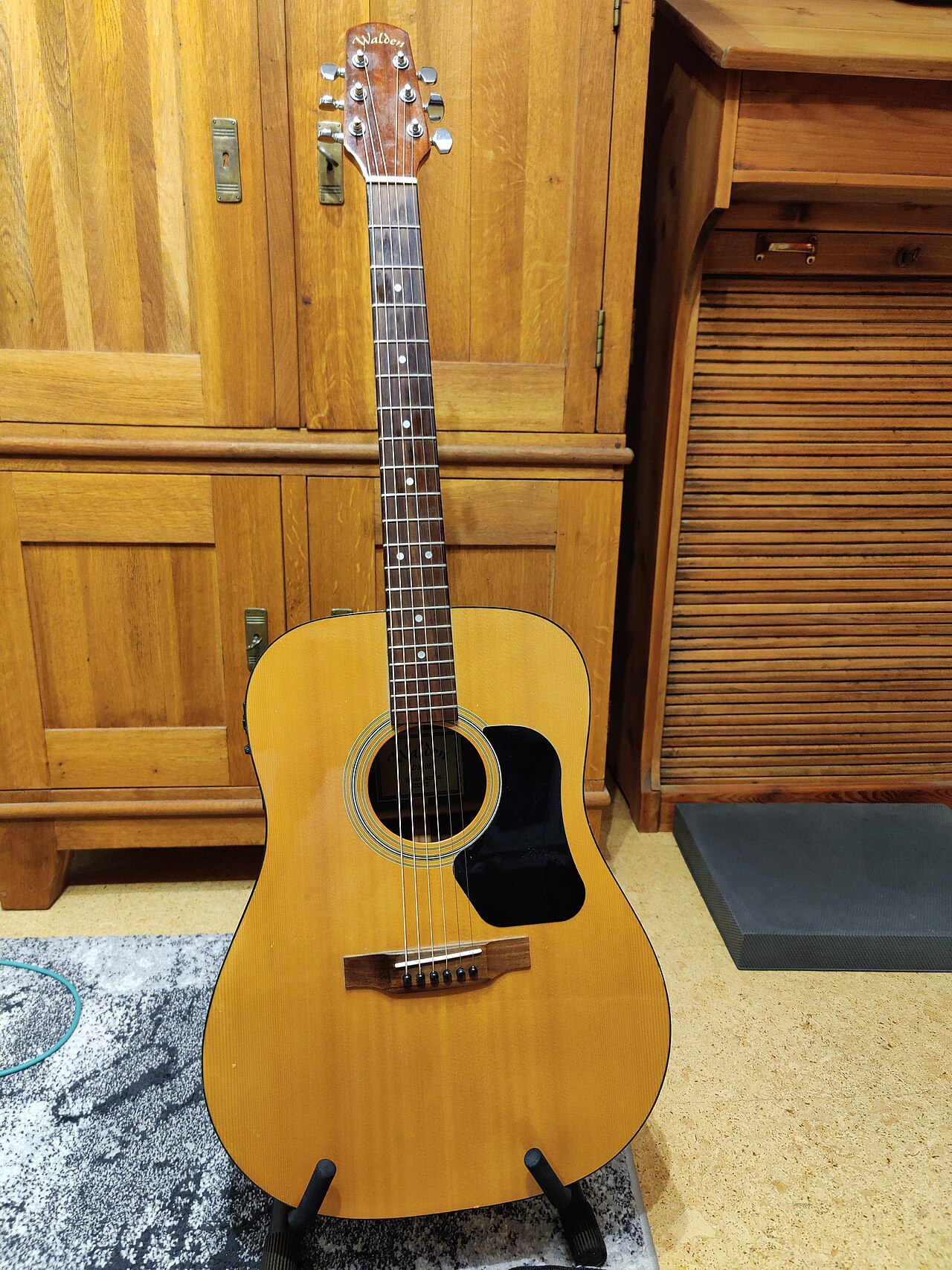
When learning guitar after 50, the single biggest comfort upgrade is a good setup. Ask a guitar shop for a professional setup with a low action (string height), so you need less pressure to fret notes. Lighter gauge strings help too. Many older beginners also find a smaller bodied or short scale guitar kinder on the shoulders, and an electric guitar is often easier on the fingers than a steel string acoustic.
| Option | Comfort benefit | Trade off |
|---|---|---|
| Electric guitar, light strings | Easiest to press; thin neck | Needs an amp or headphones |
| Nylon string classical | Soft on fingertips | Wide neck can stretch the hand |
| Small body steel string acoustic | Easier reach, no amp needed | Firmer strings; setup matters most |
Sit in a chair without arms, keep your shoulders relaxed and consider a footstool or a strap so you are not hunched over. Reading glasses set for arm’s length, or a large print chord chart on a stand, can save a lot of squinting.
A short session practice plan
For learning guitar after 50, short, regular sessions beat long, rare ones, especially for your hands. Fifteen to twenty minutes on most days is a sensible starting point in our view. Interestingly, in the Seinfeld study, participants were asked to practise 45 minutes a day but averaged about 21. Real life gets in the way, and that is fine.
A simple shape for each session: two minutes of warm up and tuning, a few minutes of chord changes, most of the time on one song, and a couple of minutes playing just for fun. The free plan below has this template ready to print.
If you want a guide to realistic timelines, see how long it takes to learn guitar, and when you are ready to tackle a full song, our guide on how to learn a song on guitar breaks it into steps.
Hands, joints and guitar with arthritis
This is general information, not medical advice. If you have arthritis or any hand, wrist or shoulder condition, talk to your GP, physiotherapist or hand therapist before you start, and ask what is safe for you. Arthritis Australia has reliable general information about living with arthritis.
Many people with arthritis do play. Things that commonly help include warming your hands first, light strings and a low action, avoiding a death grip on the neck, simpler chord shapes, and stopping before pain builds. Gentle movement can help, and our post on stretches and hand exercises for guitar players has ideas to discuss with your health professional.
Some fingertip soreness in the first weeks is normal; see sore fingertips from guitar. Sharp pain, swelling, numbness or pain that lasts after you stop is not normal. Read guitar injuries and how to prevent them and get it checked.
Songs that suit older beginners
When learning guitar after 50, choose songs you love, then check they use a few open chords and a steady tempo. Folk, country, early rock and roll and many singer songwriter songs fit well. A capo lets you move a song into a key that suits your voice while keeping easy shapes. Playing along with a backing track also helps your timing; our guide to practising guitar with drum loops explains how.
Teacher or self taught?
Both work. Self teaching is cheap and flexible, but it is easy to build tense habits that later hurt your hands. A teacher, even for a handful of lessons, can check your posture and grip early and keep you motivated. In our experience older beginners often enjoy the structure and accountability.
A middle path is a structured course you can follow at your own pace. Our online beginner course starts from holding the guitar and builds up gently, so you can pause and repeat any lesson as often as you like.
Free first year plan
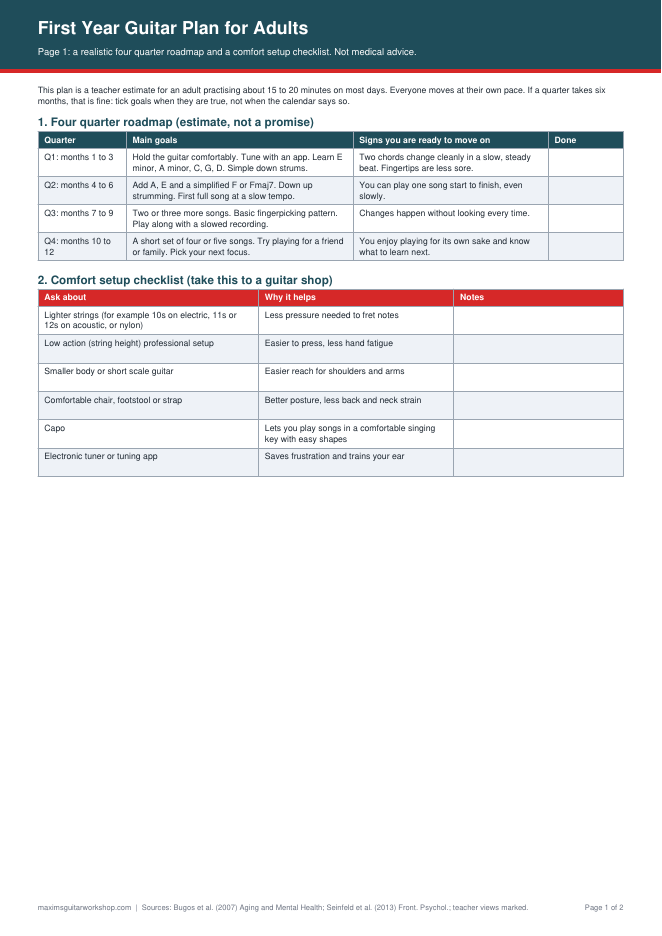
Our printable First Year Guitar Plan for Adults covers learning guitar after 50 step by step: a four quarter roadmap with realistic goals, a comfort setup checklist to take to a guitar shop, a 15 minute session template and a joint comfort log to rate your hands before and after practice.
Download the free First Year Guitar Plan for Adults (PDF)
Playing also has broader benefits; see our post on the health benefits of playing guitar, which treats the evidence with the same caution.
FAQ
Is learning guitar at 50 harder than learning as a child?
Some parts may be, such as building fingertip calluses and finger independence. Adults usually have more patience, focus and musical knowledge. Learning guitar after 50 is mostly a matter of regular, comfortable practice rather than talent.
How long until I can play a song?
It varies widely. As a teacher estimate, many adults practising most days can play a simple two or three chord song slowly within the first few months. Some take longer, and that is fine.
Can I play guitar with arthritis?
Many people do, with adjustments such as light strings, a low action and short sessions. Check with your GP or physiotherapist first, as this article is not medical advice.
Is it too late to learn guitar at 60 or 70?
No. The research above involved adults up to 85 starting from zero. The best time for learning guitar after 50, 60 or 70 is when you have the time and the wish to play.
Acoustic or electric for an older beginner?
An electric with light strings is usually the easiest on the fingers. If you prefer acoustic, get a smaller body and a professional setup.
Image credits
Senior couple playing guitar in a wooden house by Shixart1985, Wikimedia Commons, CC BY 2.0. Walden acoustic guitar by Elmschrat, Wikimedia Commons, CC BY SA 4.0. Plan preview by Maxim’s Guitar Workshop.