Most bands do not run out of talent; they run out of rehearsal time. Two hours disappear into setting up, chatting, playing the songs everyone already knows, and one long argument about the bridge. Learning how to run a band rehearsal with a simple plan fixes that. This guide gives you a two hour shape, a song status board the whole band can see, and a list of tasks to take home, plus a free printable planner.
Quick answer
Agree one person to lead, bring a written song list, and give every song a status: learning, rough, tight or gig ready. Then split two hours into setup (15 min), a warm up song (10), fixing weak sections (25), a break (10), one new song (20), a full set run (30) and wrap up with tasks for next week (10). Spend your time on the songs that need it, not the ones you already love playing.
How to run a band rehearsal (the two hour shape)
The trick to how to run a band rehearsal well is deciding what each block of time is for before anyone plugs in. Here is the band rehearsal plan we suggest for a two hour session. Treat the minutes as a starting point and adjust them to your songs.
| Time | Block | What happens |
| 0:00 (15 min) | Setup and line check | Tune, set levels, check that the vocals can be heard over the band. |
| 0:15 (10 min) | Warm up | One gig ready song, played as if it were the first song of a gig. |
| 0:25 (25 min) | Fix weak sections | Only the bars that went wrong last week, slowly, then back in the song. |
| 0:50 (10 min) | Break | Water and a rest for your ears. |
| 1:00 (20 min) | New song | Agree the key and the form, then play it through slowly. |
| 1:20 (30 min) | Full set run | Tight and gig ready songs in gig order, without stopping, recorded on a phone. |
| 1:50 (10 min) | Wrap up and tasks | Update the status board and agree what each person works on before next week. |
The order matters. Fixing problems comes early, while everyone is fresh. The full run comes late, because a gig happens when you are a bit tired too.
Before you start: roles, a song list, and a status board
Ten minutes of preparation during the week is the cheapest part of how to run a band rehearsal. Three things make the biggest difference.
Pick a leader for the session. It does not have to be the singer or the best player, just one person who keeps time on the plan and calls the next block. Elaine King observed student wind, saxophone and string quartets over four weeks of rehearsals. Groups with a regular leader had more stable roles, stayed more focused and made better progress than groups without one (King, 2006). It was a small observation study of student quartets, not rock bands, but it matches what we see in our own student bands.
Share a song list before the day. Everyone should know which songs are on the plan, in which key, and at what tempo. If a song is new, each player learns their part at home first. Our guide on how to learn a song on guitar covers how to do that quickly, and the band rehearsal should not be where anyone learns the chords for the first time.
Keep a status board. A whiteboard, a shared note or the printable board below works. Every song gets one of four labels:
- Learning: the band has not played it all the way through yet.
- Rough: you can get through it, but some sections fall apart.
- Tight: the whole band plays it start to finish without stopping, with agreed starts and endings.
- Gig ready: tight three runs in a row, at gig tempo, standing up, and you could open a gig with it cold.
The board stops the most common time waster: playing the songs everyone already enjoys while the rough ones stay rough. Once you know how many songs sit in each column, the planner below turns them into a timed session.
Rehearsal time planner
Count your songs on the status board, enter them below, and get a timed plan for the session. Learning songs get the most time, then rough songs, then tight songs. Tight and gig ready songs make up the full set run.
The session itself: setup, warm up, weak sections, new song, full run
Here is how to run a band rehearsal block by block once everyone is in the room.
Setup and line check. Arrive ready to play, with your gear in working order. Tune to one tuner, set the drums first, then bass, guitars and keys, and finally the vocals. If you cannot hear the singer, everyone else turns down; the vocal should not be pushed up to fight the band.
Warm up. Play one gig ready song exactly as you would open a gig: count in, play it through, stop cleanly. It warms up hands and ears, and it tells you straight away whether anyone is out of tune.
Fix weak sections. This is where a rehearsal earns its time. Go straight to the bars that went wrong, not the top of the song. Play the section slowly, then at tempo, then from a few bars before it so the band practises getting into it. Practising to a drum loop at home helps here, and our guide to practise guitar with drum loops shows how to build up the tempo.
Agree on cues. When Jane Ginsborg, Roger Chaffin and George Nicholson studied a singer and a pianist/conductor preparing a performance together, the musicians picked out landmarks in the music during their own practice, then turned some of them into shared performance cues in joint rehearsals (Ginsborg, Chaffin and Nicholson, 2006). For a band, that means naming the landmarks out loud: “drum fill into the last chorus”, “everyone stops on the one”, “guitar solo is two rounds of the verse”.
Break. Take it, even when things are going well. Rehearsal rooms are loud, and the World Health Organization advises earplugs in noisy places and regular breaks from loud sound to protect your hearing (WHO safe listening). Musician earplugs are worth it for every member of the band.
New song. One new song per rehearsal is plenty for most bands. Agree the key, the form and the count in first, write the form on the board (verse, chorus, verse, chorus, solo, chorus), then play it slowly from top to bottom without stopping, even if it is messy. That gets it from learning to rough.
Full set run. Play the tight and gig ready songs in gig order without stopping. If someone makes a mistake, keep going, as you would on stage. Record it on a phone, because what you hear back is often different from what you felt in the room.
Making songs gig ready (what “tight” actually means)
A gig ready rehearsal is not about playing a song perfectly once. In our 20 years of teaching and playing, the bands that sound tight are the ones that agree on the small things. Getting these details right is the part of how to run a band rehearsal that most bands skip. Before you mark a song tight, check that everyone agrees on:
- The start: who counts in, at what tempo, and whether it starts on a drum beat, a riff or a chord.
- The tempo: write the bpm next to the song, and check it on a phone metronome before you count in.
- The form: how many times through each section, and where the solo goes.
- The transitions: who signals the change into each section, and how.
- The dynamics: which parts are quiet and which are loud.
- The ending: a clear final hit, a fade or a ring out, and who calls it.
Move a song to gig ready only after three clean runs in a row, ideally across two rehearsals. If you have a gig coming, our guide on how to prepare for your first gig covers the set list, gear, soundcheck and nerves for the night itself. Want a low pressure first outing? Our open mic tips for guitarists show how to test new songs on a real stage.
Tasks for next week
The last part of how to run a band rehearsal happens after the music stops. A rehearsal that ends with “good one, see you next week” wastes the week in between. Spend the last ten minutes on the board. Move songs between columns honestly, then give each person one to three specific tasks, for example “bass: learn the bridge of song four at 90 bpm” or “vocals: write out the lyrics for the new song”.
Share the phone recording of the full run in your group chat, and ask everyone to note one thing they heard. For players working on their own song lists, our repertoire tracker in how to memorise songs on guitar keeps personal practice on track between rehearsals.
The free planner has a two hour band rehearsal plan with space for the songs you will work on, roles for the session, a song status board for up to 14 songs, and a tasks table for next week.
Download the free Band Rehearsal Planner (PDF)
FAQ
How long should a band rehearsal be?
Two hours suits most bands: long enough for a setup, focused work and a full run, short enough to stay fresh. With an hour, skip the break and the new song and keep the full run. For three hours, add a second break.
How often should a band rehearse?
Once a week works well for most bands, with each player practising their parts at home in between. Add extra sessions in the weeks before a gig rather than making every session longer.
Who should run the band rehearsal?
Anyone who is organised and fair; how to run a band rehearsal is a skill any member can learn. The leader keeps to the plan and calls the next block; it is not a licence to make every musical decision. Some bands rotate the job each week.
What if one member never practises at home?
Raise it early and kindly, using the board rather than blame: “this song has been rough for three weeks, what would help?” Clear tasks with a song, a section and a tempo are easier to finish than “practise more”.
How many songs should we work on in one rehearsal?
Fewer than you think. One new song and two or three rough ones is plenty for two hours, plus a full run of the songs that are already tight. The planner above shows when you are trying to fit in too much.
Bring a plan and the songs will follow
Knowing how to run a band rehearsal comes down to three things: a plan for the time, an honest status board, and tasks for the week in between. Print the planner, try the two hour shape for a month, and watch songs move across the board. When the bookings start, our guide on how much to charge for a gig will help you price them.
If you are still building the chords and rhythm skills to play in a band, our online beginner course takes you through them at your own pace.
Sources
- King, E. (2006). The roles of student musicians in quartet rehearsals. Psychology of Music, 34(2), 262 to 282. DOI link
- Ginsborg, J., Chaffin, R. and Nicholson, G. (2006). Shared performance cues in singing and conducting: a content analysis of talk during practice. Psychology of Music, 34(2), 167 to 194. DOI link
- World Health Organization. Deafness and hearing loss: safe listening (questions and answers). WHO
Image credits
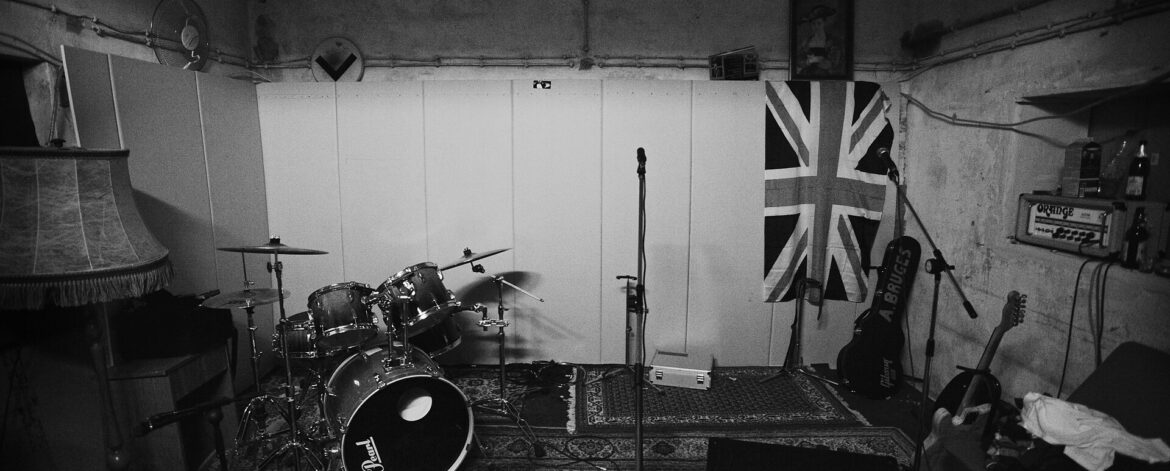
Music practice room 1, air raid shelter, Stuttgart, 2013, photo by Gerold Schneider, Wikimedia Commons, CC BY 2.0. Planner preview by Maxim’s Guitar Workshop.