
Shawn Lane technique is famous for one thing above all: astonishing legato speed that still sounded musical. The Memphis guitarist, pianist and composer played with a flowing, almost liquid style, built from groups of notes rather than single notes, and he did it while fighting a painful illness for most of his life. This post covers his story, how his playing worked, six original legato exercises, a safe tempo ladder for building speed, and a free printable worksheet.
Quick answer: what is Shawn Lane technique? Mostly legato: hammer ons and pull offs carry the notes while the pick, or a finger of the picking hand, adds accents. He thought in groups of four, five, six or seven notes, moved symmetric shapes up the neck and kept the picking hand relaxed. For students, the lesson is to practise small groups slowly and raise the tempo only when every note is clean.
Who was Shawn Lane?
Shawn Lane was born in Memphis, Tennessee, on 21 March 1963. He started on piano at eight with his sisters and took up the guitar seriously at about ten. By his early teens he was practising for hours a day, and at 14 he was the lead guitarist in the Southern rock band Black Oak Arkansas.
At 15 he saw Allan Holdsworth play with the band U.K., and it changed his idea of what a guitar could do. Holdsworth’s smooth legato lines became a lasting influence. Lane also loved pianists such as Liszt, Art Tatum and Georges Cziffra, and the Pakistani singer Nusrat Fateh Ali Khan, so his music always reached well beyond rock guitar.
His debut album, Powers of Ten, came out on Warner Bros. in 1992. He played almost every instrument on it, and Guitar Player readers voted him Best New Talent. The live album Powers of Ten Live! followed in 1993, and his second studio album, The Tri Tone Fascination, came out on Eye Reckon Records in 1999.
Much of his later work was with the Swedish bassist Jonas Hellborg, in trios with drummers such as Jeff Sipe and Anders Johansson and in Indian fusion projects with V. Selvaganesh. Their improvised records are some of the best places to hear him stretch out. The Guitar World profile of Shawn Lane tells the full story of his life and music.
He lived with psoriasis all his life, and worsening psoriatic arthritis made his last years very hard. Long treatment with cortisone also caused other health problems. He died of lung related illness in Memphis on 26 September 2003, aged 40.
Shawn Lane technique explained
The key idea is that he did not think one note at a time. A bandmate said he would think in combinations, not notes. A group of four, five or seven notes was one gesture, like a word rather than a string of letters. He described his fretting hand as moving through geometric shapes while the picking hand worked almost without conscious thought.
Most notes in his lines were played legato. One picked note starts each group and the hammer ons and pull offs do the rest. The pick, or sometimes the middle finger of the picking hand, adds accents. This is why his fast lines sound smooth and connected rather than hard and percussive.
Mixing group sizes was his secret weapon. Play a group of four and then a group of seven, and the accents land in different places against the beat. The line seems to tumble forward. He also loved symmetric patterns built from repeating intervals, such as major thirds and minor thirds, because the same finger shape can move up the neck and sound strange and exciting.
Finally, he used wide intervals and big stretches, and his guitars were set up with very low action and a flat fingerboard. You do not need his setup, but a good setup helps legato enormously. If your action is high, a technician can lower it in a few minutes and make every exercise below easier.
Lesson 1: three notes per string
This is the foundation of Shawn Lane legato. Using the A minor scale, pick only the first note on each string and hammer on the next two. Then come back down, picking the first note on each string and pulling off the rest. The count is in triplets: “1 trip let, 2 trip let”.
      1   t   l   2   t   l   3   t   l   4   t   l
e  |......................................7...h8..h10.|
B  |..........................6...h8..h10.............|
G  |..............5...h7..h9..........................|
D  |..5...h7..h9......................................|
      >           >           >           >
      1   t   l   2   t   l   3   t   l   4   t   l
e  |..10..p8..p7......................................|
B  |..............10..p8..p6..........................|
G  |..........................9...p7..p5..............|
D  |......................................9...p7..p5..|
      >           >           >           >
The accent mark shows the picked note. Keep the hammer ons strong enough that they sound as loud as the picked notes. If the hammered notes disappear, slow down and press closer to the fret wire.
Lesson 2: groups of four on one string
Now play a four note group on the top string: pick fret 5, hammer to 7 and 8, then pull off to 7. Repeat it in sixteenth notes and accent the first note of every group. Staying on one string lets you focus on evenness without worrying about string changes.
      1   e   &   a   2   e   &   a   3   e   &   a   4   e   &   a
e  |..5...h7..h8..p7..5...h7..h8..p7..5...h7..h8..p7..5...h7..h8..p7..|
B  |..................................................................|
      >               >               >               >
If you know my easiest chromatic guitar exercise, this will feel familiar: the goal is the same relaxed, even motion, just with scale notes instead of every fret.
Lesson 3: mixing groups of four, seven and five
This exercise uses the same notes as Lesson 2 but phrases them in groups of four, seven and five. That still adds up to sixteen notes, so the bar fits, but the accents fall in unexpected places. This is the “falling down the stairs” feeling you hear in many Shawn Lane licks.
      1   e   &   a   2   e   &   a   3   e   &   a   4   e   &   a
e  |..5...h7..h8..p7..5...h7..h8..p7..p5..........5...h7..h8..p7..p5..|
B  |......................................8...p6......................|
      4               7                           5
Say the group sizes out loud as you play: “four, seven, five”. It feels odd at first because the accents do not line up with the beat. If you want to understand why this works, read my posts on polyrhythm and polymeter and understanding triplets in music.
Lesson 4: symmetric shapes
Here a three note shape made of major thirds moves up the B string one fret at a time and back. Because every interval is the same, the shape never changes, only its position. It sounds outside the key in a way that is very typical of Shawn Lane technique.
      1   t   l   2   t   l   3   t   l   4   t   l
e  |..................................................|
B  |..3...h7..h11.4...h8..h12.5...h9..h13.4...h8..h12.|
G  |..................................................|
      major thirds
The next one does the same with minor thirds on the G string. These stretches are wide, so warm up first and stop if your hand aches.
      1   t   l   2   t   l   3   t   l   4   t   l
B  |..................................................|
G  |..2...h5..h8..3...h6..h9..4...h7..h10.3...h6..h9..|
D  |..................................................|
      minor thirds
Lesson 5: hybrid accents
In this one the pick (P) starts a group on the G string, two hammer ons follow, and then the middle finger of the picking hand (m) plucks a note on the B string. Four notes fit in each triplet beat group, so the accents shift again. It is a great way to add bite to a legato line without picking every note.
      1   t   l   2   t   l   3   t   l   4   t   l
e  |..................................................|
B  |..............8...............10..............6...|
G  |..5...h7..h9......5...h7..h9......4...h5..h7......|
      P           m   P           m   P           m
How to play fast legato safely: the guitar tempo ladder
The fastest way to learn how to play fast legato is, oddly, to practise slowly and climb in small steps. A tempo ladder makes that simple. Each rung is a metronome tempo. You only climb to the next rung when you have played the exercise cleanly three times in a row.
- Find the tempo where the exercise is clean and relaxed. That is rung one.
- Play it three times cleanly, then raise the metronome by 4 bpm.
- If your hand tightens or notes go missing, drop back 8 bpm and climb again.
- At each rung, play eighth notes, then triplets, then sixteenths.
- Write your best clean tempo on the worksheet every day.
This guitar tempo ladder works for every exercise in this post and for almost anything else you practise. For a full weekly plan, see my guitar practice routine for rock and metal.
Look after your hands
Given what Shawn Lane went through, it would be wrong to write about speed without talking about health. Warm up for five minutes, practise in blocks of about twenty minutes and rest in between. Stop at any pain, not just discomfort. These stretches and hand exercises for guitar players are a good start, and my guide to guitar injuries and how to prevent them explains the warning signs.
Relaxation is also a speed skill. Tension is the main thing that stops legato getting faster. If your shoulders rise or your thumb squeezes the neck, the ladder tells you to drop back. Good Shawn Lane technique always looks easy, and that ease is something you practise.
Common mistakes when learning his style
The first mistake is chasing speed before evenness. If some notes in a group are louder than others, a faster tempo only makes the problem bigger. Record yourself at a slow tempo and listen back; uneven legato is easy to hear on a recording and easy to miss while playing.
The second is squeezing. Legato needs firm, quick fingers, not a crushing grip. Press only as hard as you need for a clear note. The third is ignoring the other strings: unwanted strings ring when you hammer, so rest the side of your picking hand lightly on the lower strings and let your fretting fingers touch the higher ones.
The last mistake is practising only the fast part. Shawn Lane technique sounded musical because the groups were part of real phrases. Once an exercise is comfortable, make up a short phrase that starts slowly, bursts into one fast group and lands on a long, held note with vibrato.
Download the worksheet
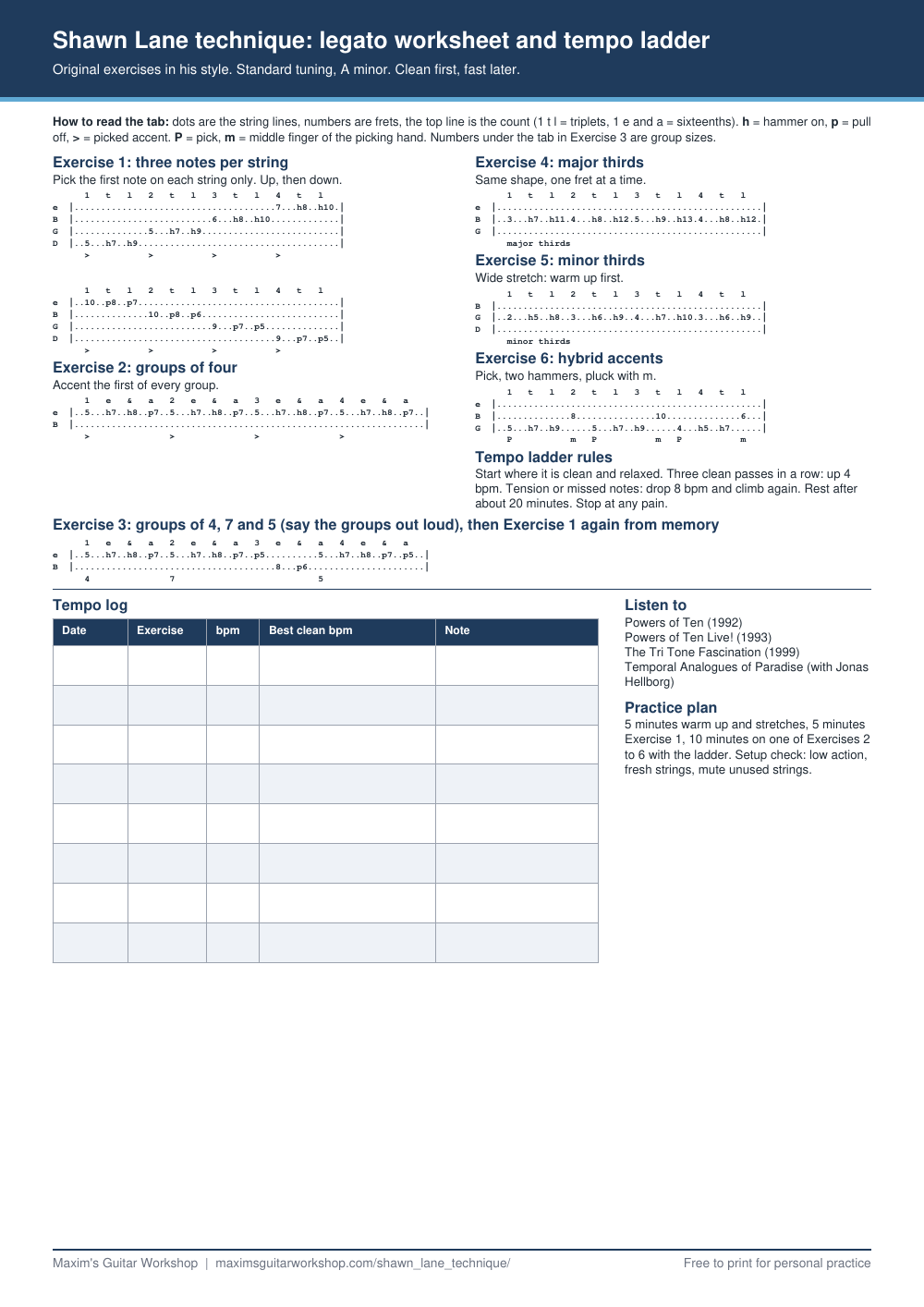
The free worksheet puts all six exercises, the tempo ladder rules, a log for your best clean tempo, a setup checklist and a short listening list on one A4 page. Print it, keep it next to your metronome, and fill in one line each day.
Download the free Shawn Lane technique worksheet (PDF)
Essential listening
- Powers of Ten (1992): his debut, with guitar, piano and almost everything else played by him.
- Powers of Ten Live! (1993): the band versions, looser and wilder.
- The Tri Tone Fascination (1999): his second studio album.
- Temporal Analogues of Paradise, with Jonas Hellborg and Jeff Sipe: improvised trio playing.
- His Indian fusion recordings with Hellborg and V. Selvaganesh.
For a deep look at how he made his first album, read the complete Powers of Ten interview by Jas Obrecht, who interviewed him for Guitar Player magazine in 1992. Hearing him talk about the powers of ten Shawn Lane sessions in his own words is a lesson in itself.
Shawn Lane FAQ
What guitar did Shawn Lane play?
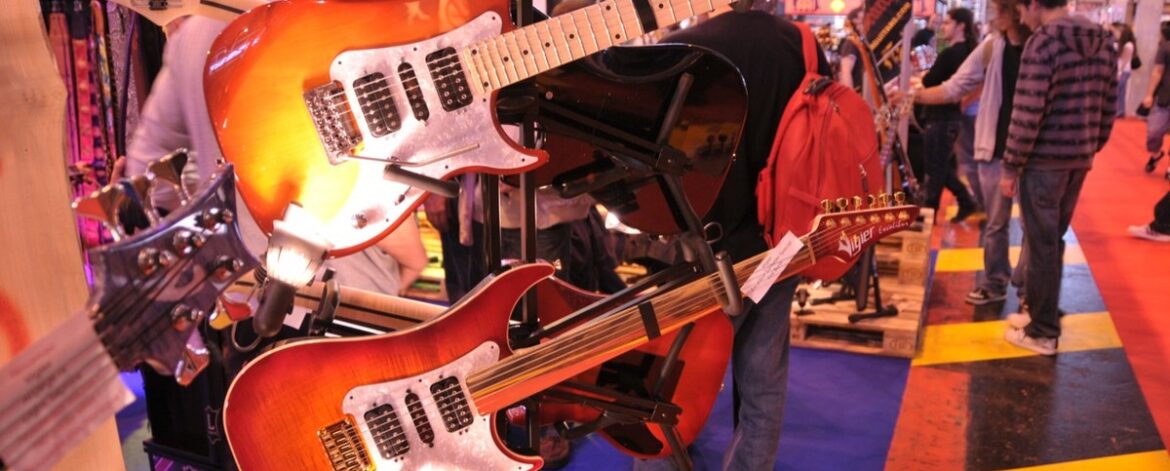
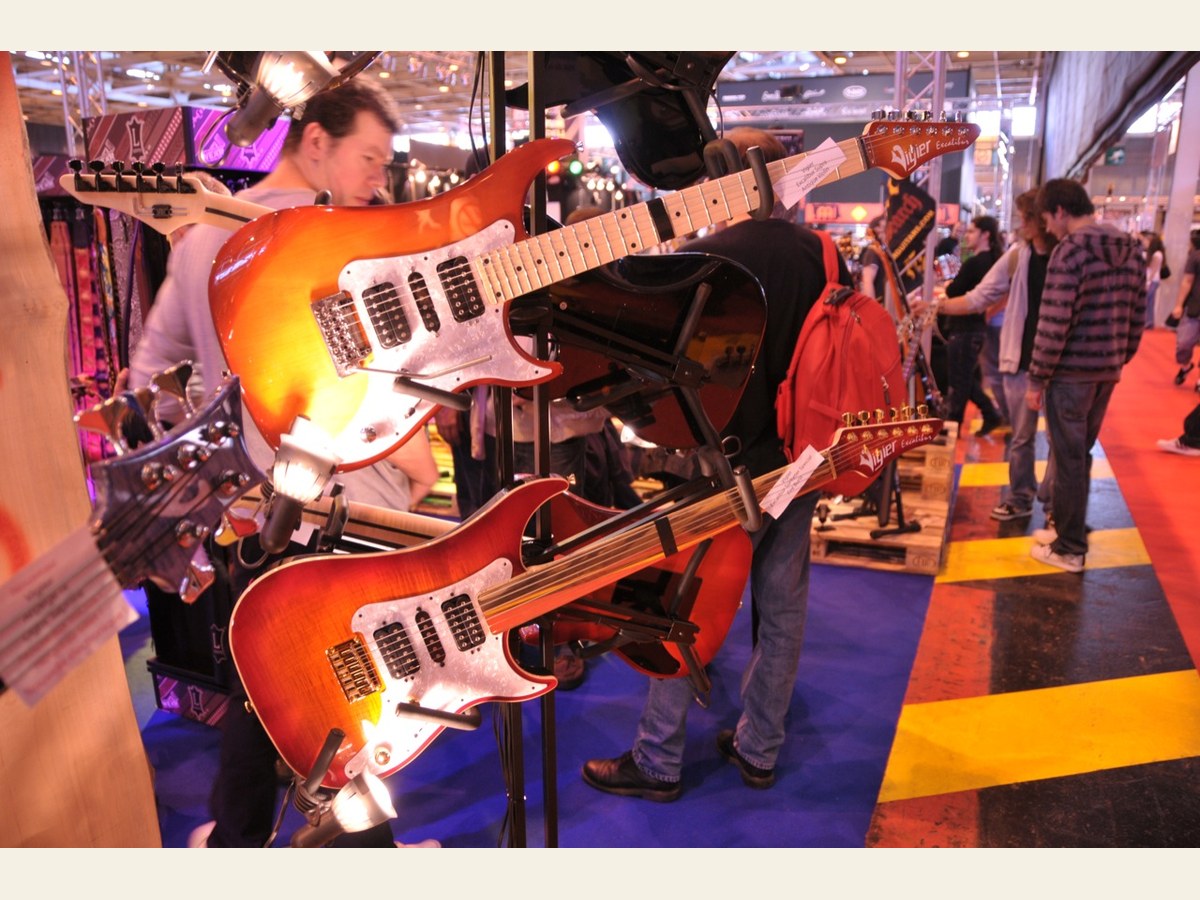
He was best known for playing a Vigier Excalibur, set up with a flat fingerboard and very low action to suit his legato style.
Was Shawn Lane self taught?
Largely, yes. He studied piano as a child but developed his guitar playing mostly through his own practice and listening.
Is Shawn Lane technique legato or picking?
Both, but legato does most of the work. He used picked and plucked accents to start groups and hammer ons and pull offs for the rest.
How old was Shawn Lane when he died?
He was 40. He died in Memphis on 26 September 2003.
How long does it take to build legato speed?
It depends on your starting point, but steady daily practice with a tempo ladder usually shows clear progress within a few weeks. Go for clean, not fast.
Who influenced Shawn Lane?
Allan Holdsworth was the big guitar influence, along with pianists such as Liszt and Art Tatum and the singer Nusrat Fateh Ali Khan.
Shawn Lane’s legacy
Shawn Lane never became a household name, but among guitarists he is a legend. Players who watch his videos for the first time often cannot believe what they are hearing, and many modern fusion and progressive players name him as an influence. If you like technical players, you might also enjoy my lesson on Paul Gilbert guitar techniques and my overview of rock guitar techniques today.
For guitarists today, Shawn Lane technique is a reminder that speed is really a by product of clear thinking: small groups, relaxed hands and patient practice. Climb the ladder one rung at a time and the speed will come. For speed with a much heavier edge, see our lesson on Chuck Schuldiner riffs.
If you are still near the start of your guitar journey, my online beginner course builds the basics that make exercises like these possible.