

How to write a metal riff comes down to three choices: a scale with a dark sound, a rhythm cell that drives, and a pedal note you keep coming back to. This guide walks you through each step with original example riffs written by us, then shows you how to turn one 2 bar idea into four variations. There is a free Metal Riff Builder worksheet at the end so you can repeat the process every session.
Quick answer
Choose a heavy scale such as Phrygian or harmonic minor, pick a one beat rhythm cell like the gallop, and use the open low string as a pedal note between your melody notes. Write two bars, then vary bar 2 by displacing, adding an octave, a chromatic pass or a rest. Record it over a drum loop and keep the version you can still hum the next day.

What makes a riff metal
Most metal riffs share three ingredients. The first is a pedal tone: a low note, often the open bottom string, that you return to between other notes. The idea is far older than metal; composers have used a pedal point for centuries. The second is a rhythm cell, a short repeating pattern that gives the riff its drive. The third is tuning and tone: low tunings, palm muting and distortion make simple notes sound huge.
Understanding these three parts is the core of how to write a metal riff, because once you can name them you can change one at a time instead of noodling and hoping. If you want to see how one master did it, our breakdown of Chuck Schuldiner riffs shows pedal tones and chromatic lines in action.
Metal scales for riffs that sound heavy
Choosing a scale is the first real decision in how to write a metal riff. The metal scales for riffs below are all shown on the low E string with E as the root, so you can play them with one finger per fret and the open string as your pedal. The numbers are fret numbers.
| Scale | Frets on the low E string | Sound |
|---|---|---|
| Natural minor | 0 2 3 5 7 8 10 12 | Dark, classic metal |
| Phrygian | 0 1 3 5 7 8 10 12 | Tense; the fret 1 note is the key |
| Harmonic minor | 0 2 3 5 7 8 11 12 | Neoclassical, exotic |
| Phrygian dominant | 0 1 4 5 7 8 10 12 | Middle Eastern flavour |
| Chromatic | 0 1 2 3 4 | Menacing, thrash and death metal |
The Phrygian mode gets its dark sound from the flattened second, the note just one fret above the root (Phrygian mode, Wikipedia). The harmonic minor scale raises the seventh, which creates the wide jump between frets 8 and 11. For more scale shapes, see our lesson on the modes of the minor pentatonic scale.
Rhythm cells: gallop, reverse gallop, syncopation and rests
Rhythm matters more than notes when you learn how to write a metal riff. A rhythm cell is one beat long. Repeat it and you have a riff skeleton. Count every beat in sixteenths, “1 e and a”, so you always know where you are.
| Cell | Where the notes fall | Feel |
|---|---|---|
| Gallop | 1, and, a (an eighth then two sixteenths) | Driving, horse hoof feel |
| Reverse gallop | 1, e, and (two sixteenths then an eighth) | Pushing forward |
| Straight sixteenths | 1, e, and, a | Relentless chug |
| Syncopated push | rest on 1, accent on and | Groovy, off balance |
| Rest | silence on a beat | Space that makes the next hit land harder |
Rests are the most underrated tool in writing guitar riffs. Cutting one beat of chugging often makes a riff sound heavier, not lighter. Our guide to rock guitar techniques covers the palm muting that makes these cells sound tight.
How to write a metal riff in 2 bars, then 4 variations
Here is an original riff we wrote for this lesson, in E Phrygian with a gallop cell and the open low E as the pedal. Each column is one sixteenth. Numbers are frets on the low E string; empty boxes mean let the previous note ring or palm mute it.
Bar 1 (original example):
| String | 1 | e | & | a | 2 | e | & | a | 3 | e | & | a | 4 | e | & | a |
|---|---|---|---|---|---|---|---|---|---|---|---|---|---|---|---|---|
| E | 0 | 0 | 0 | 0 | 0 | 0 | 1 | 0 | 3 |
Bar 2 (original example): the same start, with a falling Phrygian line on beat 4.
| String | 1 | e | & | a | 2 | e | & | a | 3 | e | & | a | 4 | e | & | a |
|---|---|---|---|---|---|---|---|---|---|---|---|---|---|---|---|---|
| E | 0 | 0 | 0 | 0 | 0 | 0 | 1 | 5 | 4 | 3 | 1 |
That is the whole method of how to write a metal riff: a cell, a pedal, a scale note or two, and an ending that leads back to bar 1. Now try four variations on bar 1 to grow more metal riff ideas from the same seed.
Variation 1, displace: start everything one sixteenth late.
| String | 1 | e | & | a | 2 | e | & | a | 3 | e | & | a | 4 | e | & | a |
|---|---|---|---|---|---|---|---|---|---|---|---|---|---|---|---|---|
| E | 0 | 0 | 0 | 0 | 0 | 1 | 0 | 3 |
Variation 2, octave: play beat 4 an octave up.
| String | 1 | e | & | a | 2 | e | & | a | 3 | e | & | a | 4 | e | & | a |
|---|---|---|---|---|---|---|---|---|---|---|---|---|---|---|---|---|
| E | 0 | 0 | 0 | 0 | 0 | 0 | 1 | 12 | 15 |
Variation 3, chromatic pass: walk up fret by fret on beat 3.
| String | 1 | e | & | a | 2 | e | & | a | 3 | e | & | a | 4 | e | & | a |
|---|---|---|---|---|---|---|---|---|---|---|---|---|---|---|---|---|
| E | 0 | 0 | 0 | 0 | 0 | 0 | 1 | 2 | 3 | 4 | 5 |
Variation 4, rest: drop the second half of beat 2 for space.
| String | 1 | e | & | a | 2 | e | & | a | 3 | e | & | a | 4 | e | & | a |
|---|---|---|---|---|---|---|---|---|---|---|---|---|---|---|---|---|
| E | 0 | 0 | 0 | 1 | 0 | 3 |
All of these examples are our own and not taken from any song. If you are stuck for a starting point, our songwriting hack post has more ways to beat a blank page.
Tuning choice and gauge
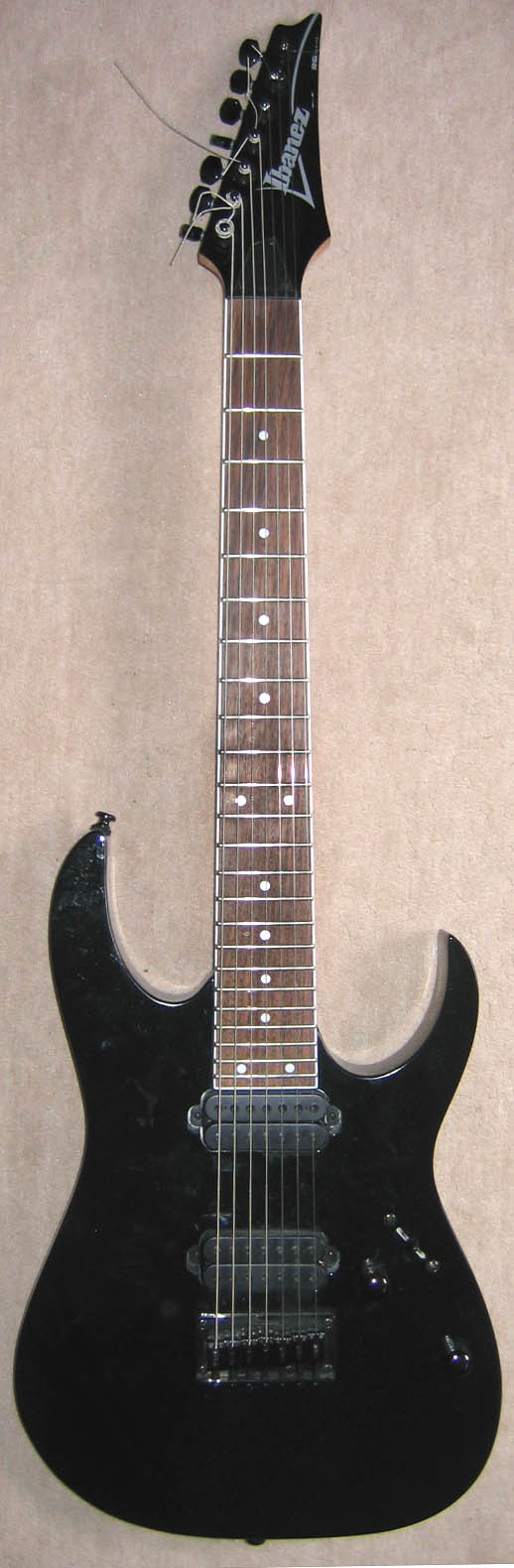
You can write a heavy riff in standard tuning, but drop D, drop C or a 7 string will give you a lower pedal note and easy one finger power chords. Lower tunings need heavier strings to stay tight and in tune. Our string gauge chart for drop tunings shows which sets suit each tuning. Teacher view: start writing in whatever tuning your guitar is set up for, and only change it when the riff asks for a lower note.
Record it over a drum loop
A riff that sounds great alone can fall apart against drums. Put it over a free loop, start slow and climb in tempo, as explained in our post on how to practise guitar with drum loops or tapping. Record a take on your phone and listen the next day; if you can still hum it, keep it. Learning how to write a metal riff is easier when you hear it in context with a beat.
Common mistakes
- Too many notes: most strong riffs use only three to five pitches.
- No repetition: listeners need to hear a cell more than once to remember it.
- Ignoring rests: constant chugging blurs together.
- Copying instead of borrowing: study riffs you love, like the styles in our Greg Ginn guitar style lesson or our look at highway metal, then write your own notes.
- Writing faster than you can play cleanly: tempo comes later.
Free riff writing worksheet
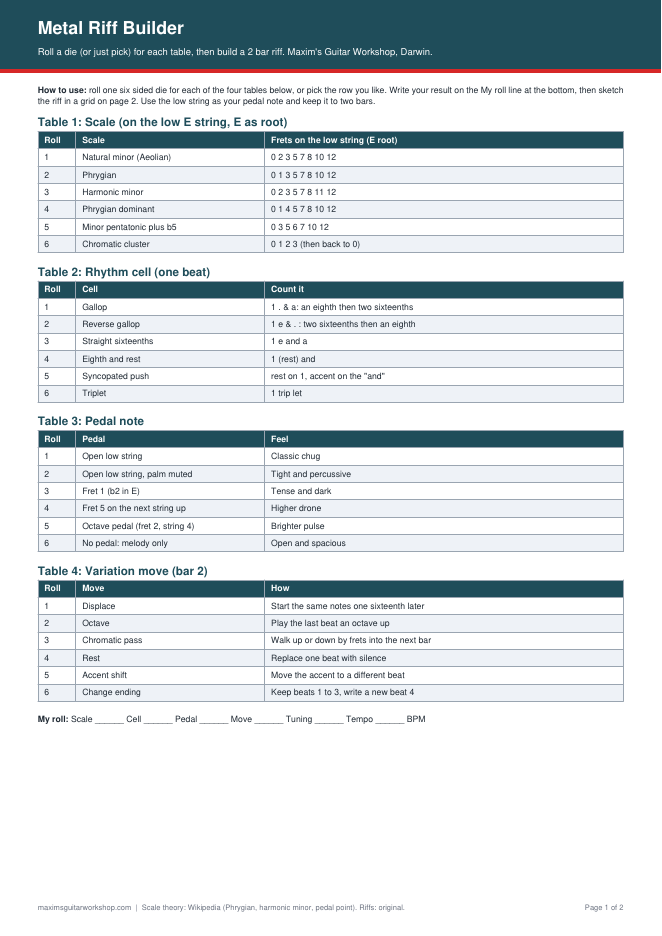
The Metal Riff Builder is a two page A4 riff writing worksheet that turns how to write a metal riff into a repeatable game. Page 1 has dice style tables: roll or pick a scale, a rhythm cell, a pedal note and a variation move. Page 2 has blank 2 bar riff grids with counting lines and a variation checklist for displace, octave, chromatic pass, rest and accent.
Download the free Metal Riff Builder (PDF)
If you want to build the basics first, such as palm muting, power chords and clean timing, our online beginner course takes you there step by step.
FAQ
How to write a metal riff if I know no theory?
Use the open low string as a pedal and add notes from one row of the scale table. Your ears will tell you what sounds heavy; theory just helps you find it faster.
Which scale is best for metal riffs?
There is no single best one. Phrygian and natural minor are the most common starting points; harmonic minor and chromatic lines add colour.
Do I need a 7 string or low tuning?
No. Plenty of heavy riffs are written in standard tuning. Lower tunings simply give you a deeper pedal note.
How long should a riff be?
Start with 2 bars. Once that works, repeat it with variations to make 4 or 8 bar sections.
Can I use the example riffs in my own songs?
Yes. They were written by us for this lesson, so treat them as practice seeds and change them to make them yours.
Image credits
Metal guitarist live: Juliana, Wikimedia Commons, CC BY SA 3.0. Seven string guitar: Wikimedia Commons, public domain. Metal Riff Builder preview: Maxim’s Guitar Workshop.