Franco Luambo guitar style is the sound at the heart of Congolese rumba: no pick, just a thumb and forefinger plucking two note shapes that bounce around the beat. Franco led OK Jazz, later TPOK Jazz, for more than three decades and made the sebene, the looping guitar dance section, the high point of the song. This post covers his life and music, how his playing works, a step by step sebene lesson with tab over I IV V chords, and a free printable practice sheet.
Quick answer: what is the Franco Luambo guitar style? He played without a plectrum, plucking with his thumb and forefinger. His parts were built from two note shapes, mostly sixths and thirds, that bounce around the beat while other guitars answer them. He did not invent the sebene, but he made it the climax at the end of the song: a looping dance section over I, IV and V chords.
I teach guitar in Darwin, and I flag my own teaching opinions as mine. This is the third post in my series on influential guitarists who deserve more attention, after Clarence White guitar technique and Wilko Johnson guitar technique. Like Wilko, Franco played with his fingers and no pick, but the music could hardly be more different.
Who was Franco Luambo?
He was born François Luambo Luanzo Makiadi on 6 July 1938 in Sona Bata, in what was then the Belgian Congo, and grew up in Léopoldville, now Kinshasa, according to Wikipedia. His father was a Tetela railway worker. His aunt Elizabeth Masaka told BBC News in 2009 that as a boy he made a guitar “out of a tin and strings” and carried it to school and the market to entertain his friends. His sister told the BBC he dropped out of school at 12 to follow music.
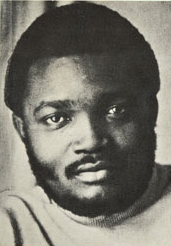
Wikipedia says he worked packing records at the Ngoma label, and the guitarist Paul Ebengo Dewayon (the BBC calls him Papa Dewayu) taught him to play. New African magazine says his professional debut came at 12 with a band called Watam. In 1953, aged 15, he signed a ten year deal with the Greek run Loningisa label, and the producer and guitarist Henri Bowane began calling him simply Franco.
Power, politics and prison
Franco’s career ran alongside the long rule of Mobutu Sese Seko. Under Mobutu’s Authenticité campaign he took the name L’Okanga La Ndju Pene Luambo Luanzo Makiadi. New African describes a tightrope: songs praising the regime sat beside veiled criticism of it. He came to own the Un Deux Trois club in Kinshasa, and from 1973 he headed the national musicians’ union, UMUZA. Mobutu made him an Officer of the Order of the Leopard in 1976.
That power had limits. As a young man he was jailed over a driving offence and wrote the song Mukoko inside, which the colonial authorities then banned. His 1966 song Luvumbu Ndoki, which the BBC describes as a veiled reference to Mobutu, was banned and he was questioned. In the late 1970s explicit songs landed him and band members in jail for a time. He later spent long stretches in Belgium, and the BBC says he released Mario from his base in Brussels.
His death
He played his last concert at the Melkweg in Amsterdam on 22 September 1989, Wikipedia says, and was admitted to hospital the next day. He died on 12 October 1989, aged 51, in hospital at Mont Godinne in Belgium, near Namur. The illness was never officially explained; many believe it was AIDS related, a cruel irony after his 1987 warning song Attention Na Sida. Mobutu declared four days of national mourning, and the Guardian notes that state radio played nothing but his songs for four days.
OK Jazz and TPOK Jazz
OK Jazz formed in 1956 among Loningisa musicians, on the initiative of Jean Serge Essous, and was named after the OK Bar in Léopoldville, where they played. Franco wrote their breakout song On Entre O.K., On Sort K.O. (you come in OK, you go out KO), released in December 1956, and the title became the band’s motto.
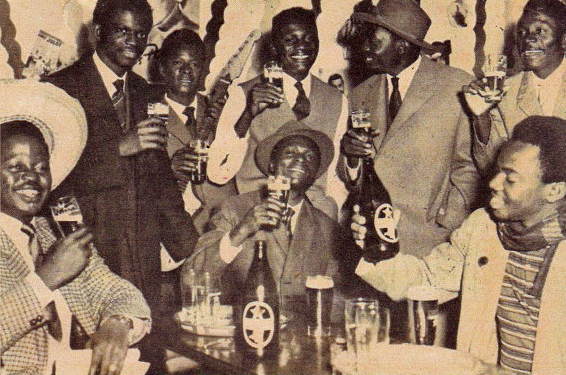
Franco was steering OK Jazz by the early 1960s and was its undisputed leader from 1970. The Guardian dates his rise to 1960, when the singer Vicky Longomba left; Wikipedia describes him as co leader with Vicky from 1967 and sole leader after Vicky departed in 1970. In the early 1970s the band became TPOK Jazz. The TP stands for Tout Puissant, all powerful, and the band lived up to it, growing into a big touring orchestra with several guitarists and singers.
The output was enormous: more than a thousand songs and somewhere between 84 and 150 albums, depending on who is counting. Wikipedia notes that 84 comes from a list in Graeme Ewens’s 1994 biography, while Franco himself claimed 150 in the mid 1980s. Late hits kept coming: Wikipedia says Mario (1985) went gold after selling more than 200,000 copies in Zaire.
Wikipedia says that by the end of the 1950s guitarists were often identified with one of two schools: the OK Jazz school of Franco and the African Jazz school, which the veteran guitarist Dizzy Mandjeku told Jabulani Radio was based on Dr Nico’s guitar. New African quotes the researcher Bob White saying OK Jazz was the only major band rooted in the more traditional, rhythmic and repetitive ondemba style, rather than the smoother fiesta style of its rivals.
Congolese rumba and the sebene explained
New African lists three key features of Congolese rumba: Cuban influenced rhythms, lyrics placed up front above the clave beat, and the sebene. Most songs open with a slower sung section, then shift into the sebene, an instrumental dance section where, in New African’s words, at least two duelling guitars take over. Franco did not invent the sebene. New African credits him with popularising the move of the sebene to the end of the song, so the whole track builds towards it.
The Wikipedia entry on the sebene says the name probably comes from the English word seven, from the seventh chords of palm wine guitar music. The usual chords are I, IV and V, changing every two or four beats. Musicians name the common loops, or cadences:
- Demi temps: I IV I V
- 2 temps: I IV V IV
- 3 temps: I V IV V
- 4 temps: I VII IV V
In C major, demi temps is C F C G. If those Roman numerals are new to you, my posts on popular major chord progressions and cadences explain how I, IV and V work in any key, and the songs with common chord progressions library shows the same chords in songs you may already know.
Who plays what in a Congolese band
Jabulani Radio’s guide calls the rhythm guitar the main chassis of the song: it runs nonstop from start to finish while everything else fits around it. In a 1985 magazine article reprinted on Muzines, the guitarist Ben Mandelson described the usual guitar roles:
- Rhythm guitar: a repeating pattern with a mellow sound on the neck pickup and no effects.
- Mi solo: a counter melody that supports or answers the soloist, with a warmer sound.
- Lead guitar: a hard, very trebly tone with plenty of delay and reverb.
The parts of Congolese rumba guitar interlock rather than stack. Each guitar fills gaps the others leave, which is why a sebene sounds busy even when every single part is simple. My post on polyrhythm and polymeter covers the idea of separate parts adding up to one groove.
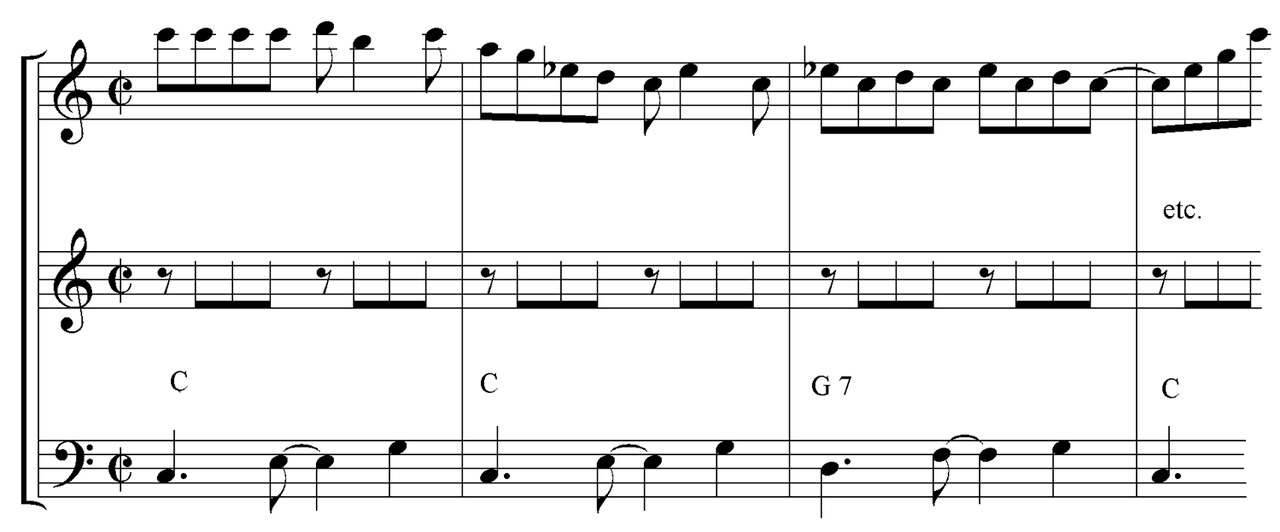
Franco Luambo guitar style explained
In my reading of the sources, the Franco Luambo guitar style comes down to four things: the picking hand, the intervals, the rhythm and his place in the band. None of it depends on speed, which is good news if you are learning it.
Thumb and forefinger, no pick
Wikipedia and New African agree that Franco played with his thumb and forefinger rather than a plectrum. New African describes the result as “a mesmerising sonic mirage of two guitar lines”, because the thumb and finger can sound like two separate players. In my teaching, this is the heart of it: the thumb takes the lower note and the finger takes the higher note, sometimes together and sometimes in turn.
Sixths and thirds
Wikipedia describes his crisp open chords, often of only two notes, that “bounced around the beat”, and points to his use of thirds and sixths. Mandelson wrote that Franco drew heavily on the guitarist Mwenda Jean Bosco and on thumb piano music, and that Bosco also picked with his thumb and first finger and played passages in sixths. Banning Eyre of Afropop Worldwide wrote that Franco’s two finger, double stop style still sounds “fresh and riveting”. In other words, he built on earlier players rather than starting from nothing.
Rhythm and repetition, not speed
A Village Voice tribute said that Franco picked his riffs and melodies “at less than quicksilver speed”. Rolling Stone called him a team player who preferred the whole band locking together to flashy solos. The lesson for us is that a short phrase, repeated with feel and placed against the beat, can carry a whole dance floor. My basics of syncopation post is good preparation.
His part in the band
Sources differ on what to call Franco’s own part. New African says he often played the mi solo. Jabulani Radio’s guide says that from the early 1970s Franco used a second solo guitar, not a mi solo, so the band kept a solo voice while he roamed freely. Either way, his part sat between rhythm and lead in the TPOK Jazz guitar lineup. Mandelson summed up why Franco Luambo guitar technique is worth studying: “Once you’ve learned his basic technique, a lot of other styles will fall into place.”
How to play the sebene over I IV V: step by step with tab
If you want to know how to play sebene parts, start here. These exercises are in the Franco Luambo guitar style, not transcriptions of his recordings. They use the demi temps loop in C (C F C G), one chord every two beats, in standard tuning. No reliable source I found documents a special tuning, so standard tuning it is. Real sebenes are faster and layered with other guitars, and Premier Guitar makes the point that listening matters more than reading here, so use the tab as a map and the records as the teacher.
How to read the tab
Each tab shows only the strings used. Numbers are frets, dots mean nothing is played, and the top line counts eighth notes (1 & 2 & 3 & 4 &). The bottom line shows the picking hand: T is the thumb, i is the index finger, and P is a pinch, thumb and index together. Pluck free stroke, as Guitar Player describes in its Niwel Tsumbu lesson: the finger plucks and comes away rather than resting on the next string. Start with a click at 60 to 70 bpm on each beat.
The shapes
- Sixths, thumb on the D string and index on the B string: C is D5 and B5, F is D7 and B6, G is D9 and B8.
- Thirds on the G and B strings: C is G9 and B8, F is G10 and B10, G7 is G7 and B6.
- Bass roots for the thumb: C is A3, F is low E1, G is low E3.
Exercise 1: the thumb pulse
Play the roots with your thumb on every beat while you say the chord names out loud. This is the floor everything else stands on.
  C           F            C           G
  1  &  2  &  3  &  4  &   1  &  2  &  3  &  4  &
D|........................|........................|
A|3.....3.................|3.....3.................|
E|............1.....1.....|............3.....3.....|
  T     T     T     T      T     T     T     T
Exercise 2: pinched sixths on the beat
Now pinch the sixth shapes on every beat. Keep the thumb on the D string and the index on the B string, and let the G string stay silent between them. Slide between the shapes without lifting your fretting fingers too far.
  C           F            C           G
  1  &  2  &  3  &  4  &   1  &  2  &  3  &  4  &
e|........................|........................|
B|5.....5.....6.....6.....|5.....5.....8.....8.....|
G|........................|........................|
D|5.....5.....7.....7.....|5.....5.....9.....9.....|
  P     P     P     P      P     P     P     P
Exercise 3: split the sixths
Here is where it starts to bounce. The thumb plays the D string on the beat and the index answers on the B string on the “and”. This is the two lines in one guitar effect New African describes, and in my teaching it is the single most important exercise on this page.
  C           F            C           G
  1  &  2  &  3  &  4  &   1  &  2  &  3  &  4  &
e|........................|........................|
B|...5.....5.....6.....6..|...5.....5.....8.....8..|
G|........................|........................|
D|5.....5.....7.....7.....|5.....5.....9.....9.....|
  T  i  T  i  T  i  T  i   T  i  T  i  T  i  T  i
Exercise 4: thirds with a 3 3 2 accent
Move up to the thirds, thumb on the G string and index on the B string, and pinch them on 1, the “and” of 2, and 4. That 3 3 2 grouping of eighth notes is the same feel as the Cuban tresillo, and it pulls against the steady beat. Hold one chord per bar to start: C then F, then C then G7.
  C                        F
  1  &  2  &  3  &  4  &   1  &  2  &  3  &  4  &
e|........................|........................|
B|8........8........8.....|10.......10.......10....|
G|9........9........9.....|10.......10.......10....|
D|........................|........................|
  P        P        P      P        P        P

  C                        G7
  1  &  2  &  3  &  4  &   1  &  2  &  3  &  4  &
e|........................|........................|
B|8........8........8.....|6........6........6.....|
G|9........9........9.....|7........7........7.....|
D|........................|........................|
  P        P        P      P        P        P
Exercise 5: the full loop, call and answer
Play two bars of Exercise 3 as the call, then two bars of thirds as the answer, hitting on 1, the “and” of 2, 3 and the “and” of 4. Loop all four bars. The answer bars are below.
  C           F            C           G7
  1  &  2  &  3  &  4  &   1  &  2  &  3  &  4  &
e|........................|........................|
B|8........8..10.......10.|8........8..6........6..|
G|9........9..10.......10.|9........9..7........7..|
D|........................|........................|
  P        P  P        P   P        P  P        P
When that feels steady, try the 2 temps loop, C F G F, with the same shapes. Keep the click on and resist speeding up; a sebene works because it feels relaxed while the dancers work hard.
Look after your fingers
No pick means your thumb and index take the wear. Keep sessions short, and stop if the skin gets sore. My guide to sore fingertips from guitar covers building up calluses safely, and my guitar practice routine post shows how to fit a short technique block like this into the week.
His guitars and tone
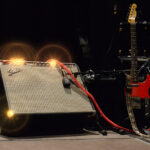
Mandelson wrote in 1985 that Franco had played Fender Jazzmasters or Jaguars, then a run of Gibson Les Pauls, and by then a newish Gibson Victory. His guitarists in 1984 used 8×12 speaker cabinets and custom built amps, each with a Roland Space Echo. Jon Pareles of the New York Times, quoted on Wikipedia, described Franco’s “raspy, slightly distorted tone”.
For your own setup, the band roles above are a good guide. A rhythm or Franco style part sounds right on the neck pickup with a clean, mellow tone. A lead part wants more treble with some delay and reverb. Premier Guitar suggests a clean tone with a touch of chorus and slapback delay, and notes that many African guitarists play Strat style guitars. If you are choosing between the two classic Fenders, my Stratocaster vs Telecaster comparison will help.
Free printable practice sheet (PDF)
The free sheet puts the Franco Luambo guitar style exercises on one A4 page: the shapes, all five tabs, the cadence names, a tempo log and a short listening list. Print it, keep it on your music stand, and write your tempo down each session so you can see steady progress.
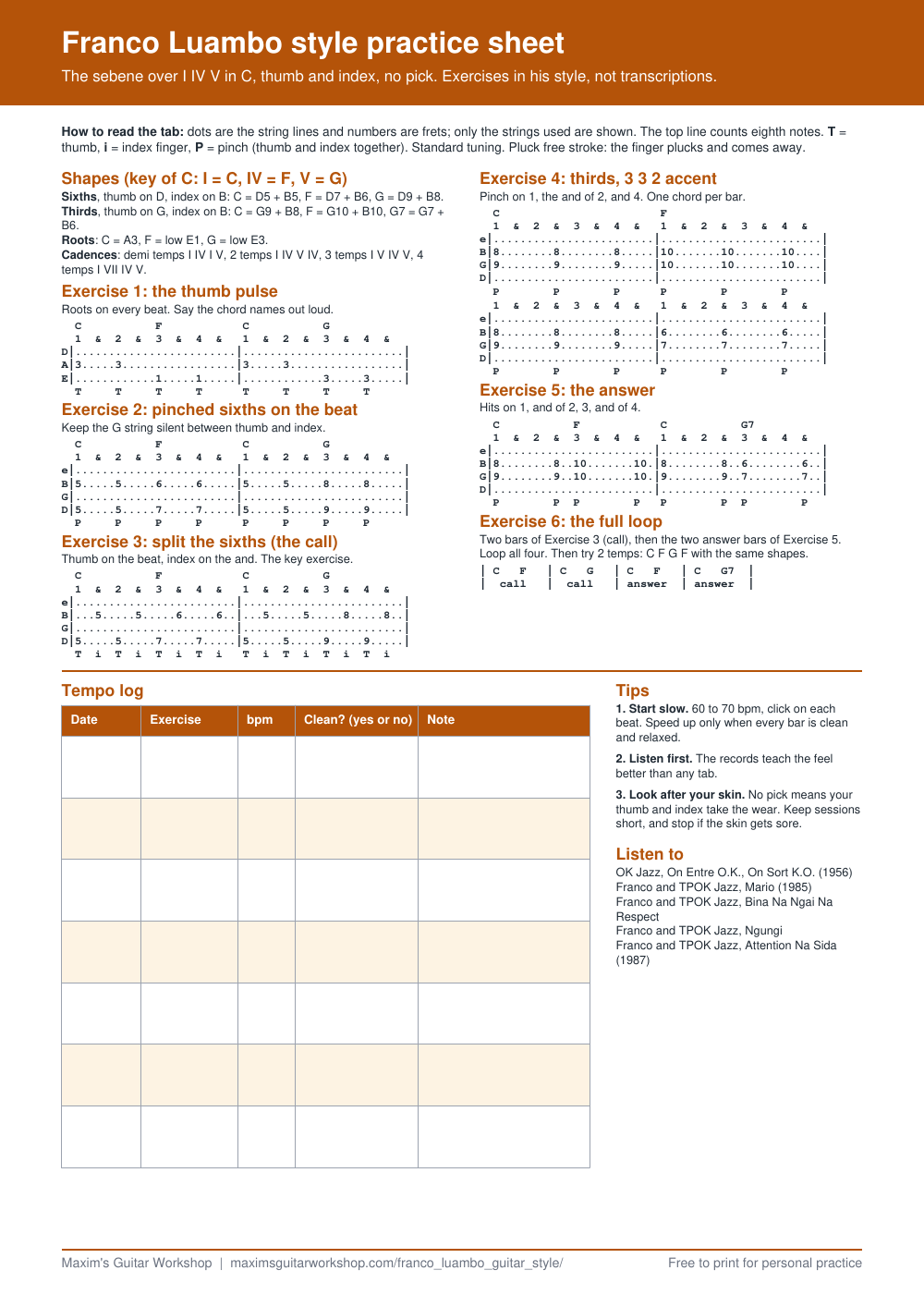
Download the free Franco Luambo practice sheet (PDF)
Essential listening list
Listening is the best way into the Franco Luambo guitar style. Many of these songs run well past ten minutes, so let the sebene come to you. Start with Mario, from the official Franco Luambo channel on YouTube.
- On Entre O.K., On Sort K.O. (1956): the early OK Jazz song that became the band’s motto.
- Luvumbu Ndoki (1966): the banned song that showed how far he would push.
- Mario (1985): his biggest late hit, and a long, patient groove to study.
- Bina Na Ngai Na Respect: New African says it runs to nearly 18 minutes, a lesson in pacing.
- Attention Na Sida (1987): his song warning about AIDS.
- Ngungi: one of the key tracks Rolling Stone picked for him.
For a modern teacher’s view of Congolese fingerpicking, the Niwel Tsumbu lesson from World Music Method is worth watching alongside the tabs above.
Legacy
Rolling Stone ranked Franco number 71 in its 2023 list of the 250 greatest guitarists. Fans and critics called him the Sorcerer of the Guitar and the Grand Maître of Zairean music, and a statue of him was put up in Kinshasa in 2015, according to New African. The broadcaster Biyevanga Lengemi told the BBC: “He is our Picasso.”
The music critic Ken Braun told New African that what keeps people coming back is “the rhythms, the melodies, the guitar artistry, the voices”. Rolling Stone describes how the band’s rumba sped up in the 1970s and 1980s and blossomed into the guitar weaves of soukous, and every guitarist who plays a looping Congolese part today is working in a tradition he shaped.
For guitarists outside Africa, the Franco Luambo guitar style is a lesson in restraint: two notes, two fingers and a loop that never hurries. In my teaching, it also fixes a common problem, which is players who know plenty of notes but cannot make a simple part groove. Spend a few weeks with these exercises and the records, and your rhythm playing in any style will benefit. For another player who did more with his fingers than most do with a pick, see our guide to Hubert Sumlin guitar technique.
If you are newer to the guitar and want a structured path to playing loops like these, my online beginner course starts from the very first chord.
Franco Luambo FAQ
What is the sebene?
The sebene is the instrumental dance section of a Congolese rumba song, where the guitars play looping patterns over I, IV and V chords. Franco popularised placing it at the end of the song.
Did Franco Luambo use a pick?
No. Wikipedia and New African both say he played with his thumb and forefinger rather than a plectrum.
Do I need a pick to learn the Franco Luambo guitar style?
No, and it is better without one, because the thumb and finger give you two separate voices. You can try a pick later for single note lead lines, or if you move on to a faster soukous guitar lesson.
What tuning did Franco use?
Standard tuning works for everything on this page. I found no reliable source documenting a special tuning.
What is the difference between Congolese rumba and soukous?
Congolese rumba is the older, Cuban influenced style with a sung section and a sebene. Soukous is the faster, dance focused sound that grew out of it in the 1970s and 1980s.
What does TPOK Jazz stand for?
TP stands for Tout Puissant, French for all powerful. The band was called OK Jazz, after the OK Bar in Léopoldville, until the early 1970s.