
Guitar injuries are more common than most players expect, and the good news is that many of the everyday ones build up slowly from habits you can change. This guide covers what research has found in guitarists, the warning signs to take seriously, the usual causes and how to set up, warm up and practise so your hands, back and ears last the distance.
This is general information, not medical advice. It cannot diagnose you or replace a check by a GP, physiotherapist or hand therapist. If something hurts, feels numb or is getting worse, please see a health professional.

Guitar injuries: what is common
A 2026 systematic review of 42 clinical studies, Kim and colleagues in Medical Problems of Performing Artists, estimated that musculoskeletal pain affects a little over half of guitarists (a pooled figure of 56 percent, with a wide range across studies). The authors linked that pain to long practice sessions and poor playing posture, and called for more preventive education. Here is what studies show about guitar injuries, area by area.
Wrists, hands and forearms
In a 2024 survey of 105 guitarists in Portugal, Dos Santos and Minghelli found that 53 percent had been injured at some point in their playing life and about 30 percent in the previous 12 months. Tendon problems (tendinopathy) were the most common injury type at about 35 percent of injuries, and the wrist was the most affected site at about 29 percent.
Players most often blamed repetitive movement, then long periods in one position, for their guitar injuries. A 2020 survey of 190 classical guitarists by Zuhdi and colleagues found 89 percent had guitar related pain in the past year, and the most common single spot was the fleshy base of the fretting hand thumb (25 percent).
A thumb squeezing far too hard is also a classic problem when learning barre chords.
The NHS describes repetitive strain injury (RSI) as pain, aching, stiffness, weakness, tingling, numbness, cramp or swelling caused by repetitive activity and poor posture, which covers a lot of what guitar wrist pain and guitarist hand pain look like in everyday life. Tendonitis in guitar players is one label people use for guitar injuries of this kind, but only a health professional can tell you what is actually going on.
Carpal tunnel and nerve symptoms
Carpal tunnel syndrome happens when a nerve at the wrist (the median nerve) is squeezed. The NHS carpal tunnel page lists tingling, numbness and pain in the thumb and first fingers, often worse at night, and suggests cutting down activities that bend the wrist or involve gripping hard, naming playing an instrument as an example.
In a small 2006 study of 24 university guitarists, Kennedy and colleagues found nerve test results consistent with median nerve trouble at the wrist in 4 players (17 percent). It was a small group, so treat that as a signal, not a firm rate.
Elbows
The NHS lists playing a musical instrument among the activities that can lead to tennis elbow. I could not find a solid study measuring how often guitarists get tennis or golfer’s elbow, so I am not going to put a number on it. If the outside of your elbow aches after playing, mention it to your GP or physio.
Neck, shoulders and back
A 2021 study of 140 guitarists by Rojas and colleagues notes that the neck is the area most often affected in musicians generally. In the Portuguese survey, low back pain was the second most common injury and the lower back the second most affected site.
A 2022 motion capture study of 25 players by Portnoy, Cohen and Ratzon found that sitting produced more forward and sideways torso lean and more sideways bend in the fretting wrist than standing, while lower back pain when standing was linked to how much players twisted their torso.
Focal dystonia
Musician’s focal dystonia is a loss of control over a well practised movement, such as a finger that curls in on its own during a passage you know well. According to a review by Altenmüller and Jabusch, it affects roughly 1 percent of professional musicians, tends to appear in the hand that does the most detailed work, and is linked with anxiety and perfectionism.
It is rare but serious: only a minority of affected musicians return to normal control, so any loss of finger control that does not go away needs a doctor, ideally one with experience in movement disorders.
Fingertips and skin
Sore fingertips are normal for beginners and are covered in detail in my sore fingertips from guitar guide. Less often, guitar injuries involve actual damage to the skin. A 2004 review of skin conditions in musicians describes calluses, small cuts and wounds, and contact allergy to nickel or chromium in strings and frets among guitarists. A rash, a split that will not heal or a cut that looks infected is one for your GP.
Hearing
Hearing damage does not hurt, so it is easy to forget. It gets its own section below.
Warning signs you should not play through
Some discomfort is part of learning, especially tender fingertips in the first weeks (see the sore fingertips guide for what ordinary soreness looks like). These signs of possible guitar injuries are different. Stop playing and get them checked:
- Numbness or tingling in the fingers, thumb or hand, especially if it wakes you at night.
- Pain at rest, meaning it aches when you are not playing.
- Swelling, heat or redness around a joint or tendon.
- Weakness or clumsiness, such as dropping your pick.
- Sharp or shooting pain, or pain that runs up the forearm.
- Pain that is getting worse from week to week, or not easing with rest.
- Loss of control of a finger in a familiar passage that does not go away.
The NHS advises seeing a GP for RSI type symptoms that are not improving or are getting worse, and for carpal tunnel symptoms that are worsening or not going away.
What causes them
Most overuse guitar injuries come from a mix of load and habit rather than one bad session:
- Too much, too soon. Big jumps in practice time before a gig, exam or audition.
- Tension. Squeezing the neck harder than needed, a death grip on the pick, raised shoulders.
- Posture. Hunching over the guitar, twisting to see the fretboard, or long periods in one position.
- Wrist angle. A sharply bent fretting wrist or a picking wrist cocked sideways for long stretches.
- Bad setup. High action, heavy strings for your level, or a strap so low your wrist has to bend hard.
- No breaks and no warm up. The Portuguese study found that players who did not warm up were more likely to be injured.

How to prevent guitar injuries
There is no single trick, but the habits below line up with the studies and guidance in this article.
| Area | Common risk | Prevention habit |
|---|---|---|
| Fretting hand and thumb | Squeezing too hard, especially on barre chords | Press only as hard as the note needs; let the arm’s weight help instead of the thumb |
| Wrists | Sharp bends held for long periods | Keep the wrist as straight as is comfortable; adjust strap height or guitar angle |
| Forearms and elbows | Repetitive picking and long sessions | Short sessions with breaks; build practice time up gradually |
| Neck and shoulders | Hunching to look at the fretboard | Tilt the neck up slightly, glance rather than stare, relax the shoulders |
| Lower back | Slumped sitting or twisting when standing | Sit with both feet flat and back supported; change position between songs |
| Fingertips and skin | Blisters, splits, metal allergy | Short sessions while calluses form; stop if skin breaks |
| Ears | Loud rehearsals and gigs | Musician’s earplugs, lower stage volume, quieter practice at home |
Warm up, breaks and practice length
The evidence on warming up and guitar injuries is encouraging but not strong. The Portuguese survey linked skipping a warm up with more injuries, and a small 2024 pilot study of conservatory students by Austen, Redman and Martini found daily warm up exercises reduced pain intensity, but only once mood, sleep and activity levels were taken into account. Neither proves cause and effect, but a gentle warm up costs little.
A practical approach from a 2006 review by Storm in Physical Medicine and Rehabilitation Clinics of North America is to build practice time up gradually and to take 5 to 10 minute breaks within 60 to 90 minute sessions.
The same review advises relative rest (playing less and easier material) rather than stopping completely for minor playing related problems, and the NHS RSI page similarly says not to rest the affected area for more than a few days. If you are injured, follow your own clinician’s plan.
A simple warm up shape:
- Two or three minutes of easy movement: shoulder rolls, gentle arm swings, opening and closing the hands.
- Gentle stretches, held without forcing and stopped straight away if anything hurts.
- Five minutes of slow, easy playing before anything fast or stretchy.
- A 5 to 10 minute break within every 60 to 90 minutes, or sooner if your hands tire.
Here are the stretches and hand exercises I do before and during practice and performance. They are what I use, not a treatment, so skip any that cause pain and check with a physio if you have a current problem.
There is more detail in my post on stretches and hand exercises for guitar players. For how to split your time across a session, see my guitar practice routine for rock and metal with its free practice log, and for realistic expectations on progress, read how long it takes to learn guitar.
Guitar posture and setup
Good guitar posture is less about one perfect position and more about avoiding extremes and moving often. The Portnoy study suggests sitting and standing each carry their own strains, so alternating can help.
- Strap height. Set the strap so the guitar sits at roughly the same height standing as it does when you sit. Slung very low, it forces the fretting wrist into a sharp bend.
- Seated. Use a chair without arms, feet flat or a footstool, and bring the guitar to you rather than leaning over it. A slight upward angle of the neck usually eases the fretting wrist.
- Standing. Keep your weight even and avoid twisting to watch your hands.
- String gauge. Lighter strings have less tension, so they take less effort to press. My post on famous guitarists’ string gauges shows how many players use lighter sets than you might think.
- Action and setup. High action (strings far from the frets) makes every note harder work. A setup by a qualified guitar technician can lower it, which matters most on cheaper beginner guitars.

Hearing protection for guitarists
Noise damage builds up quietly and is permanent. In a German study of 2,227 professional musicians, Schink and colleagues (2014) found musicians were about 3.6 times as likely as the general population to be diagnosed with noise induced hearing loss.
In a survey of 111 Norwegian rock musicians, Størmer and colleagues (2015) found hearing loss in 37.8 percent and chronic tinnitus in 20 percent; guitarists and bass players had worse hearing than vocalists, earplugs were protective, yet only a minority wore them consistently.
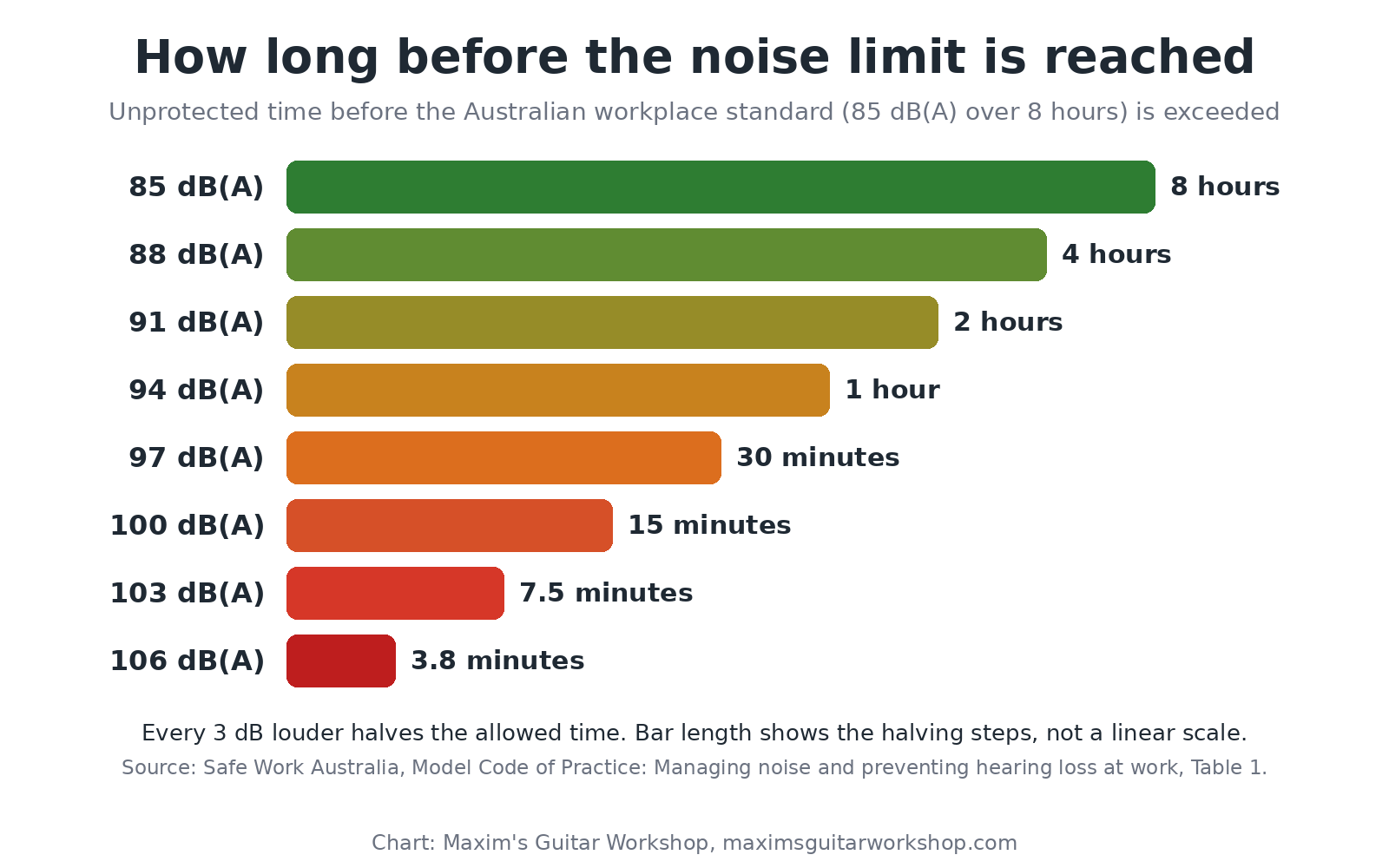
In Australia, Safe Work Australia sets the workplace exposure standard at 85 decibels averaged over eight hours. Its model Code of Practice on noise shows that every 3 decibels louder halves the allowed time, so at 100 decibels the limit is reached in 15 minutes. The Australian Government’s protecting your hearing video advises limiting loud exposure, taking breaks, wearing earplugs at loud events and getting your hearing checked.
Practical steps:
- Wear earplugs at every loud rehearsal and gig. Musician’s earplugs aim to lower volume evenly so music still sounds clear, and audiologists can fit custom moulded ones, which the Norwegian study found especially protective.
- Turn the amp down at home and point it at your ears rather than your legs.
- Keep headphone volume moderate and take breaks.
- Ringing or muffled hearing after a gig is a warning sign; if it does not settle, get a hearing test.
When to see a professional about guitar injuries
If you have any of the warning signs above, or pain that is not easing, these are the people to talk to:
- GP. A good first stop for numbness, tingling, swelling, skin problems, hearing changes or anything you are unsure about. In Australia you can also call the healthdirect helpline on 1800 022 222 to speak with a registered nurse.
- Physiotherapist. Physios assess and manage muscle, joint and tendon problems. According to the Australian Physiotherapy Association, you do not need a doctor’s referral to see one.
- Hand therapist. The Australian Hand Therapy Association explains that an accredited hand therapist is a registered occupational therapist or physiotherapist with advanced training in the hand and upper limb. They are a strong option for wrist, hand and elbow problems.
- Audiologist. For hearing tests, tinnitus and custom earplugs.
Bring your guitar to the appointment if you can, because many problems only show up in the playing position.
FAQ
Can playing guitar cause carpal tunnel syndrome?
Playing an instrument is one of the wrist activities the NHS suggests cutting down if you have carpal tunnel symptoms, and a small study found nerve test changes in some university guitarists. Tingling or numbness in the thumb and first fingers, especially at night, is a reason to see your GP.
Why does my wrist hurt when I play guitar?
Common contributors to wrist related guitar injuries are a sharply bent wrist, squeezing too hard, a low strap, high action and long sessions without breaks. If pain continues, is present at rest or comes with numbness, see a GP, physio or hand therapist.
Should I play through pain?
No. Tender fingertips while calluses form are normal, but pain in the wrist, forearm, elbow, neck or back is a signal to stop and reduce your load. If it keeps coming back or lasts more than a few days, get it checked.
How long should I practise guitar a day?
There is no single safe number; it depends on your level and condition. Build up gradually and take regular breaks. Several short sessions are usually kinder to your hands than one long one.
Will lighter strings or a thinner neck help?
Lighter strings and a lower action reduce the effort needed to press notes, which many players find more comfortable. Neck shape is more personal: I did not find good evidence that a thin neck is better for everyone, so try guitars in a shop and pick the one your hand relaxes on.
Guitar injuries are much easier to prevent than to fix, and most prevention is simply good technique practised patiently. If you want to build that technique from the start with a clear plan, my online beginner course is a good place to begin.