
Here is how to tune a guitar by ear in two sentences: get your low E string as close to pitch as you can from a reliable reference, then press its fifth fret and tune the open A string until the two notes match. Repeat that on each pair of strings (using the fourth fret on the G string to tune the B), and your guitar will be in tune with itself.
The honest part: tuning by ear is a skill, your first attempts will not be perfect, and a tuner is more accurate. Below is the method to tune your guitar by ear, how to hear when notes match, why small errors creep in, and what to practise so your ear improves over weeks and months.

Relative tuning: what tuning by ear really means
When you tune a guitar without a tuner, you are doing relative tuning: get one string as well in tune as you can, then tune the rest relative to it. That is how to tune a guitar by ear when you have no tuner.
The guitar ends up in tune with itself, so chords sound right. Whether it matches a piano or a recording depends on that first string, so start from a proper reference pitch if you want to play with others.
What you need before you learn how to tune a guitar by ear
You need one reliable note to start from:
- A tone app playing E2 (the low E) or A 440 Hz.
- A recently tuned piano or keyboard. Your low E is the E below the C below middle C.
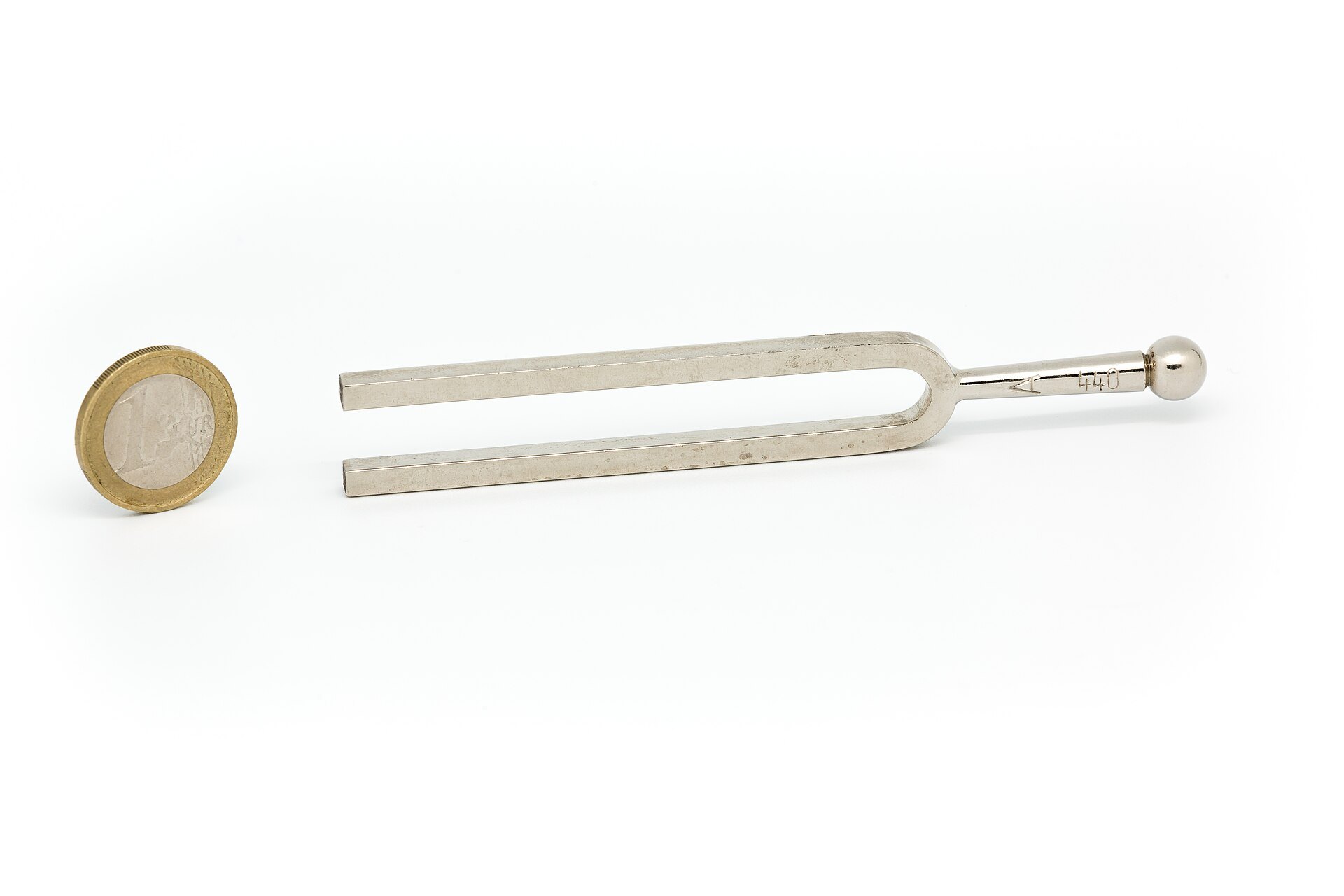
- A tuning fork. Most sound A at 440 Hz, the pitch standardised internationally as ISO 16 in 1975. That A matches the fifth fret of your high E string.
- A recording in standard tuning that starts on a low E or E minor chord. Less reliable, as some recordings are tuned slightly off or down.
Standard tuning EADGBE runs from thickest string to thinnest. According to Wikipedia’s guitar tunings page, the target frequencies are E2 82.41 Hz, A2 110 Hz, D3 146.83 Hz, G3 196 Hz, B3 246.94 Hz and E4 329.63 Hz.
Bass uses the same notes as the lowest four guitar strings, E A D G, an octave lower; see my bass guitar for beginners guide.
How to tune a guitar by ear with the fifth fret method
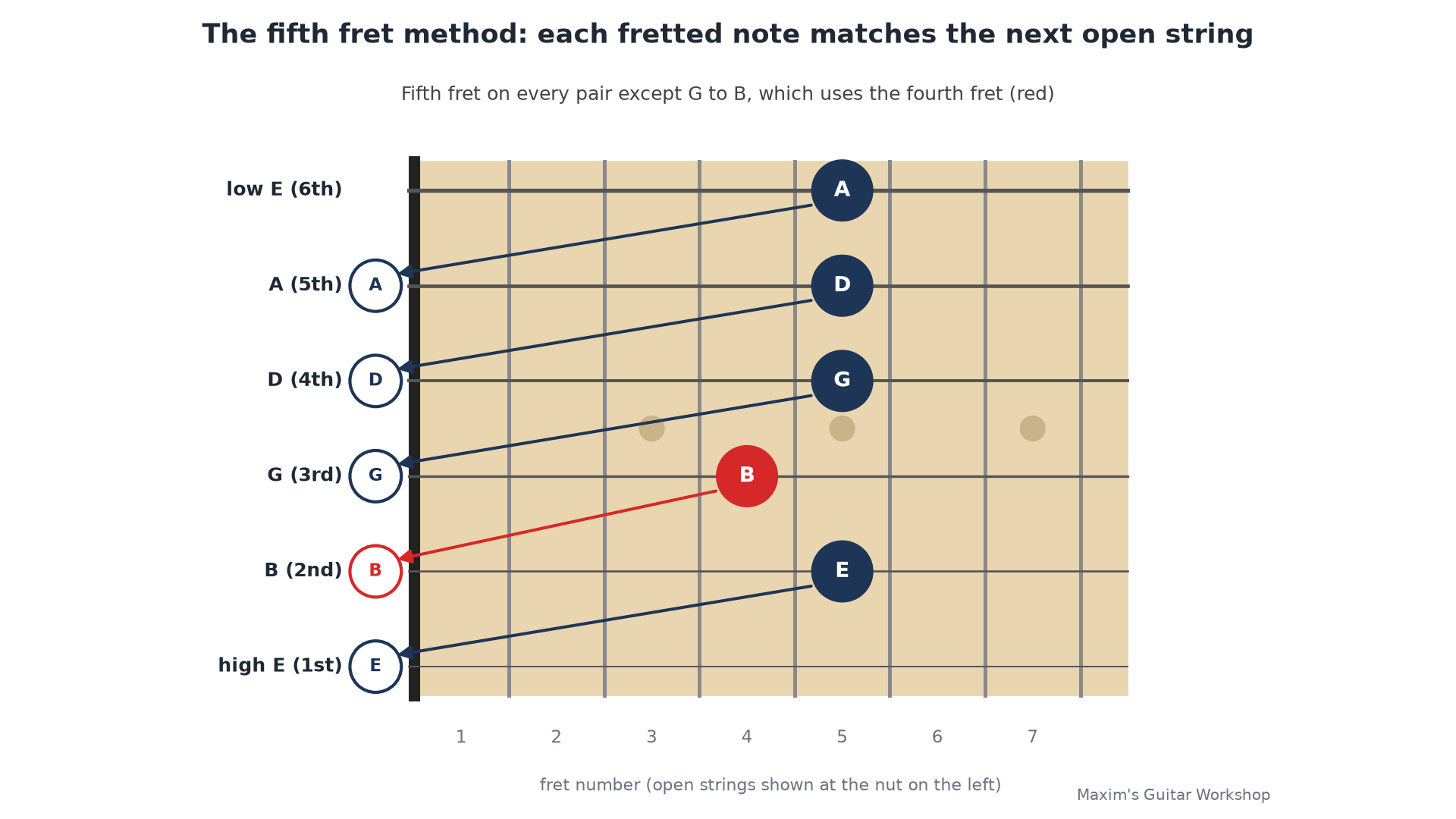
Once your low E matches your reference, work across the neck. Each fretted note matches the next open string.
- Low E to A. Press the low E at the fifth fret (an A). Play it with the open A string and adjust the A until they match.
- A to D. Fifth fret of the A string (a D) tunes the open D.
- D to G. Fifth fret of the D string (a G) tunes the open G.
- G to B. The exception: the fourth fret of the G string (a B) tunes the open B, because G and B are a major third apart while every other pair is a fourth.
- B to high E. Fifth fret of the B string (an E) tunes the open high E.
That is the whole method to tune your guitar by ear, with each string matched to the one before. Then go through it once more. Changing one string’s tension can pull the others slightly, and D’Addario’s tuning guide recommends checking every string again afterwards.
How to hear when strings match as you tune by ear
Play the fretted note and the open string together and let them ring. When two notes are close but not the same, you hear a wobble in the volume called beats. As the Wikipedia article on beats explains, the beat rate equals the difference between the frequencies, so 110 Hz against 111 Hz gives about one wobble per second. This is the heart of guitar tuning by ear.
- Wobble slowing down: you are getting closer. Keep turning in small amounts.
- Wobble speeding up: you went past it. Drop below the note and come back up.
- Steady, smooth sound: close enough to play.
Always tune up to the note, as D’Addario’s guide also advises. In my experience the string then holds pitch better.
If beats are hard to hear at first, hum the first note, pluck the second and ask: higher or lower? That is the first skill of how to tune a guitar by ear; beats come later.
Why it will not be perfect (and why that is fine)
- Errors add up. Each string is tuned from the one before. If every step is 3 cents sharp (a cent is a hundredth of a semitone), the high E ends up about 15 cents from the low E. Wikipedia’s article on cents cites roughly 5 to 6 cents as the smallest difference people notice, varying from person to person, so errors you barely hear still build up.
- Fretted notes are slightly sharp. Pressing a string down stretches it and raises its pitch, an effect UNSW Music Acoustics calls considerable on steel strings.
- Intonation. A poor setup makes fretted notes sharp or flat.
- Harmonics follow pure intervals, not equal temperament. Guitar frets are spaced for equal temperament, where fourths are about 2 cents wider than pure and major thirds are about 14 cents wider. Harmonics give you pure intervals, which is why harmonic tuning is, in UNSW’s words, only approximate.
The goal is a guitar that sounds good playing chords. Small leftovers are normal.
What to practise to build your ear
Learning how to tune a guitar by ear is mostly ear training, and it improves slowly with short, regular practice. In a lab study of pitch discrimination, Micheyl and colleagues (2006) found non musicians’ thresholds started more than six times larger than classical musicians’, and eight new non musicians needed 4 to 8 hours of focused training to catch up on that task.
A guitar in a real room is harder than a lab test, so in my teaching experience (an opinion, not a measured figure) expect progress over weeks and months. My 10 minute daily routine:
- Match a reference (2 minutes). Play E2 from a tone app, detune your low E slightly flat and bring it up to match.
- Sing or hum it (2 minutes). Hum the reference, then pluck the string. Higher, lower or the same?
- Listen for beats (3 minutes). Do the fifth fret method slowly and notice the wobble change as you turn each peg.
- Detune and return (1 minute). Detune one string by a small turn, then tune it back by ear.
- Check with a tuner (2 minutes). Check every string with a tuner and write down how many cents each was off. That feedback is what makes the practice work.
Keep notes for a few weeks and watch the numbers shrink as you tune your guitar by ear more accurately.
If your fingertips are tender, keep fretted notes light; see my guide to sore fingertips from guitar.
For a realistic picture of how skills build, see how long it takes to learn guitar.
Download the free tune by ear cheat sheet (PDF)
Common mistakes when you tune by ear
- Tuning down to the pitch. Coming down from sharp can leave the string drifting flat. Go below and come up.
- Not stretching new strings. New strings keep dropping in pitch until they settle. D’Addario suggests gently pulling newly fitted strings as you tune them so they settle faster.
- Tuning only one string. Retuning one string without checking the others leaves the guitar out with itself.
- Pressing too hard on the fretted note. This pushes it sharp.

Check your tuning with harmonics
Harmonics are clear, bell like notes you get by touching a string lightly above the fret wire (not pressing) and plucking. They make beats easier to hear. UNSW’s Physclips page on beats demonstrates this exact check on a guitar.
- Fifth and seventh frets: the fifth fret harmonic on one string should match the seventh fret harmonic on the next string up. Use this for low E to A, A to D, D to G and B to high E.
- G to B: skip harmonics here, because this pair is a major third. Use the fourth fret method, or compare the seventh fret harmonic on the low E with the open B.
- Twelfth fret: the twelfth fret harmonic should match the fretted twelfth fret note on the same string. If not, that points to intonation, not tuning.
When to use a tuner anyway
A tuner is more accurate than most ears. For example, BOSS lists its TU 3 pedal tuner at an accuracy of plus or minus 1 cent. Use one when:
- you play with others, gig or record;
- you have just fitted new strings or the room is loud;
- you want feedback on your ear.
Knowing how to tune a guitar by ear covers you when there is no tuner and trains your ear, so both skills are worth having. Once you are in tune, pick something to play from my list of songs with common chord progressions.
Can I learn how to tune a guitar by ear without a tuner or any reference?
Yes. Pick a low E that sounds about right and use the fifth fret method. The guitar will be in tune with itself, but probably not at concert pitch.
How long does it take to learn to tune by ear?
It varies. Most beginners can follow the steps of how to tune a guitar by ear on day one, but hearing small differences reliably usually takes weeks to months of regular practice (my teaching opinion).
Now that you know how to tune a guitar by ear, a clear, step by step start on guitar is the next move, and my online beginner course is a good place to begin.