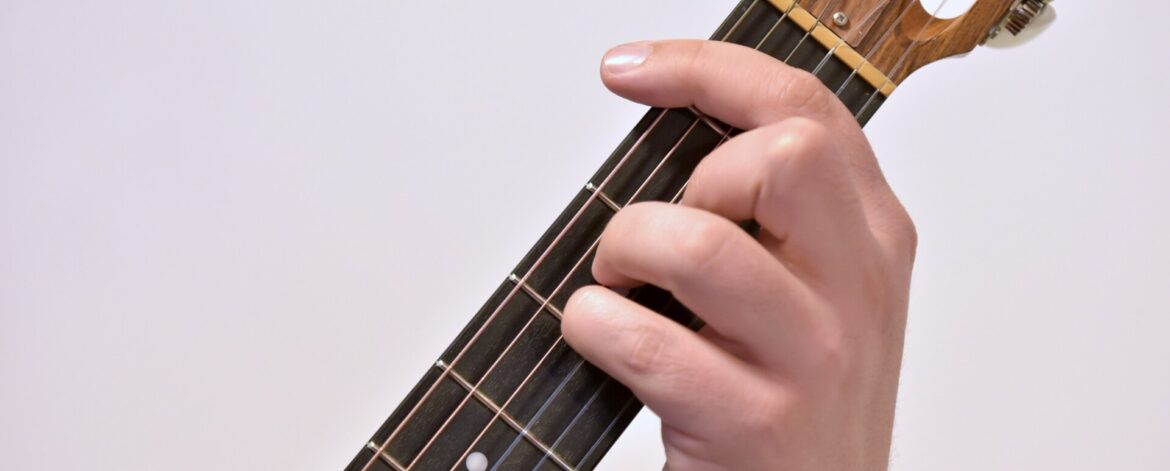
If you are wondering how to play barre chords without the buzzing, muted strings and aching hand, the short version is this: a well set up guitar, a lower thumb, a barre finger rolled slightly onto its side, and short daily practice that starts higher up the neck. The promise of this guide: a clean F chord in about 4 weeks with 10 to 15 minutes a day. That is a typical timeline in our teaching opinion, not a guarantee. Some players need a few months, especially on acoustic.
Barre chords are the best known wall for beginners. In our guide to how long it takes to learn guitar, we found players reporting anywhere from about 2 weeks to about 10 months for a usable F chord. Below: why that range is so wide, what to check on your guitar, a 4 week plan with a free drill sheet, and first shapes and songs.
How to play barre chords: the quick answer
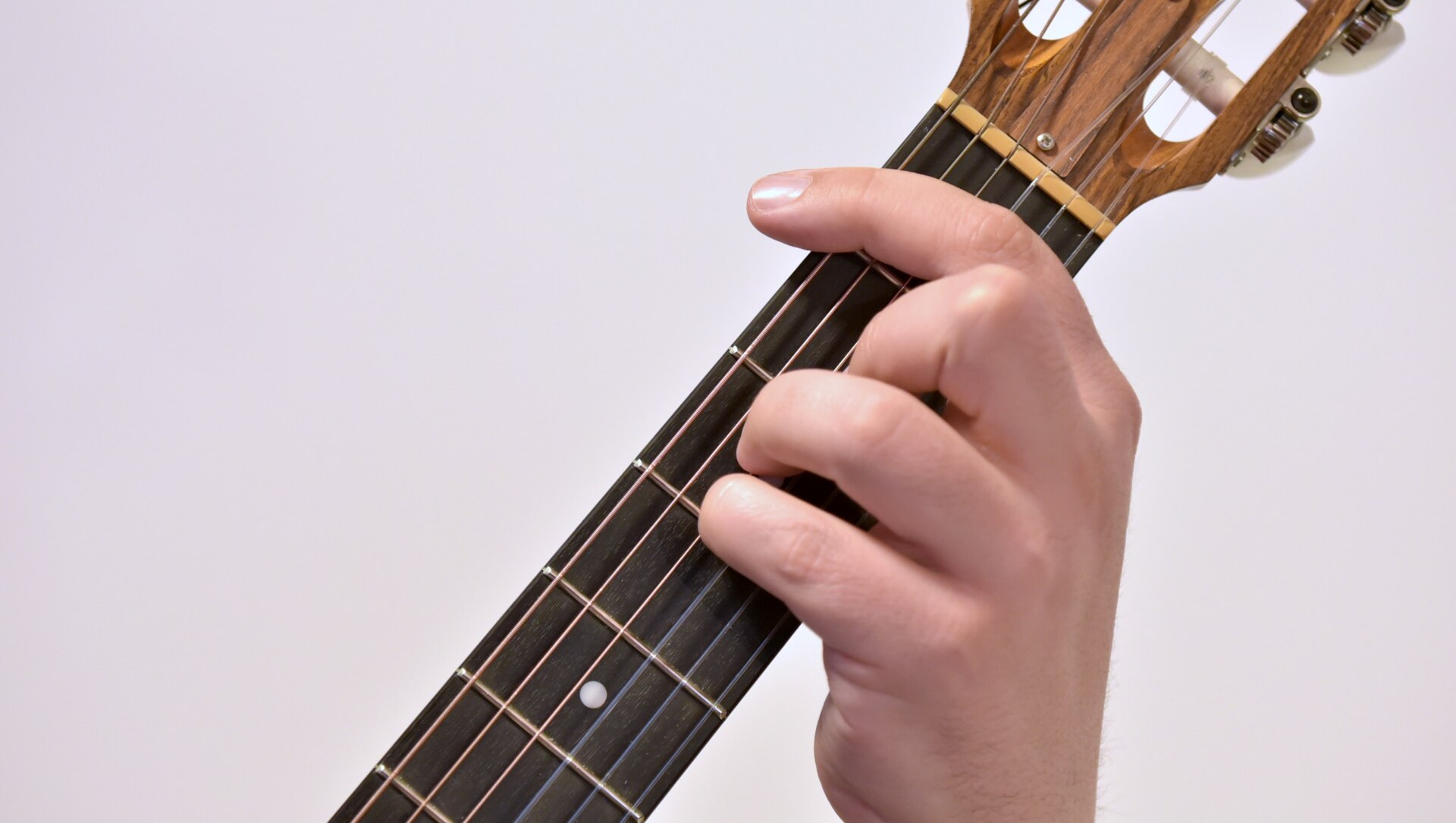
A barre chord uses one finger, usually the index, to press several strings at the same fret while your other fingers make a chord shape in front of it. Guitar World describes the barre finger as working “like a capo”, which is why a couple of shapes let you play almost any chord. Here is the method in six steps.
- Check the guitar. High action or a high nut makes barres much harder.
- Place the barre just behind the fret, not in the middle of the gap between frets.
- Roll the index finger slightly onto its outer edge. Guitar World notes that the side of your finger is harder than the front, so it presses more easily.
- Drop your thumb to the back of the neck, roughly behind your middle finger, rather than hooking it over the top.
- Use arm weight, not grip. Let the arm pull back gently so the fingers sink in, instead of squeezing between thumb and fingers. This is a tip JustinGuitar community members often share.
- Pick each string one at a time to find the dead or buzzing one, adjust, then strum.
None of this needs huge strength. As one JustinGuitar community member put it in the long running F chord thread, “A little strength is required, but it’s mainly about good technique.”
Why barre chords feel so hard
Finger strength and the index finger
Your index finger has creases at the joints, and a string that falls into one will not press down properly. One finger is also doing the job of up to six. Fender’s F chord guide sums up what beginners hear: a chord “full of fret buzz, sore fingertips and strained wrists”. Fender also points out that the F at the first fret is so close to the headstock that it needs a lot of pressure to sound clean. In our teaching experience, finger position fixes more barre chords than strength does.
Thumb position
Wrapping the thumb over the top of the neck, fine for many open chords, pulls the index finger away from the strings in a barre. Richard_close2u, a moderator and JustinGuitar Approved Teacher, advises in the JustinGuitar community F chord thread that the tip of the thumb should sit no more than about two thirds of the way up the back of the neck for barre chords, and that the elbow should be a little out from your body rather than digging in. Hands differ, so treat this as guidance, not a fixed rule.
Setup and action
Action is the height of the strings above the frets. Fender’s Allen Abbassi explains the trade off: “The lower the action, the easier it is to push the string down to the fret, but it also makes it more possible that your fret will buzz.” In our experience, many budget and second hand guitars arrive with the action or nut higher than it needs to be, and forum accounts point the same way. On the JustinGuitar community, one member said it took 6 months to play the E shaped F on an acoustic, with no trouble on electric, and that a first ever setup fixed it. Another said a luthier adjusting the action ended months of struggle. These are individual accounts, not data.
Setup first: action, string gauge, nut, tuning
Before you blame your hands, check the guitar. These published starting points are guides, not hard rules; a good technician will set your guitar to suit how you play.
| What to check | Published starting point | Source |
|---|---|---|
| Electric action at the 17th fret (9.5 to 12 inch neck radius) | 4/64 inch (1.6 mm) on both bass and treble sides | Fender Stratocaster setup guide |
| Acoustic action at the 12th fret | 3/32 inch (2.4 mm) bass side, 2/32 inch (1.6 mm) treble side, lower if there is no buzz | Martin Guitar action gauge |
| String height over the 1st fret (nut), low E to high E | About 0.025, 0.022, 0.020, 0.016, 0.014 and 0.011 inch (about 0.64 mm down to 0.28 mm) | StewMac |
Action. Measure from the top of the fret to the bottom of the string with a rule that starts at its edge. If your guitar is well above these figures, a setup may help more than any exercise.
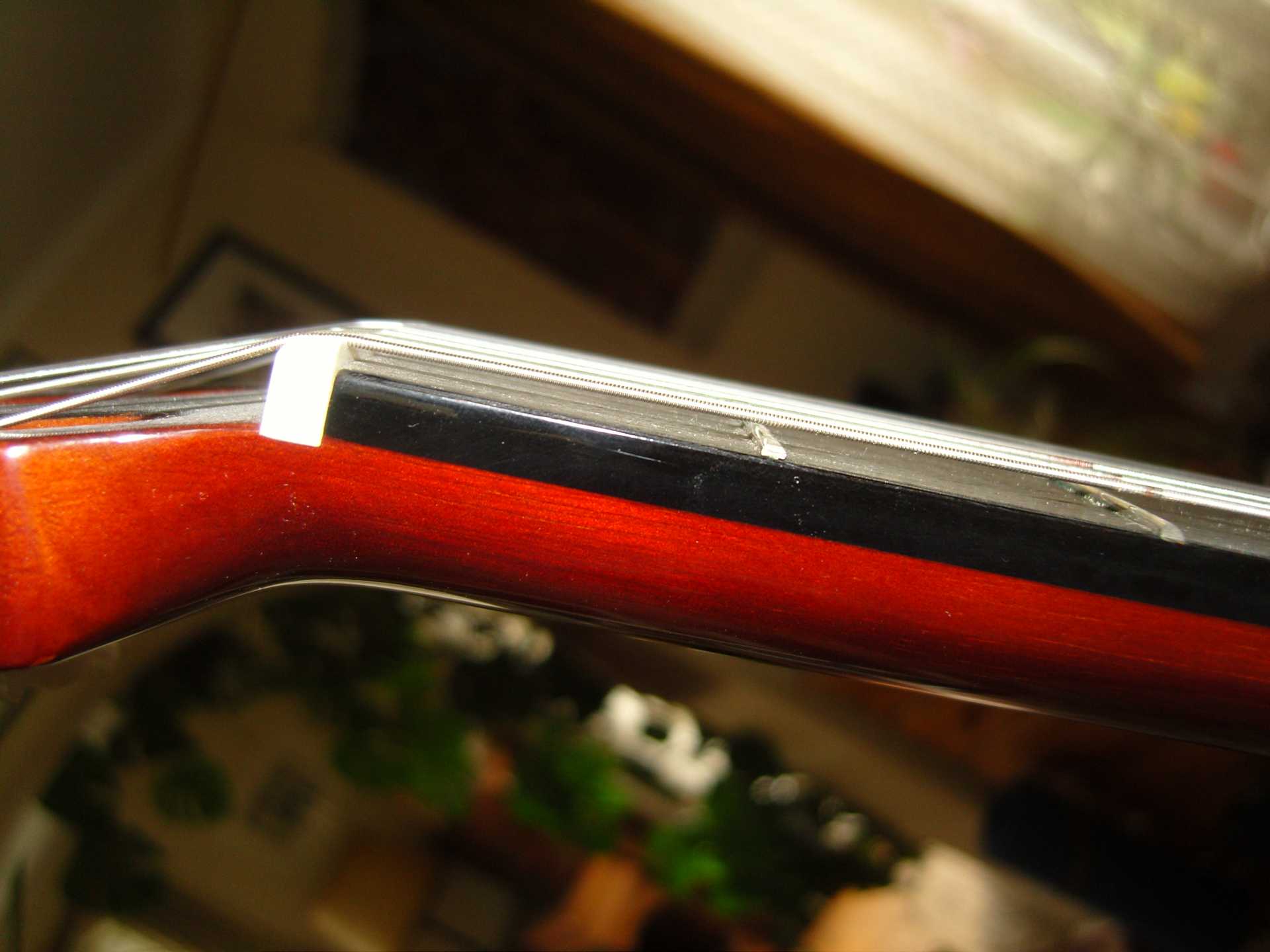
Nut. The nut is the slotted strip at the headstock end. If its slots are too high, the first two frets feel stiff, which is exactly where the F chord lives. A quick check from StewMac: press a string down at the 3rd fret, then look at the gap over the 1st fret. There should be only a very small gap. StewMac also warns that filing a nut is risky, because “all it takes is one swipe” to ruin it, so leave nut work to a technician.
String gauge. Lighter strings carry less tension. Adding up the per string tensions D’Addario publishes, a 9 to 42 electric set totals about 84 lb (38 kg), a 10 to 46 set about 103 lb (47 kg), and a 12 to 53 light acoustic set about 161 lb (73 kg). Tension is not the same as the force under your finger, but it helps explain why barres feel easier on a light electric set. Our guitar string gauge guide shows what well known players use.
Tuning. Tune before every session. An out of tune barre chord sounds wrong even when your technique is right.
The 4 week plan
The best way to learn how to play barre chords is little and often, so this plan is built around 10 to 15 minutes a day. The weekly targets are typical, not guaranteed, and it is fine to repeat a week. The idea, which Fender’s guides also follow, is to start with partial barres and the easier frets higher up the neck, then work down to the F chord at fret 1. Fender notes that higher up the neck the frets are closer together and less pressure is needed.
| Week | Focus | Barre chord exercises | Minutes a day |
|---|---|---|---|
| 1 | Partial barres and hand position | Two string barre at fret 5 (B and high E), then three strings. Mini F: the 3 note and 4 note versions from Fender’s guide. Pick each string to check it rings. | 10 |
| 2 | Full E shape higher up the neck | E shape A major at fret 5, then G at fret 3. Press and release: hold for a slow count of 2, relax fully, repeat 10 times. Pick string by string. | 10 to 12 |
| 3 | F at fret 1 and the A shape | E shape F at fret 1. A shape D major at fret 5, then B at fret 2. Slow changes from C to F, four beats each. | 12 to 15 |
| 4 | Changes and songs | Change between E shape and A shape barres. Play a song progression slowly with a metronome, four beats per chord, then two. | 15 |
Warm up with a minute of easy open chords, do the exercises, then finish with something you enjoy. Rest if your hand starts to ache. Checkpoints to aim for, in our teaching opinion: by the end of week 2, G at fret 3 rings on all six strings in most attempts; by the end of week 3, F at fret 1 rings cleanly when picked slowly; by the end of week 4, you can change from C to F in time at a slow tempo. If you want to fit this into a wider routine, our guitar practice routine guide shows how professional players split their practice time.
Download the free barre chord daily drill sheet (PDF)
Common mistakes and quick fixes
Barre chord buzzing
Barre chord buzzing usually comes from one of three things: the barre sits too far from the fret, a string lies in a crease of your finger, or the action or nut is too low or too high. Move the barre right up behind the fret, roll the finger slightly onto its edge, and pick string by string. If a string buzzes even on open chords, the guitar probably needs a technician.
Muted strings
A dead string means the barre is not pressing it or another finger is touching it. On the E shape, the G string often lands in the crease of the index finger; sliding the whole barre slightly up or down usually finds a better spot. Keep the other fingers arched so they press with their tips. Guitar World also notes that on the E shape it is fine to leave out the high E string while you learn.
When barre chords hurt my hand
If barre chords hurt your hand, the most common cause in our experience is squeezing too hard between thumb and fingers. Drop the thumb, relax the grip until the chord just starts to buzz, then add only enough pressure to make it ring. Keep sessions short and use the press and release drill rather than holding a chord for minutes. Fender’s advice is blunt: “If you experience wrist pain, stop!” Some tiredness in the hand muscles is common at first, but sharp pain, numbness, tingling or pain that lasts after you stop playing is not something to push through. If your fingertips are the problem, see our guide to sore fingertips from guitar.
Wrist angle
A 1997 study by Werner and colleagues measured pressure inside the carpal tunnel in seven people and found it was lowest with the wrist in a neutral position, and highest with the wrist bent strongly forward or back. It was small and not about guitar, but it fits the usual teaching advice: raise the neck a little and keep your elbow slightly away from your side so the wrist stays closer to straight.
This is general guidance, not medical advice. If pain persists, see a teacher or a health professional.
Barre chord shapes to learn first
For barre chords for beginners, two shapes cover most songs. They are named after the open chords they come from.
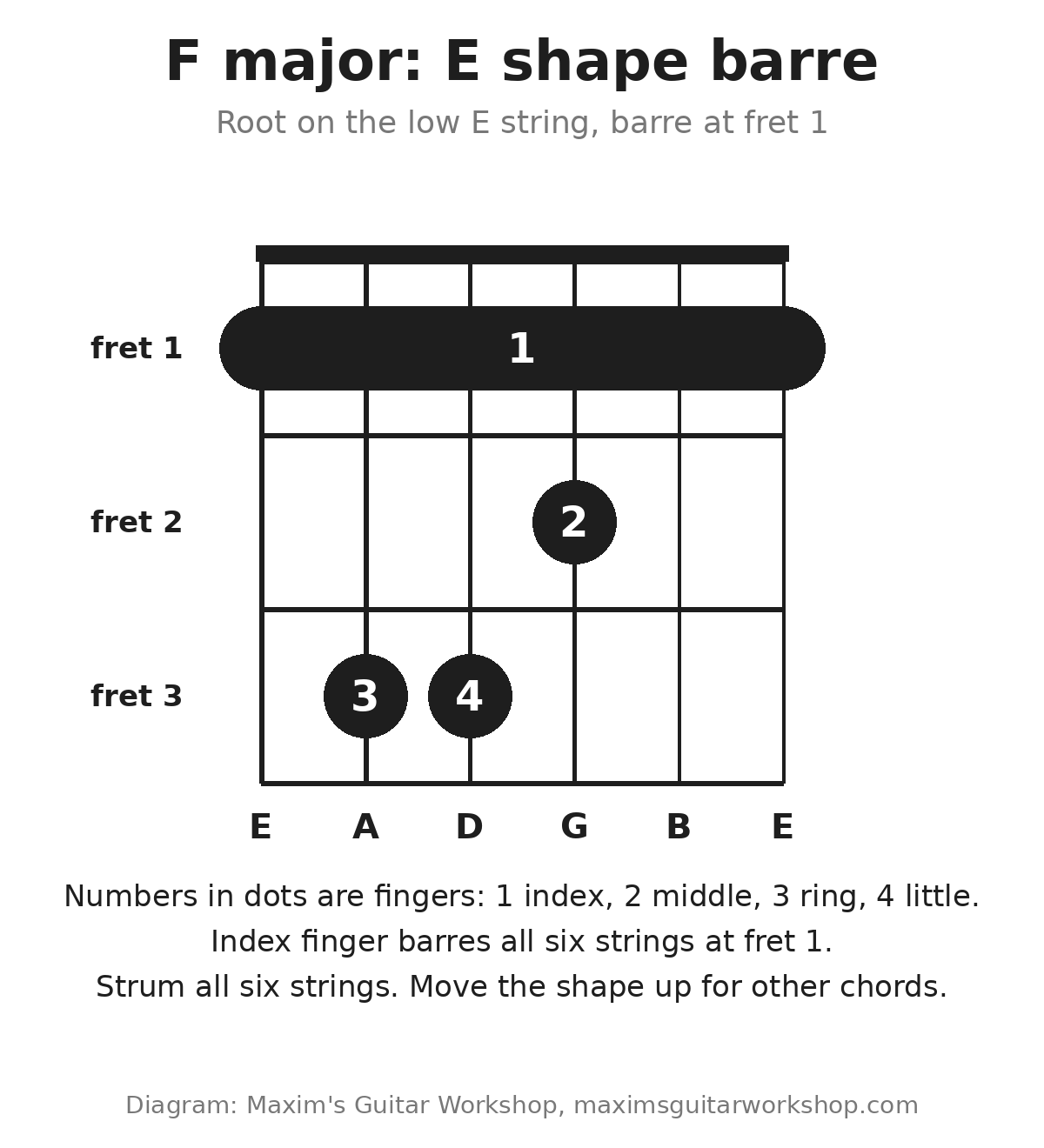
The E shape (root on the 6th string)
This is the open E chord moved up the neck, with the index finger acting as the nut. At fret 1 it is F major; at fret 3 it is G; at fret 5 it is A. The note under your index finger on the low E string names the chord.
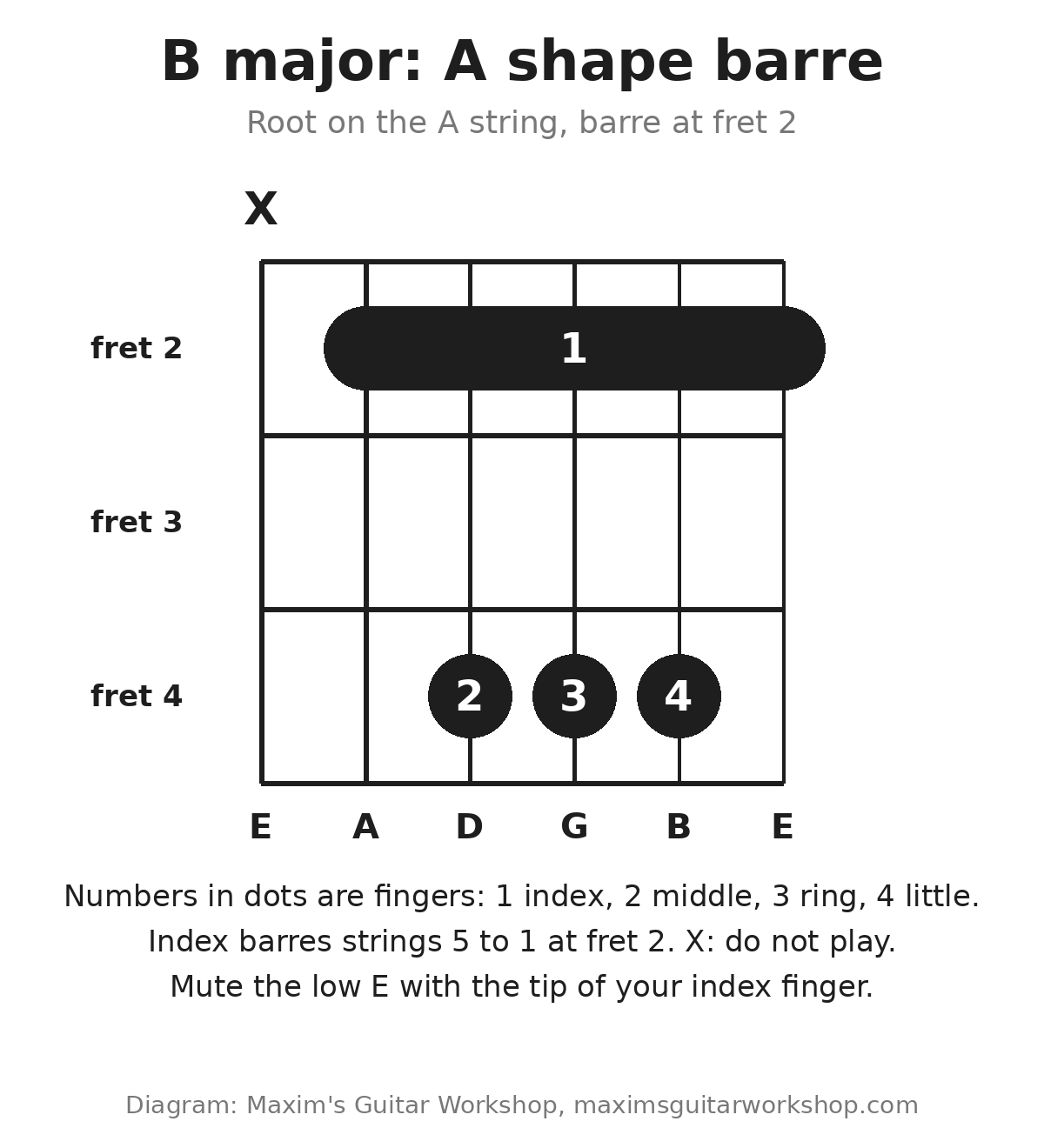
The A shape (root on the 5th string)
This is the open A chord moved up the neck. The index finger barres strings 5 to 1 and the other three fingers sit two frets higher on the D, G and B strings. At fret 2 it is B major; at fret 1 it is B flat. Mute the low E string with the tip of your index finger. Some players barre those three notes with the ring finger instead, Guitar World notes.
Once these two feel steady, the minor versions come next: the E shape minor is the open E minor shape moved up the neck, and the A shape minor is the open A minor shape moved up. Fender’s B minor guide walks through the A shape minor at fret 2.
First songs that use barre chords
We have only listed songs where we could confirm the chords from two sources.
- Creep, Radiohead. The whole song cycles through G, B, C and C minor, as described in the Wikipedia article on the song. Andy Guitar’s Creep lesson plays it entirely with root 6 (E shape) barre chords at frets 3, 7 and 8. One shape moving around the neck makes it a good week 4 song.
- With Or Without You, U2. The progression is D, A, B minor and G, per Wikipedia and our library of songs with common chord progressions. Only B minor needs a barre (an A minor shape at fret 2), so it is a gentle first step.
As a rule of thumb, songs in keys such as F, B flat or B usually need at least one barre chord.
FAQ
Why do my barre chords buzz?
Usually the barre is too far from the fret, a string sits in a finger crease, or the thumb is too high. If one string buzzes everywhere, have the guitar checked.
How long do barre chords take to learn?
In our teaching opinion, about 4 weeks of 10 to 15 minutes a day is a typical target for a slow, clean F chord on a well set up guitar. Fast changes take longer, and player reports range from about 2 weeks to about 10 months.
Are barre chords harder on acoustic guitar?
Usually, yes. Acoustic strings are heavier and carry more tension, and acoustic action is often higher. Fender suggests learning the full F on an electric first if you can, because the lighter string tension is easier on the wrist.
Can I skip barre chords?
For a while. Capos, the mini F and other partial shapes will get you through many songs. In our opinion, you will still want barre chords eventually, because they let you play chords anywhere on the neck and in any key.
Should barre chords hurt?
Some fingertip soreness and tired hand muscles are common in the first weeks. Sharp pain, numbness or pain that lingers is not normal. Stop, check your thumb and wrist, and if it persists see a teacher or a health professional.
Knowing how to play barre chords opens up the whole neck, and a few minutes a day is enough to make steady progress. If you would like a guided start, have a look at our online beginner course.