You can strum the chords and you know the words, but the moment you try both, your strumming hand stops or your voice follows the guitar off the beat. That is normal, and it is a skill you can practise like any other. This guide shows you how to sing and play guitar at the same time with a six rung practice ladder, a free timing trainer you can use right on this page, and a printable worksheet. In our 20 years of teaching, this ladder has got many nervous students singing along to their own playing.
Quick answer
Get the guitar part automatic first, so you can strum it without looking or thinking. Then add your voice in small steps: speak the lyric with one strum per bar, then sing with one strum per bar, then a strum on every beat, then the full strum pattern. Mark where each chord change falls under the lyric, start slowly, and only speed up when a rung feels easy three times in a row.
How to sing and play guitar at the same time (the short method)
Here is how to sing and play guitar at the same time in three parts. The rest of this guide fills in the detail.
- Automate the guitar. Play the chords and strum pattern until you can do it while chatting to someone. If you need to watch your hands, it is not ready.
- Map the song. Write out the lyric and mark the syllable where each chord change lands. Most changes fall on beat 1, right on a stressed word.
- Climb the ladder. Combine voice and guitar in six small rungs, from speaking the words over one strum per bar up to a full performance. Note your tempo at each rung so you can see progress.
Why it feels impossible at first (hands vs voice)
Psychologists have studied doing two things at once for decades, and singing while you play is the textbook musical example. Richard Hass, Robert Weisberg and Joseph Buonanno call a singer accompanying themselves on guitar the classic example of dual task performance in music. Summarising earlier work, they note that in laboratory studies, performance on either task can suffer, and that practising the two tasks together improves combined performance, though not always to the point of zero errors (Hass, Weisberg and Buonanno, 2014).
Part of the reason is a bottleneck in decision making. In Harold Pashler’s review of dual task research, when two tasks each need a response at almost the same moment, one response is usually delayed (Pashler, 1994). On guitar, that is the moment a chord change and a new line of lyric arrive together, and the strumming hand freezes.
The fix is automaticity. In a study by Russell Poldrack and colleagues, people practised a key pressing sequence for about three hours over several days. By the end, a second task barely slowed them down, and brain areas linked to effortful control were much less active during the dual task (Poldrack and colleagues, 2005). The researchers defined automaticity exactly this way: performance that is hardly affected by another task.
Attention matters too, and it changes with skill. Sian Beilock and colleagues found that experienced golfers putted more accurately when distracted by a second task than when told to focus on each step of their stroke. Novices showed the opposite pattern, doing better when they focused on the skill itself (Beilock and colleagues, 2002). For guitar, that suggests learning the part with full attention first, then letting it run on its own while your attention moves to your voice.
An honest note: none of these studies tested singing guitarists directly. The closest is a study of beginner class guitar students asked to sing and accompany a familiar melody by ear, where in the second experiment the group who saw and heard an instructor model it finished fastest (Wlodarczyk, 2010). Our ladder is a teaching sequence informed by this research, not a tested protocol.
The six rung ladder, with tempo boxes
The ladder is the practical heart of how to sing and play guitar at the same time. Use a slow, steady tempo, a metronome or a drum loop, and one song. Move up a rung when you can play the whole verse cleanly three times in a row. If a rung falls apart, drop back one rung or slow down by 10 beats per minute. The worksheet has boxes for your starting tempo and your solid tempo at every rung.
- Guitar alone, eyes up. Play the chords and the strum pattern for the whole song without looking at your hands. Test it by talking, counting out loud or humming over the top.
- Speak the lyric, one strum per bar. Strum once on beat 1 of each bar and speak the words in rhythm. Speaking removes pitch from the job, so you can focus on timing.
- Sing, one strum per bar. Same as rung 2, but sing the melody. Let each strum ring while you sing.
- Sing, a strum on every beat. Simple down strums on each beat. You will start to feel which words land on which strums.
- Sing with the real strum pattern. Add the full pattern. Practise the hardest line on its own if needed, then put the verse back together.
- Full performance, recorded. Play the whole song at your target tempo, looking up rather than at your hands, and record it. Listen back for rushed changes and lost words.
Practising with a groove helps rungs 4 to 6 feel like music rather than an exercise. Our guide to practise guitar with drum loops shows simple ways to set that up.
The song prep grid: chord changes under the lyric
The single most useful thing you can do before you sing a new song is to write the lyric out and mark exactly which syllable each chord change falls on. Once you know that the change to C lands on “sweet”, your hands and voice have a shared target instead of two separate jobs. Most of the work in learning how to sing and play guitar at the same time is getting those meeting points clear.
The trainer below shows a worked example using “Amazing Grace”, which is in the public domain. It is in 3/4 time, so you count 1 2 3. Press Start, strum on beat 1 of each bar for rung 3, or on every beat for rung 4, and sing along. The red box follows the beat, and the line under the bar number warns you before every chord change.
Sing and play timing trainer: Amazing Grace (public domain)
Press Start for a one bar count in, then strum on beat 1 of each bar (or on every beat) and sing. The red box shows the beat you are on, and the next change line warns you before every new chord. Chord changes are marked in red and land on the bold syllable. In 3/4 time, count 1 2 3. Start slow and only speed up when it feels easy.
Tempo
|
|
|
| ||||||||||||||||||||||||||||||||||||
|
|
|
| ||||||||||||||||||||||||||||||||||||
|
|
|
| ||||||||||||||||||||||||||||||||||||
|
| ||||||||||||||||||||||||||||||||||||||
Lyrics: John Newton (1779), tune New Britain (1829), both public domain. Newton wrote “now am found”; many hymn books sing “now I’m found”. The (A) in bar 14 is the pickup when the trainer loops back to the start. Simple three chord arrangement in G by Maxim’s Guitar Workshop. The click needs sound on; the trainer runs in your browser and saves nothing.
Notice the pattern in the worked example. Every chord change lands on beat 1, on the first stressed syllable of a bar: “sweet”, “sound”, “me”, “once”, “now”, “found” and “see”. The words “A”, “I” and “that” are pickups, sung just before the change. When you prepare your own song, look for these meeting points first, then mark any change that comes between words or before a line starts, because those are the ones that trip people up. Mapping these points is the step most people skip when they try to work out how to sing and play guitar at the same time.
The worksheet has a blank grid for your own song: one line per lyric phrase, beat boxes along the top and a row for the chord above each syllable. It also repeats the Amazing Grace example so you can see how a finished grid looks.
Download the free Sing and Play Worksheet (PDF)
How to sing while playing guitar: picking a first song
Your first song makes a big difference. If you are working out how to sing while playing guitar for the first time, choose one that makes the job easy:
- Three or four chords you already change between cleanly.
- A slow to medium tempo with a steady, simple strum.
- Chord changes once per bar, ideally on beat 1.
- A melody in a comfortable range for your voice. Use a capo to move the key up until it sits well, and keep the same chord shapes.
- Words you know by heart, so you are not reading lyrics as well as playing and singing.
Folk songs, hymns and campfire songs are ideal because their rhythm is simple and steady. Our list of songs with common chord progressions has plenty of options that reuse the same few chords. To break a new song into parts before you start singing, use our guide on how to learn a song on guitar.
Once a song is solid, play it for people. Our open mic tips for guitarists cover your first night on stage. If you want to play outdoors, check the busking permit rules for your city first, and when someone offers to pay, our guide on how much to charge for a gig will help you set a fair fee.
FAQ
Why can’t I sing and play guitar at the same time?
Usually because the guitar part is not automatic yet, so it competes with your voice for attention. The hardest moments are when a chord change and a new line arrive together. Make the guitar part automatic, map the changes under the lyric, and build up with the ladder.
How long does it take to learn to sing while playing guitar?
It varies a lot. Many students get a simple song together within a week or two of short daily practice, and the second and third songs come faster. Songs where the strum and the vocal rhythm clash take longer, so slow them right down.
Should I learn the guitar part or the singing first?
The guitar part, until you can play it without looking or thinking. Know the words by heart too. Then combine them using the ladder, which is the core of how to sing and play guitar at the same time.
Do I need to be a good singer?
No. You can learn how to sing and play guitar at the same time with an ordinary voice. Rung 2 has you speaking the words, so timing comes first and pitch can improve separately. Choosing a comfortable key with a capo helps more than most people expect.
What if the strumming rhythm and the vocal rhythm are different?
That is common, especially with syncopated songs. Slow right down, write the grid with every strum marked, and find which syllables line up with which strums. Practise just that line at rung 4 before adding the full pattern.
Start with one song
Learning how to sing and play guitar at the same time is not a talent you either have or do not have. It is two skills joined at a few clear points, practised in small steps. Pick one easy song, print the worksheet, and climb one rung at a time.
If you want help getting your chords and strumming automatic first, our online beginner course takes you through the basics at your own pace.
Sources
- Beilock, S. L., Carr, T. H., MacMahon, C. and Starkes, J. L. (2002). When paying attention becomes counterproductive: impact of divided versus skill focused attention on novice and experienced performance of sensorimotor skills. Journal of Experimental Psychology: Applied, 8(1). DOI link
- Hass, R. W., Weisberg, R. W. and Buonanno, J. (2014). Pickin’, singin’, and attendin’: possible limitations on human processing at the highest level of accomplishment. Psychomusicology: Music, Mind, and Brain, 24(2). DOI link
- Pashler, H. (1994). Dual task interference in simple tasks: data and theory. Psychological Bulletin, 116(2). DOI link
- Poldrack, R. A., Sabb, F. W., Foerde, K., Tom, S. M., Asarnow, R. F., Bookheimer, S. Y. and Knowlton, B. J. (2005). The neural correlates of motor skill automaticity. Journal of Neuroscience, 25(22). DOI link
- Wlodarczyk, N. (2010). The effect of audio and video modeling on beginning guitar students’ ability to accurately sing and accompany a familiar melody on guitar by ear. Journal of Music Therapy, 47(2). DOI link
- Newton, J. (1779). Amazing Grace, in Olney Hymns. Public domain. Tune: New Britain (1829), public domain.
Image credits
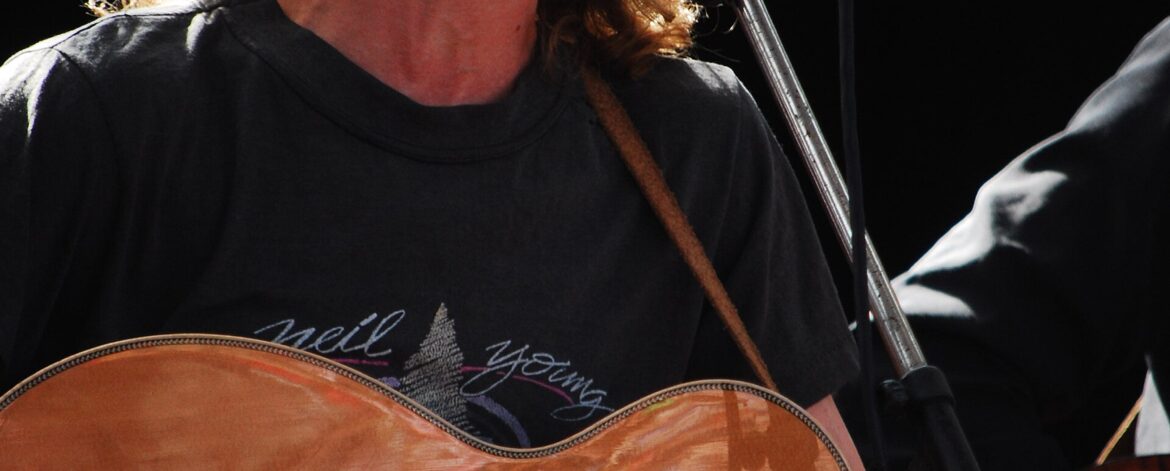
Willie Watson of Old Crow Medicine Show at Golden Plains festival, Meredith, Australia, by ashton, Wikimedia Commons, CC BY 2.0. Amazing Grace score (familiar style), Wikimedia Commons, public domain. Worksheet preview by Maxim’s Guitar Workshop.