

To transcribe a guitar solo by ear, you listen to a recorded solo, work out each note and rhythm on your own guitar, and write it down as tab or notation. It sounds hard, but broken into phrases it is a skill any player can build. This guide from Maxim’s Guitar Workshop in Darwin walks through the method we teach and includes a free printable worksheet.
Quick answer
To transcribe a guitar solo by ear, pick a short, slow solo you love, find the key, loop one phrase at a slower speed, sing it, find the first note, follow the shape and intervals, then add rhythm, bends and slides. Check it against the recording and keep the best licks in a lick book.
Why transcribing is worth it
Research suggests ear players have an advantage. Woody and Lehmann (2010) asked 24 college music students to learn short melodies by ear (Student Musicians’ Ear Playing Ability as a Function of Vernacular Music Experiences, Journal of Research in Music Education). Students with experience in styles such as rock, jazz and worship bands needed fewer listen and play attempts than students trained mainly from notation. Singing a melody back took fewer attempts than playing it. It is one small study, but it supports singing before you play.
Teachers agree. Guitarist Michael Kaplan told Berklee Online that transcribing by ear “is always the better way to go” because you hear the player’s nuances. The Leeds Conservatoire transcription guide calls it a practice method that works on time, technique, aural skills and feel all at once.
Choosing your first solos
The best first solo is one you love that is also slow, short and easy to sing. Leeds Conservatoire suggests choosing solos you really like, on your own instrument at first. Page two of our worksheet has a ladder of 12 suggested solos rated 1 to 5. The ratings are our teaching estimates, and tabs online vary, so always check against the recording.
| Stage | Examples from the ladder | What it trains |
|---|---|---|
| Start here | Knockin’ on Heaven’s Door melody, Day Tripper riff | Finding notes, short loops |
| Next | Wonderful Tonight, Wish You Were Here first solo | Bends to pitch, vibrato, space |
| Stretch | Comfortably Numb first solo, Hotel California outro | Long phrases, speed, two guitars |
Set up: slow down and loop tools
Tune first, so your notes match the recording. If you tune by ear, our guide on how to tune a guitar by ear helps. Then you need a way to slow down and loop a phrase without changing its pitch. Free options: YouTube lets you change playback speed, and the free Audacity editor has a Change Tempo effect that changes speed without changing pitch. Paid software such as Transcribe! adds named loops and section markers, with a free trial.
Find the key and the box
Most rock and blues solos sit in a minor pentatonic shape. Hum the note the solo keeps resting on, then find that note on the low E string. That fret is usually the root of box 1. The key finder strip on the worksheet maps frets to keys, and our post on the modes of the minor pentatonic scale shows the other shapes. Knowing the box means most notes you hear will be under your fingers.
Phrase by phrase: how to transcribe a guitar solo by ear
Loop one phrase, usually two to four seconds. Listen until you can sing it. Then find the first note on the guitar. Next, follow the contour: does the line go up or down, in steps or jumps? For jumps, use interval reference songs. Our lists of interval ear training reference songs and descending reference songs help you name each jump.
Write each phrase on its own card on the worksheet: loop points, speed, first note, a sketch of the contour, intervals and a tab line. Teachers differ here. Kaplan warns that working only phrase by phrase can lose the sense of the whole solo, and suggests moving on when one bit will not come and returning later. Our view: use cards, but listen to the whole solo often.
Rhythm and articulation
Notes are only half the job. Tap your foot and note where each phrase starts against the beat. Then listen for how each note is played: bends (match the target pitch by ear), slides, hammer ons, pull offs, vibrato and muting. Tick these on each card. Kaplan says a good transcription gets notes, rhythms and chord changes right first, then the articulations.
Check, play along and keep a lick book
When every card is done, play along with the recording, first slowed, then at full speed. Wherever you clash, go back to that card. Once you can play it from memory, copy your favourite licks into the lick book page and try them in another position or key, as Kaplan recommends. Learning a whole song works the same way; see how to learn a song on guitar.
The more often you transcribe a guitar solo by ear, the more phrases you recognise next time. That is a teacher observation from our lessons, not a measured result.
Free transcription worksheet
Our two page Solo Transcription Worksheet helps you transcribe a guitar solo by ear one phrase at a time. Page one has a key finder strip and five phrase cards with loop points, sung contour, first note, intervals, a tab line and articulation ticks. Page two has the graded ladder of 12 first solos and a lick book page.
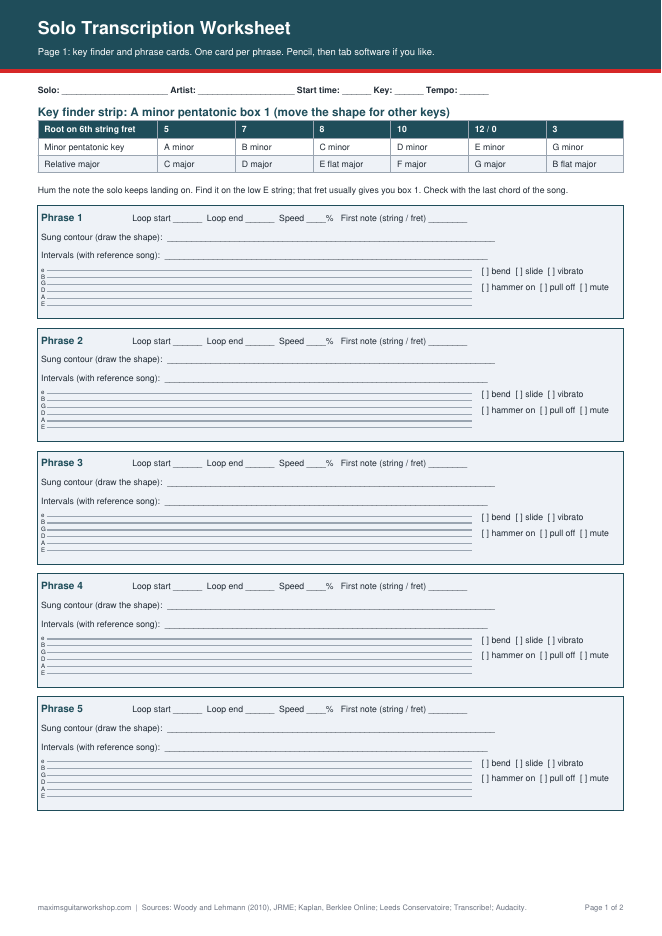
Download the free Solo Transcription Worksheet (PDF)
If you are still building the basics, our online beginner course is a good place to start.
FAQ
How long does it take to transcribe a guitar solo by ear?
It depends on the solo and your ear. A short, slow solo might take a session or two; a long, fast one can take weeks. That is our teaching estimate. Leeds Conservatoire notes the process may take months at first, and that is fine.
Can a beginner transcribe a guitar solo by ear?
Yes, if the solo is simple. Start with a slow melody you can sing and a few open position notes.
Should I use tabs instead?
Tabs are useful to check your work, but many are inaccurate. Kaplan suggests written transcriptions as a tool while your ear develops, always listening to the recording too.
How do I learn solos by ear faster?
Sing before you play, learn interval reference songs, and know your pentatonic boxes. Ear training for guitar solos improves with regular practice rather than shortcuts.
Do I have to write it down?
Not always, but writing it down helps you remember it and spot patterns. Kaplan writes a solo out only after he can play it from memory.
Image credits
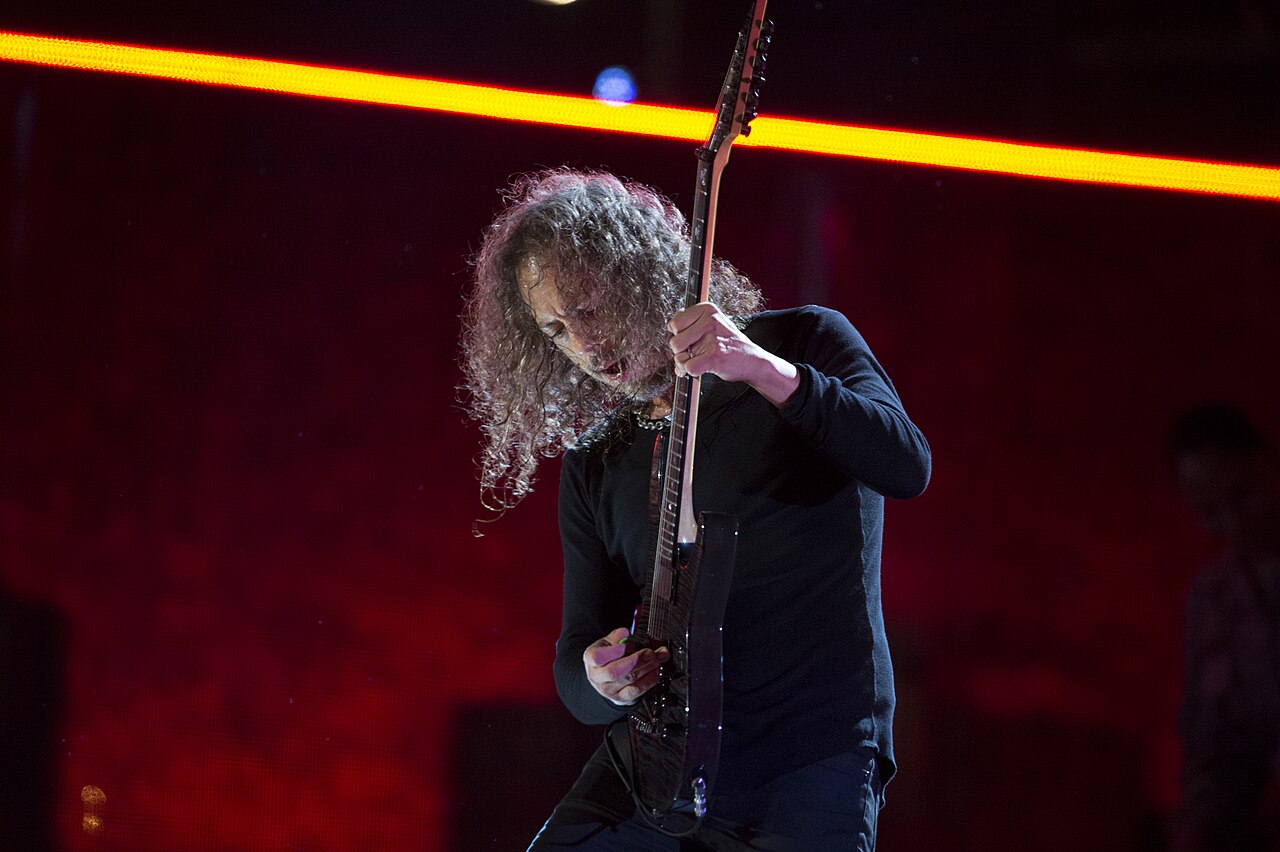
Kirk Hammett playing a guitar solo: DoD News Features, photo by EJ Hersom, Wikimedia Commons, licensed CC BY 2.0.
Solo Transcription Worksheet preview: Maxim’s Guitar Workshop.