

Interval ear training songs work like this: each song below starts with a rising interval. Learn the opening of the song, and when you hear two notes rise by the same distance, the song pops into your head and names the interval for you.
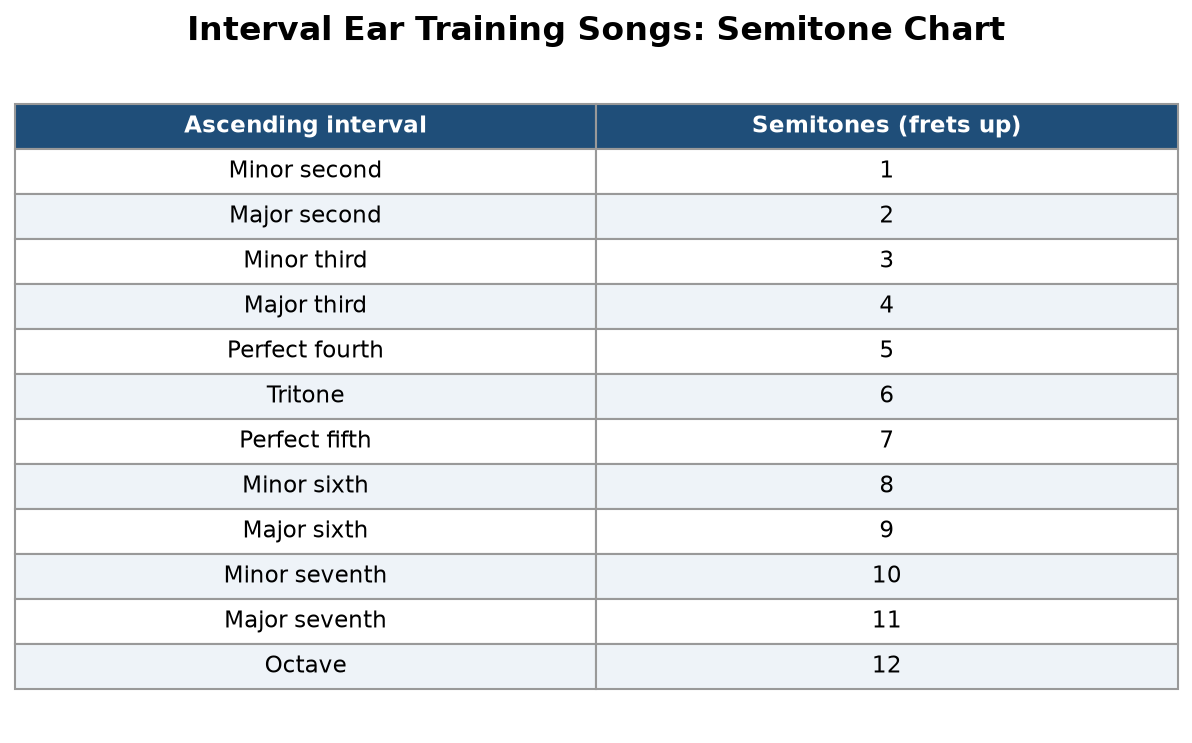
| Ascending interval | Semitones | Frets up one string |
|---|---|---|
| Minor 2nd | 1 | 1 |
| Major 2nd | 2 | 2 |
| Minor 3rd | 3 | 3 |
| Major 3rd | 4 | 4 |
| Perfect 4th | 5 | 5 |
| Tritone | 6 | 6 |
| Perfect 5th | 7 | 7 |
| Minor 6th | 8 | 8 |
| Major 6th | 9 | 9 |
| Minor 7th | 10 | 10 |
| Major 7th | 11 | 11 |
| Octave | 12 | 12 |
For more on intervals, see Wikipedia on intervals and Open Music Theory on intervals.
Using a reference song to recognise an interval is a very useful technique. Following is a list of all the intervals (ascending) with a corresponding reference song. The songs listed here are popular songs and therefore easy to remember.
Minor 2nd: Isn’t she lovely
Major 2nd: Happy birthday
Minor 3rd: Brahm’s lullaby
Major 3rd: When the saints go marching in
Perfect 4th: Here comes the bride
Tritone (minor 5th) : The devil’s note, and it doesn’t need a reference song! The tone is very evil and distinguishable.
Perfect 5th: Twinkle twinkle
Minor 6th: Love story (theme song)
Major 6th: Jingle Bells
Minor 7th: The winner takes it all
Major 7th: Star wars (theme song)
A Simple Daily Routine With Interval Ear Training Songs
Spend five minutes a day. Pick one string, play any note, then play a second note a set number of frets higher using the chart above. Sing or hum the matching reference song as you play. After a few days, ask a friend or an app to play random intervals and name them before checking.
Begin with intervals that sound very different, such as the major 2nd and the perfect 5th, and only add a new one when you get the first ones right almost every time.
Practice Tips for Faster Progress
Sing before you play. Hum the opening of the reference song, then find both notes on one string. Matching your voice to the guitar links the sound of each interval to its fret distance.
Train melodic and harmonic intervals. A melodic interval plays the two notes one after the other, while a harmonic interval plays them together. Reference songs help most with melodic intervals, so once those feel easy, play both notes at once and try to name the interval from its overall sound.
Use inversions to check yourself. An interval and its inversion add up to an octave, so a perfect 4th up from C lands on F, the same note as a perfect 5th down. Likewise a major 3rd inverts to a minor 6th, and a minor 2nd to a major 7th.
Keep sessions short and regular. A few focused minutes most days are easier to keep up than one long session a week. Say each interval name out loud as you play it, and keep a note of the intervals you mix up so you can give them extra attention.
For a deeper look at inversions, see Wikipedia on inversion.
Interval Ear Training Songs: FAQ
Do I need to know descending intervals too?
Yes, melodies move both ways. Continue with our descending interval reference songs.
Why do some intervals sound smooth and others tense?
That is the difference between consonance and dissonance, explained in consonant vs dissonant intervals.
What should I train after intervals?
Move on to chords and progressions with our chord progressions ear training library and learning the chord progression of a song by ear, and keep your guitar in tune with how to tune a guitar by ear.
Interval ear training songs work best alongside regular playing. For a guided start on guitar, try our online beginner course.
Put these intervals to work: learn how to transcribe a guitar solo by ear with our free worksheet.