

Sooner or later every student asks me the same thing: what should I actually do when I sit down with the guitar? A good guitar practice routine answers that question before you even pick up the pick. In this guide we look at how 14 rock and metal players, from John Petrucci and Steve Vai to Dimebag Darrell and Misha Mansoor, structured their practice in their own words, what the research on musicians says about structure, and how to turn all of it into a routine you can run in 30, 60 or 120 minutes a day. At the end you can grab a free practice log PDF built from the same ideas.
If you’re after the raw numbers, we’ve already looked at how many hours famous guitarists practised. This post asks a different question: not how long they played, but what they did with those hours, in what order, and with which tools.
Why structure beats hours
The most quoted study on practice is Ericsson, Krampe and Tesch Römer (1993). The best violinists at a Berlin music academy had built up far more solitary practice, around 10,000 hours by age 20 on retrospective estimates. The authors defined deliberate practice as effortful, goal directed work designed to improve performance. Less often quoted is what the paper says about session length:
- Practice diaries showed “uninterrupted sessions of practice alone were limited to a duration between 1 and 1.5 hr.”
- The paper cites the violin teacher Leopold Auer and the psychologist Carl Seashore recommending practice periods of “less than 1 hr with ample rest in between”.
- Training studies showed “essentially no benefit from durations exceeding 4 hr per day and reduced benefits from practice exceeding 2 hr”.
- Expert pianists showed a similar ceiling of around four hours of deliberate practice a day.
There are caveats. A 2014 meta analysis by Macnamara, Hambrick and Oswald found deliberate practice explained about 21% of the variance in music performance (about 23% after a 2018 correction). A 2019 replication of the violin study found practice explained 26% of the variance, against 48% in the original. So practice is essential, but hours alone don’t decide who gets great. What you do with them matters.
Quality over quantity
The study I quote most to students is Duke, Simmons and Cash (2009). Seventeen advanced pianists practised a hard Shostakovich passage and were retested the next day. Total time, total repetitions and complete run throughs did not predict the result. Better retention went with a higher proportion of correct attempts and fewer errors. The top performers fixed errors straight away, worked out where and why each one happened, varied the tempo systematically, and repeated a passage until it was correct and stable before moving on.
Spacing and mixing it up
- Spacing: in Simmons (2012), musicians learned a keyboard sequence with gaps of 5 minutes, 6 hours or 24 hours between sessions. The published abstract reports speed gains with 6 and 24 hour gaps, while accuracy gains needed the 24 hour gap, which includes sleep. A 2006 review by Cepeda and colleagues (317 verbal recall experiments, not motor skills) also found spaced practice beats cramming.
- Interleaving: Shea and Morgan (1979) found mixing motor tasks felt worse during practice but gave better retention than blocked practice. Wulf and Shea (2002) caution that simple lab tasks don’t always carry over to complex skills, especially for beginners. Carter and Grahn (2016) had 10 advanced clarinettists swap between a concerto excerpt and an exercise every 3 minutes, with modest, not always significant, gains.
One honest note: I couldn’t find a study on how electric guitarists specifically should split their practice. The research is on pianists, violinists, clarinettists and general motor learning, but it lines up well with what the pros below describe.
How 14 rock and metal pros practise
These profiles stick to what the players said in interviews. Where a detail comes from secondary summaries, I’ve said so.
John Petrucci (Dream Theater)
As a student Petrucci “practiced a minimum of six hours a day”, but the useful part is how he split it. His Guitar World column says to decide how long you have, then “parcel out specific blocks of time for each subject”, for example two hours as eight 15 minute chunks. His sample first hour is three 20 minute blocks: hand synchronisation, scales (four modes in one position, 5 minutes each) and arpeggios (Am7 in four positions, 5 minutes each). His key line: “always practice what you don’t know, not what you do know.” He also says half an hour every day beats five hours once a week.
His Rock Discipline video (1995) runs from stretches (“big to small”) to hand warm ups, synchronisation, then metronome work starting slow, around 60 BPM. (Secondary summaries say each of four technique areas gets about 30 minutes; that split is unconfirmed.) On tour he does about three hours in two 90 minute blocks, drills only the hard parts of the show, and keeps it to “a very light workout, maybe 15 minutes before the gig”, an idea he credits to Joe Satriani.
Steve Vai

Vai recently put his teenage schedule at about nine hours: “My schedule back then, I was happy if I got nine hours a day.” He’s clear that drive came first: “Passion is a much more powerful engine of creation than discipline.” His 10 Hour Workout (Guitar World, January 1990) is described by its Hal Leonard reprint as covering “scale and chord exercises, ear training, sight reading, music theory”. Secondary summaries describe one hour blocks of technique, scales and chords, ending with an hour of expressive “sensitivity” playing (one says jamming), so treat the exact split as unconfirmed. The 30 hour version was a multi day programme.
By 2015 his advice was simpler: “Practice very, very slow and perfect”, and only speed up once you can play it “at least 11 times in a row without making one mistake”. Premier Guitar reported that the 10 hour workouts were a thing of the past.
Joe Satriani
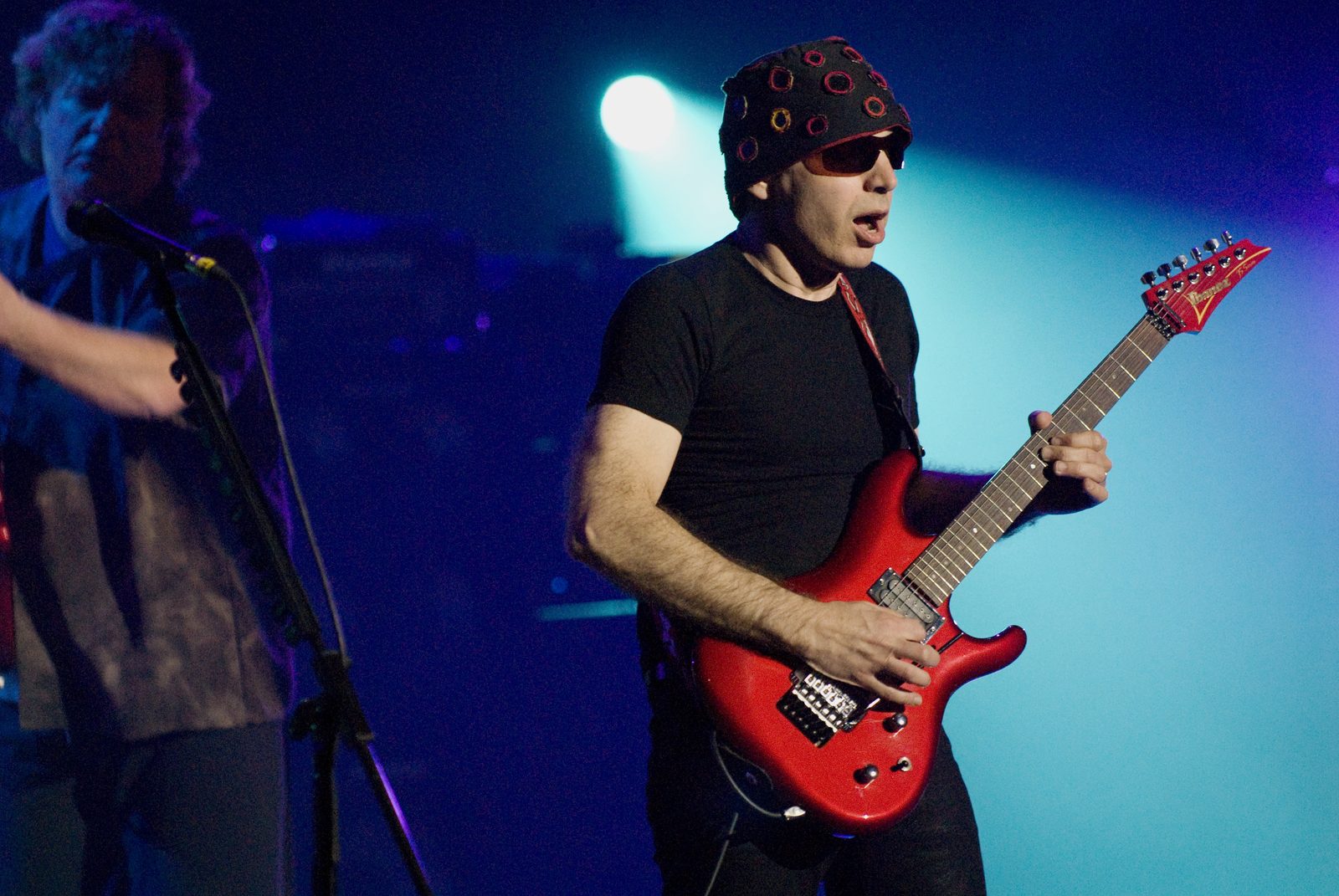
As a teenager Satriani practised for an hour before school, doing “all the boring stuff just to get it over with” so his afternoons were free for jamming, including every chord in a Joe Pass chord book: “there’s no substitute for bonehead repetition.” His rule: “limit yourself to one hour a day on anything that is new or especially challenging.” Learn every note on the neck (start with E everywhere) and stay in tune. Later he moved to spaced practice: “I’ll do something for 20 minutes and not do it again until eight hours later”, which he links to tension issues when he was young.
Paul Gilbert (Racer X, Mr. Big)
Gilbert’s teenage rule was simple: “My goal was to learn one new thing every day, with no days off. It didn’t have to be complicated or fast.” At 22 he broadened into songwriting, vibrato, phrasing and richer chords. His speed came from slowing a short phrase down until it was perfect, then speeding it up. Band rehearsals four or five days a week “really was the best practice I could ever have”. And a warning: his old pick grip “would hurt my thumb if I practiced too much”, so he spent nine months relearning it. More in our Paul Gilbert guitar techniques guide.
Yngwie Malmsteen
Yngwie rejects the word: “I didn’t practice. I never practiced… I played as if I was performing.” He admits “it’s inadvertently practicing, because I played so much. But I improvised”, for example in A harmonic minor, and he taped himself: “I’d listen back and decide.” The takeaway: improvise in a chosen key with full intent, then listen back honestly.
Marty Friedman (Cacophony, Megadeth)
Friedman says he hasn’t “practiced in probably three decades” because he’s always “performing, writing, rehearsing, recording”. His priority: “creating opportunities to play in front of people”, because a real deadline makes you work harder “than you would sitting at home with no goals”.
Kirk Hammett (Metallica)

In a 2023 Rick Beato interview (quotes from a transcript), Hammett describes playing first thing in the morning: Joe Satriani’s “jazz chord relay”, then “the old chromatic thing”, then “the modes in cycle of fourths”, then asking “do I have any riffs in me”, then learning something that caught his ear that week. Through the day he picks up the guitar “for like 15, 20 minutes” about “four or five times a day”. Metallica’s backstage Tuning room, often “an hour or more”, doubles as a warm up and riff recording session.
Dimebag Darrell (Pantera)
Dimebag’s tips: wide stretch trills (two, three, then four fret spans), the pentatonic blues scale “for fret and pick hand dexterity”, learning licks and songs from records, soloing over his own four track rhythm recordings, and never rehearsing the exact licks he’d play live, because “the feel overrides everything”. His father challenged him to learn “one new lick a day”. Don’t copy one thing: he trilled “until I feel a burn”, which conflicts with medical advice.
Zakk Wylde (Ozzy Osbourne, Black Label Society)
From about 15, Zakk learned “diatonic and pentatonic scales and how to change keys” plus songs from his teacher Leroy Wright. In 1989 he said he still practised “all day long”, and advised starting with “just some chromatic scales and finger exercises. Once you learn some songs, you won’t mind playing scales to improve.” Around 1999 it was a metronome, “some pentatonic scales”, videos of Al Di Meola, Alvin Lee or Joe Pass, and jamming with old records. He calls constant writing “the best way to evolve”.
Synyster Gates (Avenged Sevenfold)
In a 2017 Rick Beato interview, Gates said he plays “as much as I can” but can’t imagine 12 hours a day. After early success he spent five or six years on gypsy jazz, then études and “the modes of harmonic minor”, wishing he did “more theory and harmony”. His summary: “Practice doesn’t make perfect… perfect practice does.” (Quotes are from an auto generated transcript.)
Tosin Abasi (Animals As Leaders)
“I think it’s a good idea to section your practice sessions,” Tosin told Guitar World. His former routine: metronome warm up with alternate picking, then legato and string skipping, 20 to 30 minutes of reading, then one cool idea from an instructional video. Now metronome work is “about as structured as I get”.
Guthrie Govan (The Aristocrats)
Govan says players become what “they chose to prioritise”. He works on “getting things I can hear in my head out onto the fingerboard”: copy everything you hear (ringtones, film themes, the radio) and sing each note of your scales and arpeggios. His most useful line for students: “If you sound really good when you’re practising, that means you’re practising things you can already do.”
Misha Mansoor (Periphery)
“People always say to practise to a metronome. I would say that is not enough,” says Mansoor. Record yourself to a click and listen back, and use “a slightly crunchy tone” so you learn muting. Early 15 hour studio days led to burnout, so the band moved to an 11am to 7pm schedule.
Alexi Laiho (Children of Bodom)

“I definitely play every day no matter what,” Laiho said in 2016: about two hours a day on the road, warming up “at least for an hour before the show”, and “at least an hour a day” at home. After shoulder surgery, “It takes a lot more time for me to get warmed up.” His warm up phrases were short: single and two string alternate picking, inside and outside picking, stretches (stop if you feel discomfort), then legato.
Two more worth a mention
Slash told Guitar Player in 1991, “I was a workaholic. I’d play 12 hours a day,” and learned Jeff Beck’s “‘Cause We’ve Ended As Lovers” note for note; see our Slash guitar techniques guide. Eddie Van Halen described playing on the edge of his bed from 7pm until his brother got home at 3am, with those ideas feeding band practice.
Common patterns and the suggested time split
Put these routines side by side and the same habits keep turning up:
- A short, physical warm up comes first: Petrucci, Hammett, Dimebag, Laiho, Tosin, Zakk.
- Practice is time boxed: Petrucci’s parcels, Vai’s hour blocks, Satriani’s one hour cap and 20 minute chunks.
- Technique uses a metronome and a clean first rule, and for shred players it’s the biggest block.
- Repertoire learned by ear is the backbone for riff players such as Slash, Dimebag, Zakk and Hammett. On tour, practice shifts to the hardest parts of the show.
- Theory, ear and reading get a small, regular slice: Tosin’s reading, Satriani’s note finding, Guthrie’s singing.
- Creativity is built in: Vai’s sensitivity hour, Dimebag’s rhythm tracks, Hammett’s riffs, Yngwie’s improvising.
- Recording yourself is the most common feedback tool: Yngwie, Dimebag, Misha, Metallica.
- Playing with others counts as practice: Gilbert’s rehearsals, Friedman’s gigs, the Tuning room.
Habits change over a career. In the early years (roughly 12 to 20) volume is high: Vai about nine hours, Petrucci six or more, Slash 12, plus lots of learning by ear. Students and early pros add structure, theory and reading. Touring pros practise less, maintain show material, split sessions and pay more attention to warm ups and injury.
For the techniques themselves, our guide to five rock guitar techniques still used today is a good menu for your technique block.
The suggested time split
The split below is my inference from the routines above, not a figure measured in any study, so adjust it to your level:
| Section | Share of session |
|---|---|
| Warm up | 10% |
| Technique | 25% |
| Rhythm | 15% |
| Repertoire | 25% |
| Theory and ear | 10% |
| Creativity | 15% |
Beginners shift time from technique to repertoire and rhythm. Advanced players shift toward technique, hard passages and writing.
Metronome and tempo: clean first, then faster
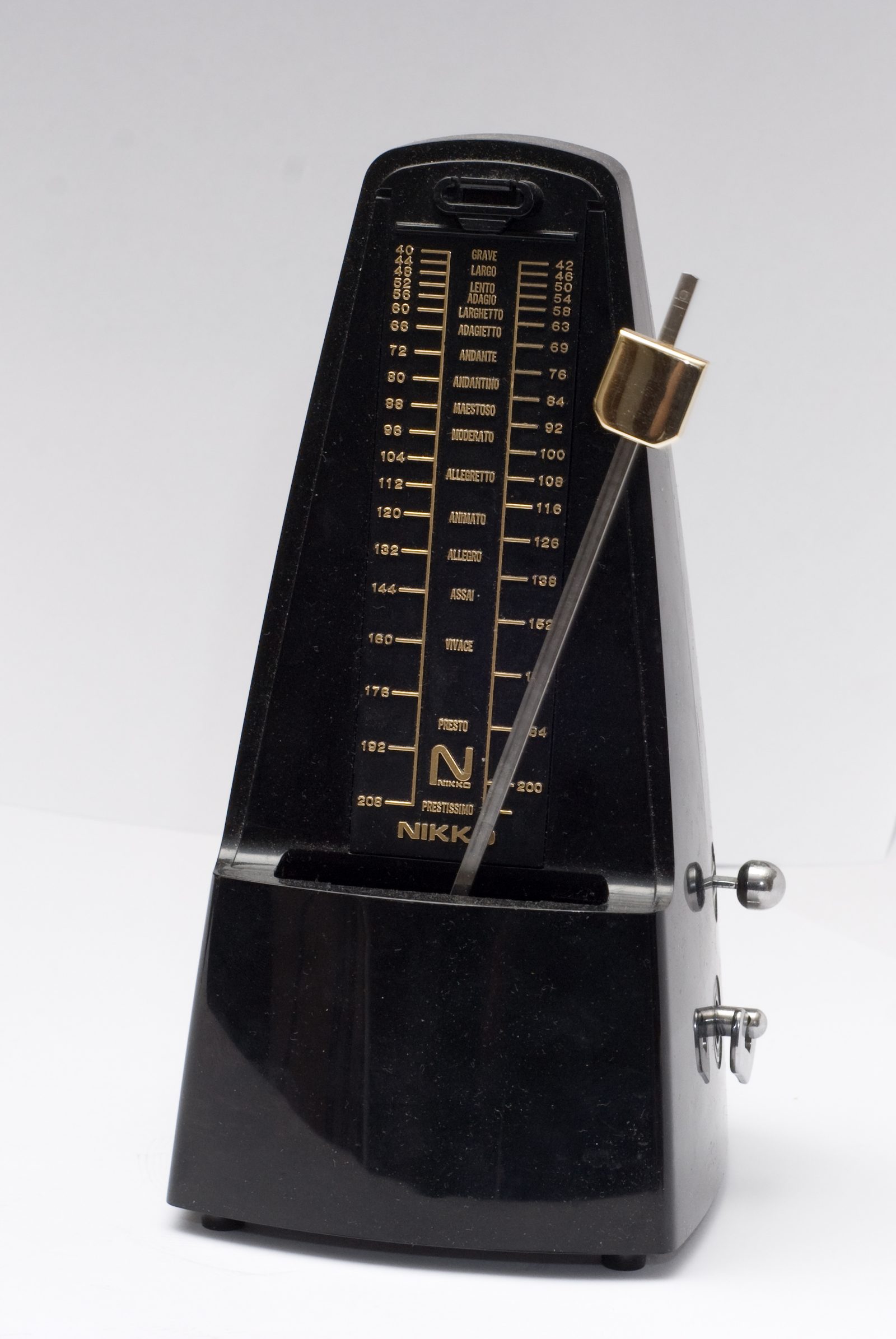
Gilbert, Vai, Petrucci, Zakk and Tosin all agree: slow and clean first, then small increases, and Mansoor adds recording against the click. Log the note value as well as the BPM, because “120 BPM” means nothing on its own. The formula is notes per second = BPM x notes per beat divided by 60, so 16th notes at 120 BPM are 8 notes per second, while triplets at the same tempo are 6. If note values are fuzzy, start with understanding triplets in music and the difference between beat, meter, tempo and pulse.
Injury prevention: protect your hands
Focal dystonia (musician’s cramp) affects about 1% of professional musicians. A 2015 systematic review of 1,144 affected musicians found it usually appears after at least ten years of intensive playing, typically between ages 28 and 44, mostly in the picking hand for plucked string players, and practice intensity often rose in the year before. The authors urge ergonomic playing, breaks and avoiding “stereotypical and repetitive exercises”. For 25% to 50% of those affected it ends or seriously limits their career.
A 2025 review of 22 studies (2,119 guitarists), still a preprint and not peer reviewed, estimated about half of guitarists report a playing related problem, with weak evidence that warm ups and breaks help. The pros learned this the hard way: Gilbert’s thumb, Satriani’s tension, Laiho’s shoulder, and Petrucci’s hands “burned out” after two hours just before a show. This isn’t medical advice, but these habits are sensible:
- Warm up gently and never play through pain. (See our stretches and hand exercises for guitar players.)
- Take a break at least every hour; shorter blocks are better.
- Don’t suddenly jump your daily volume, for example cramming before an exam or gig.
- Vary repetitive drills.
- Get persistent pain, loss of control or cramping checked by a GP or a physiotherapist experienced with musicians, for example through the Australian Society for Performing Arts Healthcare.
Your guitar practice routine: 9 templates for 30, 60 and 120 minutes
These rules apply to every template:
- Warm up gently, never to pain.
- Start technique below your clean tempo. Only raise the BPM (by 2 to 5) after several clean repetitions in a row. Vai’s bar is 11; a practical student target is 3 to 5.
- Split anything longer than 60 minutes into blocks with a break, ideally hours apart.
- Use the last 2 to 5 minutes for your log: what went wrong, where, why, and what you’ll start with tomorrow.
Beginner: 30 minutes
For roughly your first year. If you’d like a guided start, our online guitar courses walk you through your first song step by step.
- Warm up, 3 minutes: open string picking, gentle finger stretches
- Technique, 7 minutes: chord changes or a one string picking pattern, slow
- Rhythm, 5 minutes: down picking or strumming with a metronome
- Repertoire, 10 minutes: one riff or song section
- Theory and ear, 2 minutes: find one note everywhere on the neck, Satriani style
- Creativity, 3 minutes: make up a two bar riff and record it on your phone
Beginner: 60 minutes
- Warm up 5 / technique 12 / rhythm 10 / break 3 / repertoire 18 / theory and ear 5 / creativity 5 / log 2
Beginner: 120 minutes (two sessions)
- Session A (55): warm up 5, technique 15, rhythm 15, repertoire 20
- Breaks: 10
- Session B (55): warm up 5, repertoire 20, theory and ear 10, creativity 15, log 5
For beginners, 120 minutes a day is optional. As Petrucci says, consistency beats length.
Intermediate: 30 minutes
For players who know several songs and are working on lead technique. This is a solid everyday rock guitar practice routine.
- Warm up 3
- Technique 8: one item, with a metronome
- Rhythm 5: palm muting, tight down picking, syncopation
- Repertoire 8: the hardest section of your current song
- Theory and ear 3: one mode or arpeggio shape, sung while playing, Guthrie style
- Creativity 3
Intermediate: 60 minutes
- Warm up 5
- Technique 15: three items in 5 minute rotations, Petrucci style
- Rhythm 10
- Repertoire 15
- Theory and ear 5
- Creativity 8: a riff or solo over a backing track, recorded
- Log 2
Intermediate: 120 minutes
- Block 1 (60): warm up 8, technique 25, rhythm 15, theory and ear 10, log 2
- Break 10
- Block 2 (50): repertoire 25, creativity 20, log 5
Advanced: 30 minutes (busy day or show day)
- Warm up 5 / technique 10 (only the passages the gig needs) / repertoire 10 (the hardest sections of the set, at tempo) / creativity 3 / log 2
On show days, do this earlier and keep any warm up right before the gig light, as Petrucci learned.
Advanced: 60 minutes
- Warm up 6
- Technique 18: interleave two or three items
- Rhythm 10: to a click, recorded
- Repertoire 14
- Theory and ear 6: reading, transcription or singing lines
- Creativity 6
Advanced: 120 minutes
- Block 1 (60): warm up 8, technique 30 (three items, 10 minutes each, interleaved), rhythm 15, theory and ear 5, log 2
- Break 10, or split across the day, Satriani style
- Block 2 (50): repertoire 25, creativity and writing 20, log 5
This is the closest thing here to a full metal guitar practice routine: tight rhythm to a click, rotating technique, and real time for writing.
Download the free guitar practice log
Plans only work if you track them. Our free guitar practice log is an A4 PDF you can print at home: six research based rules, a goals page for SMART goals and BPM targets, a weekly planner with a hand and body check, daily log pages that count clean reps and BPM, a monthly BPM tracker, all nine routines at a glance, plus a repertoire tracker and riff bank. Print a stack and your guitar practice routine is ready to go.
A4 PDF, 10 pages. Print at home and start logging today.
Online course
Guitar Foundations 1: Play Your First Song
New to guitar? This online course walks you step by step from your first chords to playing your first complete song, so your practice routine has a clear goal from day one.
FAQ
How long should a guitar practice session be?
Shorter than most people think. In the Ericsson study, uninterrupted solo practice was limited to 1 to 1.5 hours. If you have two hours, split them into two blocks, ideally hours apart, like Petrucci and Satriani.
How do I build speed without getting sloppy?
Start below the tempo you can play cleanly, count clean repetitions in a row, and only add 2 to 5 BPM once you hit your target (3 to 5 for most students, 11 if you’re taking Vai’s challenge). If a tempo stalls for two weeks, drop back 10 to 20% and rebuild.
What are good guitar warm up exercises?
Simple and gentle: chromatic finger patterns, single and two string alternate picking, easy stretches and short legato phrases, as Petrucci, Laiho and Hammett use. Stop if anything hurts.
Do I need to practise every day?
Regular beats heroic. Petrucci says half an hour every day is better than five hours once a week, and the spacing research suggests sleep between sessions helps accuracy stick. Build a guitar practice schedule you can actually keep, with at least one light day a week.
Keep going
Structure is easier with someone in your corner. If you’d like a teacher to build your routine with you and keep you accountable, have a look at our guitar lesson options and fees.
Sources
Player sources
- Guitar World, John Petrucci, Practice Tips, Part 1 (Wild Stringdom column), republished 8 March 2013. https://www.guitarworld.com/blogs/john-petrucci-practice-tips-part-1
- Killer Guitar Rigs, transcript of Coffee With Ola interview with John Petrucci, 15 February 2023. https://killerguitarrigs.com/john-petrucci-practice-unnerving-aspect-dream-theater-shows/
- Guitar Player, John Petrucci’s top five tips, 9 December 2023. https://www.guitarplayer.com/player/john-petrucci-five-tips-for-guitrarists
- MusicRadar and Total Guitar, John Petrucci’s ultimate warm up guest lesson. https://www.musicradar.com/totalguitar/john-petruccis-ultimate-warm-up-guest-lesson-533027
- Guitar.com, Steve Vai on his teenage practice schedule, 19 August 2025. https://guitar.com/news/music-news/steve-vai-practice-schedule-as-a-teenager/
- Hal Leonard, Guitar World Presents Steve Vai’s Guitar Workout. https://www.halleonard.com/product/119643/guitar-world-presents-steve-vais-guitar-workout
- Guitar World, Revisit Steve Vai’s Classic Guitar World Lessons, 10 October 2014. https://www.guitarworld.com/features/revisit-steve-vais-classic-guitar-world-lessons-new-book-steve-vais-guitar-workout
- Premier Guitar, 10 Things We Learned from Steve Vai, 1 October 2015. https://www.premierguitar.com/artists/10-things-we-learned-from-steve-vai
- Guitar World, Practice Tips from Joe Satriani (July 2004), republished 15 August 2018. https://www.guitarworld.com/lessons/practice-tips-joe-satriani
- Guitar World, Joe Satriani on The Elephants of Mars, 2022. https://www.guitarworld.com/features/joe-satriani-the-elephants-of-mars
- Guitar World, Paul Gilbert Discusses the Art of Shred Guitar. https://www.guitarworld.com/magazine/paul-gilbert-discusses-art-shred-guitar
- Intimate Audio, Psycho Licks 101 Paul Gilbert lesson interview (archived 2010). https://web.archive.org/web/20100310075225/www.intimateaudio.com/psycho_licks.gilbert.html
- Guitar Messenger, Paul Gilbert interview. https://guitarmessenger.com/paul-gilbert-interview/
- MusicRadar, Unpicking Yngwie Malmsteen’s guitar claim. https://www.musicradar.com/news/i-never-practiced-unpicking-yngwie-malmsteens-guitar-claim
- Blabbermouth, Yngwie Malmsteen says he never practised. https://blabbermouth.net/news/yngwie-malmsteen-says-he-never-practiced-guitar-i-played-as-if-i-was-performing
- TrueFire, Yngwie Malmsteen MaestroClass. https://truefire.com/yngwie-malmsteen-guitar-lessons/maestroclass/c2554
- Guitar Player, Marty Friedman on playing live, 22 January 2025. https://www.guitarplayer.com/guitarists/marty-friedman-on-why-playing-live-and-not-practicing
- Rick Beato, Kirk Hammett Reflects On His Career In Metallica, 17 August 2023 (transcript). https://rosetta.to/u/rickbeato/kirk-hammett-reflects-on-his-career-in-metallica
- Rolling Stone, Metallica: Louder, Faster, Stronger, 2 October 2008. https://www.rollingstone.com/music/music-news/metallica-louder-faster-stronger-77309/
- Guitar World, Dimebag Darrell’s Top Five Practice Tips, republished 8 December 2017. https://www.guitarworld.com/lessons/practice-tips-dimebag-darrell
- Guitar World, Dimebag Darrell on advice from his father, 20 August 2025. https://www.guitarworld.com/artists/guitarists/dimebag-darrell-on-the-priceless-playing-advice-he-got-from-his-father
- Guitar World, Zakk Wylde’s first GW interview (June 1989), republished 14 January 2025. https://www.guitarworld.com/artists/guitarists/zakk-wylde-1989-interview
- Vintage Guitar, Wylde’s Kingdom. https://www.vintageguitar.com/2887/zakk-wylde/
- Rick Beato, The Synyster Gates Interview, 8 September 2017 (transcript). https://rosetta.to/u/rickbeato/the-synyster-gates-interview
- Guitar World, Dear Guitar Hero: Tosin Abasi (2014), republished 7 January 2025. https://www.guitarworld.com/artists/guitarists/dear-guitar-hero-tosin-abasi-2014
- Guitar World, Guthrie Govan’s practice tips, 20 October 2023. https://www.guitarworld.com/features/guthrie-govan-practice-tips
- Guitar.com, Guthrie Govan on practising things that sound bad, 25 September 2023. https://guitar.com/news/music-news/guthrie-govan-advice-learning-guitar-should-sound-bad/
- MusicRadar, Misha Mansoor’s top 5 tips, 12 July 2016. https://www.musicradar.com/news/guitars/peripherys-misha-mansoor-my-top-5-tips-for-guitarists-639824
- Loudwire, Alexi Laiho interview, 9 May 2016. https://loudwire.com/children-of-bodom-alexi-laiho-touring-keeping-busy-practicing-guitar/
- Guitar World, Alexi Laiho reader Q&A, 25 June 2019. https://www.guitarworld.com/artists/alexi-laiho-on-writing-riffs-imitating-yngwie-and-children-of-bodoms-new-album-hexed
- MusicRadar, Alexi Laiho’s 11 essential guitar warm up phrases, 16 February 2016. https://www.musicradar.com/tuition/guitars/alexi-laihos-11-essential-guitar-warm-up-phrases-633105
- Guitar Player, Slash explains how he got started (December 1991), republished 21 July 2022. https://www.guitarplayer.com/players/i-sold-my-soul-to-the-guitar-slash-explains-how-he-got-started
- Guitar World, Billy Corgan interviews Eddie Van Halen, April 1996 (fan transcript). https://www.vhlinks.com/pages/interviews/evh/gw0496.php
Research sources
- Ericsson, Krampe and Tesch Römer (1993), Psychological Review 100(3), 363 to 406. https://doi.org/10.1037/0033-295X.100.3.363
- Macnamara, Hambrick and Oswald (2014), Psychological Science 25(8), 1608 to 1618. https://doi.org/10.1177/0956797614535810 (corrigendum 2018: https://doi.org/10.1177/0956797618769891)
- Macnamara and Maitra (2019), Royal Society Open Science 6, 190327. https://doi.org/10.1098/rsos.190327
- Duke, Simmons and Cash (2009), Journal of Research in Music Education 56(4), 310 to 321. https://doi.org/10.1177/0022429408328851
- Simmons (2012), Journal of Research in Music Education 59(4), 357 to 368. https://doi.org/10.1177/0022429411424798
- Cepeda, Pashler, Vul, Wixted and Rohrer (2006), Psychological Bulletin 132(3), 354 to 380.
- Shea and Morgan (1979), Journal of Experimental Psychology: Human Learning and Memory 5(2), 179 to 187.
- Wulf and Shea (2002), Psychonomic Bulletin and Review 9(2), 185 to 211.
- Carter and Grahn (2016), Frontiers in Psychology 7, 1251. https://doi.org/10.3389/fpsyg.2016.01251
- Altenmüller and Jabusch (2010), Medical Problems of Performing Artists 25(1), 3 to 9. https://doi.org/10.21091/mppa.2010.1002
- Rozanski, Rehfuess, Bötzel and Nowak (2015), Deutsches Ärzteblatt International 112, 871 to 877. https://pmc.ncbi.nlm.nih.gov/articles/PMC4736554/
- Castillo Barragán and colleagues (2025), medRxiv preprint, not peer reviewed. https://doi.org/10.1101/2025.10.08.25337619