

Beat, tempo, meter and pulse, four of the terms used almost interchangeably in music but are they the same? In some ways they do share similar characteristics but they do have distinct definitions and therefore should be looked at differently. Following are the definitions and then you decide how they are similar and what the differences are.
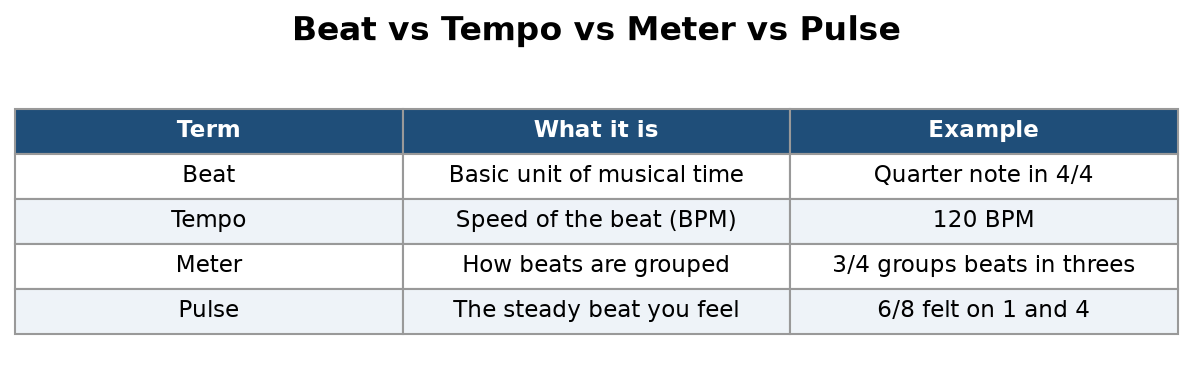
Beat vs tempo vs meter: the beat is the basic unit of time you tap your foot to. Tempo is how fast those beats go, measured in beats per minute (BPM). Meter is how the beats are grouped into bars, shown by the time signature. Pulse is the steady series of beats you feel underneath the rhythm.
For formal definitions, see the Wikipedia entry on tempo and the Wikipedia entry on metre.
| Term | What it is | How it is shown | Example |
|---|---|---|---|
| Beat | The basic unit of musical time | The note value in the bottom number of a time signature | In 4/4 the quarter note gets one beat |
| Tempo | The speed of the beat | BPM or Italian terms such as Allegro | 120 BPM means two beats every second |
| Meter | How beats are grouped and accented | The time signature | 3/4 groups beats in threes |
| Pulse | The steady, felt series of beats | Not written; it is what you tap along to | In 6/8 you usually tap on 1 and 4 |
Beat:
Beat in simple terms in the unit we use to measure time in music. Think of this as second hand on a wall clock. A subdivision of the beat is also possible and that is called tuplet.
Meter:
Meter tells us how the beats are going to be grouped to form a bar. A 4/4 meter for example tells us that there will be four beats in each bar which we will count as 1 2 3 4. So each of those are single beats and they are grouped in 4. This grouping is defined by the meter.
Tempo:
Tempo tells us how fast the beats are going to be counted. Going back to the example of second hand on a clock, the second hand will move at a universal pace. But if there was a way to change that and fasten the clock, it would be the same as increasing the tempo of the song. Tempo in the context of music is measured in BPM (Beats Per Minute). If the tempo is 100 BPM, then the beats are spaced out in a way so that we can fit 100 beats in one minute. Meaning the higher the bpm, the faster the tempo or speed is going to be of that music.
Pulse:
Pulse defines how a person is going to feel the music. If a music is played, regardless of what the tempo or meter is, any layman would be able to feel the music and tap the foot along. How the music is felt and how the tapping takes place is called the pulse of the music. Often the pulse is not going to be exactly the same as the beats. For example, on a 6/8 meter, a person is likely to tap on the 1st and the 4th beat.
6/8 1 2 3 4 5 6
Beat vs Tempo vs Meter: Common Questions
What is the difference between tempo and meter?
Tempo tells you how fast the beats go; meter tells you how they are grouped. A song in 3/4 can be a slow waltz at 80 BPM or a fast one at 180 BPM. The meter stays the same while the tempo changes, which is why beat vs tempo vs meter questions are best answered by separating speed from grouping.
Tempo vs beat: are they the same thing?
No. The beat is the unit and tempo is the rate of that unit. If you change the tempo from 90 to 120 BPM, each beat simply arrives sooner.
Beat vs pulse: what is the difference?
The two words overlap a lot. Music theory often describes the pulse as a series of evenly spaced beats, audible or implied, that the rhythm sits on. On this site we use pulse for the beat you actually feel, so in 6/8 you count six eighth notes but feel two pulses per bar. Read more in simple vs compound meter.
Does the time signature tell you the tempo?
No. A time signature shows meter only. Tempo is written separately as a BPM marking or an Italian term. See our guide to time signatures and the difference between 4/4 and 2/2.
Keep Learning Rhythm
Once beat vs tempo vs meter makes sense, try dividing the beat in new ways with triplets in music, or push against the beat with syncopation. For a refresher on note values, read note duration.
If you want to put this into practice on the guitar, start with our online beginner course.