
Guitar care in humid weather comes down to three habits: measure the air around your guitar, keep it in a closed case in the driest room you have, and wipe the metal parts after you play. Wood swells when it takes on moisture, and sweat and damp air corrode strings and frets. None of this needs expensive gear, but it does need a hygrometer and a routine.
This guide is written for any humid place, from a tropical wet season to a sticky coastal summer. It covers the safe humidity range according to guitar makers, the signs your guitar is too wet, storage options that work, strings and sweaty hands, and a simple weekly routine. At the end you can download our free Humid Weather Guitar Care Log, a two page printable that turns a hygrometer reading into an action and tracks your guitar across a season.
Quick answer
For guitar care in humid weather, keep your guitar at about 45 to 55 percent relative humidity, the range recommended by both Taylor Guitars and C. F. Martin. In humid weather, store it in a closed hard case with absorbing or two way humidity packs, run a dehumidifier or dry mode air con in the room, check a hygrometer weekly, and wipe strings after every session. Act when readings stay above 60 percent for days, not hours.
Why humidity matters to wood and steel
A guitar is thin wood held together with glue and under string tension. Martin’s Care and Feeding guide explains that as humidity rises, the moisture content of wood goes up rapidly and the wood expands and swells. It adds that a gradual rise generally will not do permanent damage, but very high humidity combined with high temperature can weaken glue joints, including the glue under the bridge.
Taylor Guitars makes a similar point. Its support article on the symptoms of a wet guitar says high humidity usually will not crack wood the way dry air can, but swelling can make glue joints fail, finish lift and neck angles go bad, and some distortion can remain even after repair. Guitar humidity problems build slowly. That is why good guitar care in humid weather focuses on slow, steady conditions rather than panic fixes.
Metal suffers too. Martin’s humidity bulletin lists tarnished frets and strings and corrosion on tuner plating among the typical symptoms at 60 percent relative humidity or above.
Ideal humidity for a guitar
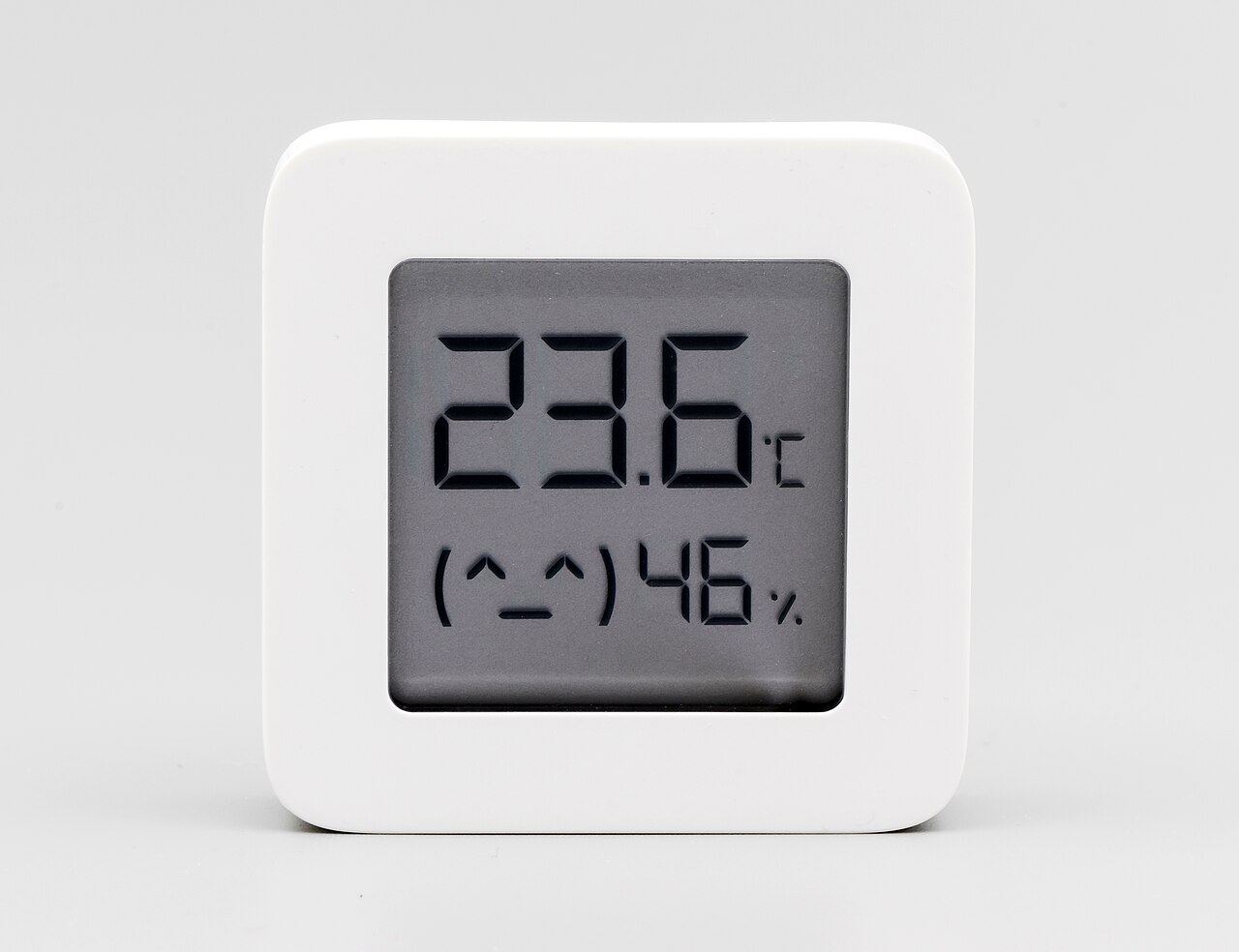
The makers agree closely on the numbers. Taylor’s support article Do I have to humidify my guitar? recommends 45 to 55 percent relative humidity (RH) and suggests a digital hygrometer that records minimum and maximum readings. Martin’s FAQ gives the same 45 to 55 percent range, with a temperature of 22 to 25 degrees Celsius.
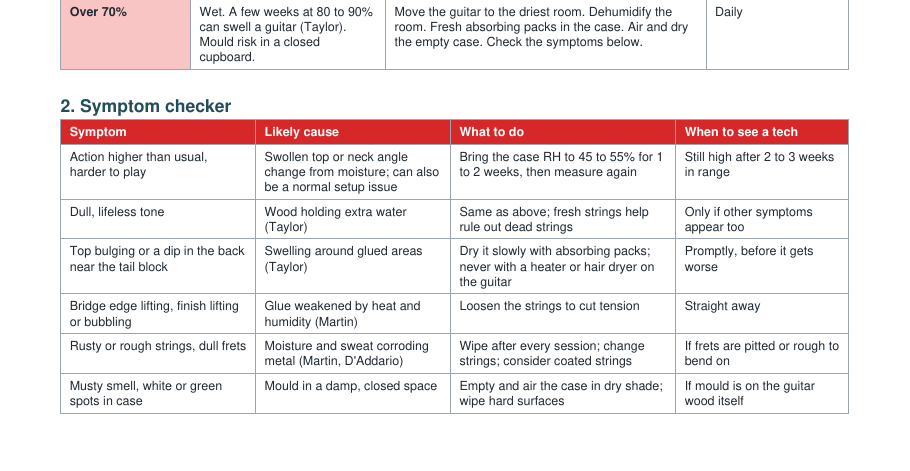
There is a little room either side. Taylor’s page on how to spot and fix an over humidified guitar calls 40 to 60 percent the acceptable range, and says its alert triggers after more than 72 hours above 60 percent. So a muggy afternoon is not an emergency. Weeks of high readings are what count.
For context, humid places sit far above that range outdoors. The Meteorological Service Singapore describes high humidity all year round, and its annual climatological reports (for example 2018) give a mean annual relative humidity of 84 percent. Swee Lee’s guide for South East Asia puts everyday humidity there at around 70 to 90 percent. Checked 1 November 2026.
Signs your guitar is too wet
Taylor lists these symptoms of an over humidified guitar. Look for several together, because Taylor notes high action alone may just mean the guitar needs a setup, and some bellying behind the bridge is normal on every acoustic.
- High action. Strings sit unusually high off the fretboard and the guitar feels harder to play.
- Dull, lifeless tone. Taylor puts this down to the extra water weight the wood is holding.
- A swollen top or a dip in the back at the tail block. The back cannot rise where it is glued to the block, so it swells either side.
- Neck angle change. Sighting down the neck, the frets appear to point below the bridge.
- Lifting finish or open glue joints, which Taylor and Martin both link to swelling, heat and moisture.
Mould is another warning sign in damp cupboards and closed cases: a musty smell, or white or green spots on the case lining. In our teaching experience this usually means the case has sat closed in a damp room for a long time. Air and dry the empty case, and if mould is on the guitar wood, take it to a qualified tech.
Taylor’s wet guitar tech sheet includes a striking example: a guitar that hung on a shop wall in Asia through a very wet season and came back to the factory for repair. It shows that even a well made instrument is not immune, and that daily checks are part of guitar care in humid weather.
Storage: cases, dehumidifiers, packs and air con
Use a closed hard case
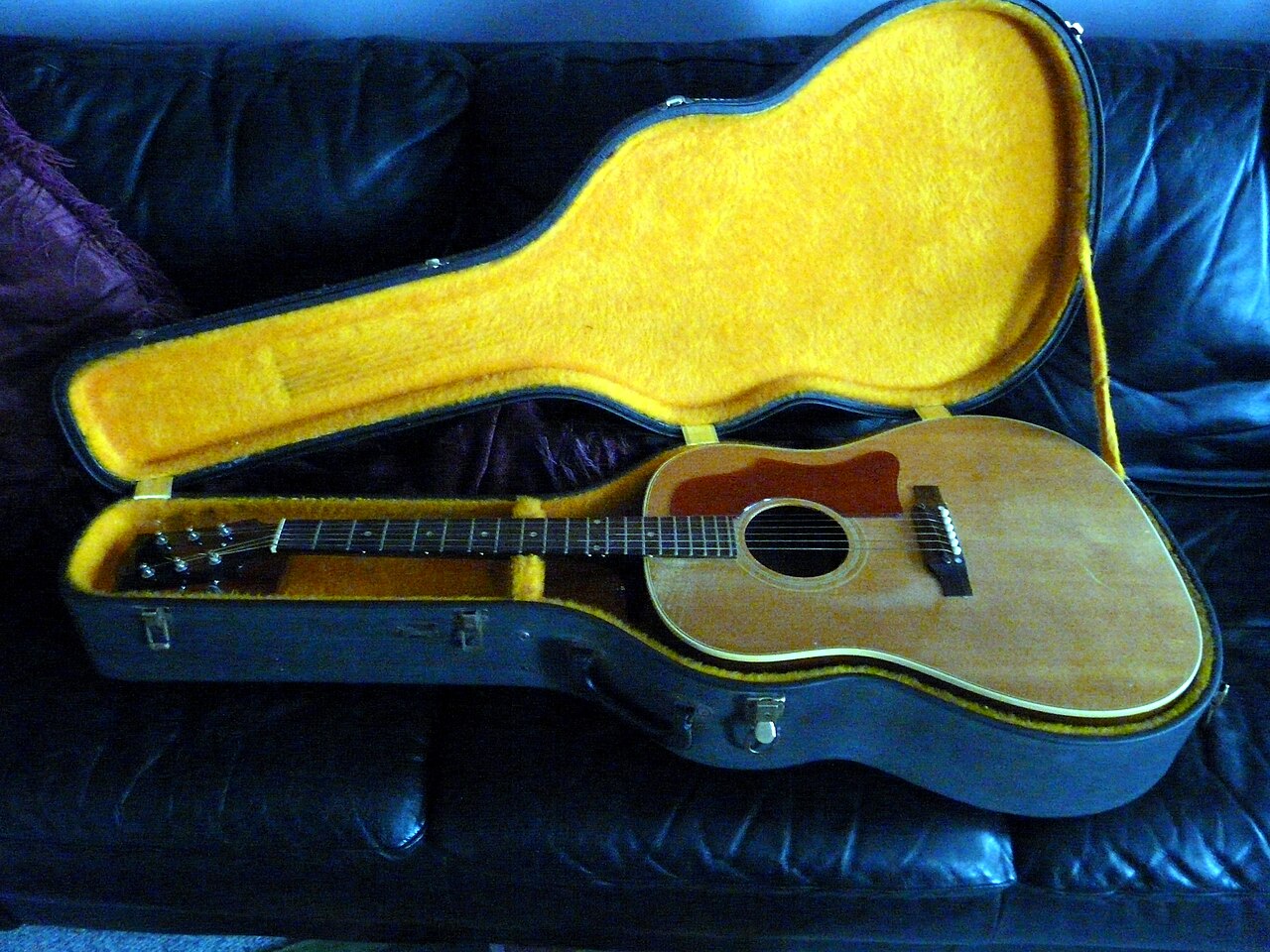
Martin recommends storing an instrument in its case when not in use, because humidity is easier to control in a small space. A hard case also lets packs do their job. A guitar on an open wall stand is fine for a few hours of playing, but in a humid room it is exposed around the clock.
Two way packs, silica and charcoal
D’Addario’s support page Which Humidipaks should I be using? says to start with Absorb packs if the case reads 60 percent or higher, then switch to Maintain packs once it is back near 50 percent. Its Humidipak page says Maintain packs hold about 45 to 50 percent in a sealed case and should be replaced as they dry out, or every 3 months at most.
Taylor suggests that where humidity is extreme or high all year, several silica gel or bamboo charcoal packs in the case, changed every few months, can work. Plain silica only absorbs, so it can overshoot in a dry spell; a hygrometer in the case tells you when to take it out. Two way packs cost more over a year but adjust in both directions.
Room dehumidifier and air con caveats
Taylor and Swee Lee both recommend a room dehumidifier where the guitars live, which protects several instruments at once. Swee Lee warns that air conditioning does not truly hold humidity at a constant level, and most people switch it off for part of the day. Watch your hygrometer when the air con goes off; readings can climb quickly.
Avoid the other extreme as well. Do not leave a guitar in a car, near a window in the sun or in front of a vent. Martin warns against rapid changes in humidity and temperature, and against storing an instrument anywhere that can take on water.
Strings, frets and sweaty hands
If your guitar strings are rusting quickly, sweat is usually part of the story. In a Musician’s Friend interview, a D’Addario engineer explains that skin oils, sweat and grit build up in the windings until a string goes dead, and that humidity in the air causes corrosion even on strings nobody touches. He adds that some players’ body chemistry is far more corrosive than others.
D’Addario tests this with a synthetic sweat spray, a salt and mild acid solution, which it shows in a corrosion test video. In the same interview, the engineer estimates its coated strings last three to five times longer than uncoated sets. That is a maker’s own estimate, so treat it as a guide rather than a promise.
What helps with sweaty hands, in our teaching experience:
- Wash and dry your hands before playing.
- Wipe the strings, including underneath, with a dry cloth after every session.
- Keep a small towel nearby on hot days and pause to dry your fretting hand.
- Try coated strings if uncoated sets go rough within a couple of weeks.
How often to change strings depends on how much you play and how your skin reacts. As a teacher estimate, regular players in humid weather often need fresh strings every 4 to 8 weeks, and heavy sweaters sooner. Let feel and tone decide, not the calendar. If your fingertips are still toughening up, our guide to sore fingertips from guitar helps, and the string gauge guide explains how different sets feel.
Acoustic vs electric vs nylon
Swee Lee’s tech notes that acoustic guitars are more susceptible to humidity damage, which matches what makers write. A thin, lightly braced top reacts quickly, so acoustics need the closest watching. Nylon string guitars are also built with thin tops and light bracing; see our guide to nylon string guitars for how they differ.
Solid body electrics are less sensitive in the wood, but still need guitar care in humid weather. The neck can move, which changes relief and action, and the hardware, pickups and frets can corrode. D’Addario notes that Humidipaks work for acoustic or electric guitars in a closed case. For more on how construction shapes a guitar, read guitar design and its effect on the tone and our overview of the different kinds of guitars.
A wet season routine for guitar care in humid weather
This is the routine we suggest to students. It is a teacher’s plan built on the maker guidance above, not a rule from any brand.
| When | What to do |
|---|---|
| Every session | Clean hands before, wipe strings after, back into the closed case. |
| Weekly | Read room and case hygrometers at the same time of day. Feel the packs. Fill in one row of the log. |
| Monthly | Check action at the 12th fret, look along the neck, check the bridge edge and finish. Air the empty case in dry shade. |
| Every 2 to 3 months | Replace two way packs (D’Addario says every 3 months at most) or change silica and charcoal packs. |
| End of the wet season | Compare your log with week 1. If action stayed high in range, book a setup. |
Free humid weather care log
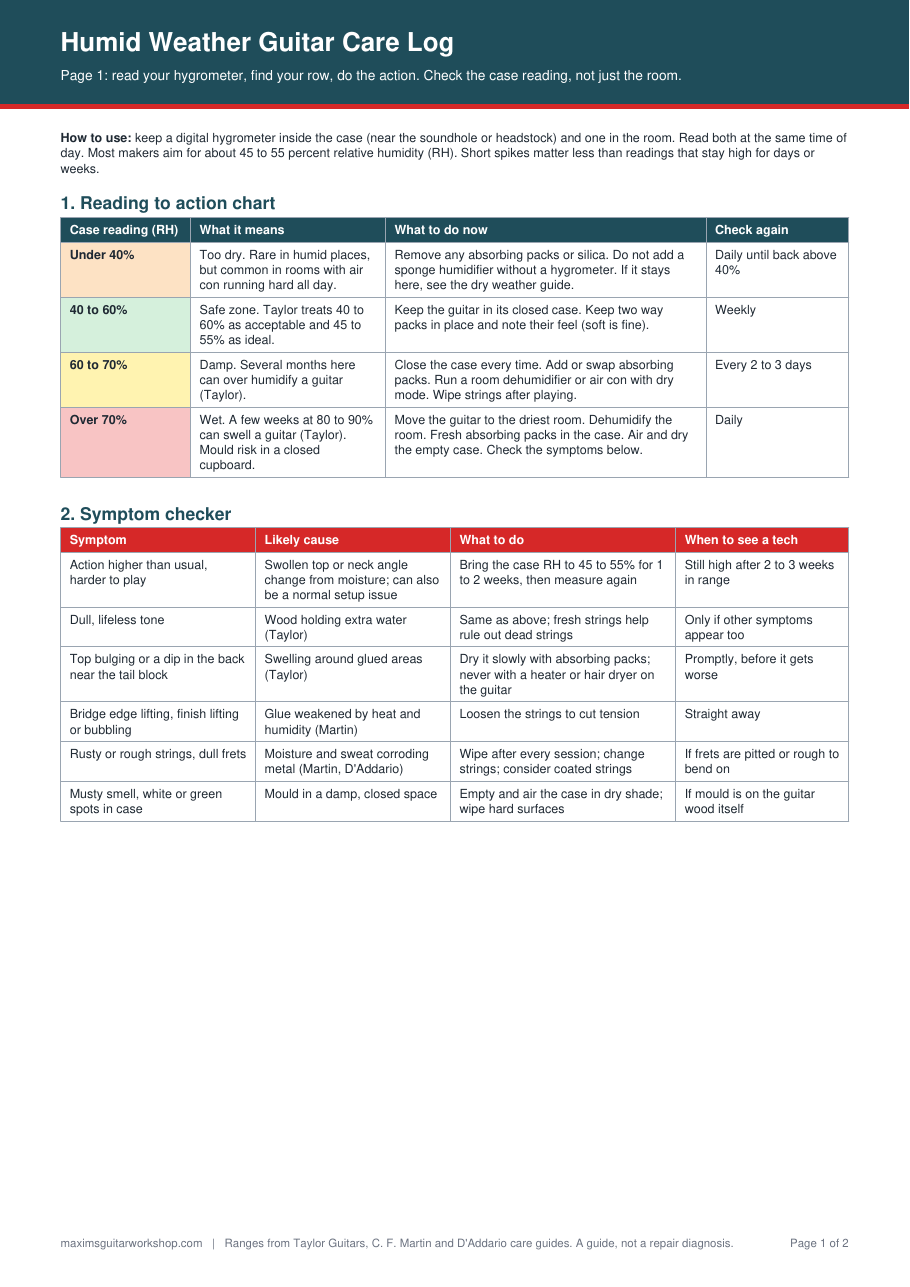
We could not find a single resource that turns a hygrometer reading straight into an action and also lets you track your own guitar over a whole season, so we made one. Page 1 has a reading to action chart (under 40, 40 to 60, 60 to 70 and over 70 percent) and a symptom checker with when to see a tech. Page 2 is a 13 week log for room RH, case RH, action, string condition and pack swaps.
Print it on A4, keep it in your case pocket and fill one row a week. Over a season you will see how your guitar responds, which makes guitar care in humid weather much less guesswork.
Download the free Humid Weather Guitar Care Log (PDF)
FAQ
What is the ideal humidity for a guitar?
Taylor and Martin both recommend 45 to 55 percent relative humidity. Taylor treats 40 to 60 percent as acceptable for short periods.
Can I keep my guitar on a wall stand in a humid climate?
For playing sessions, yes. For storage, a closed case with packs, in a dehumidified room, is safer. Guitar care in humid weather is easier in a small, controlled space.
Are silica gel packs enough?
They can be in rooms that stay humid all year, and Taylor suggests changing them every few months. Check the case with a hygrometer so they do not dry the guitar too far.
Why are my guitar strings rusting so fast?
Sweat, skin oils and damp air all corrode string metal. Wipe strings after playing, wash your hands first, and consider coated strings.
Will a wet guitar go back to normal?
Often, once it is brought back into range slowly. Taylor says it can take several weeks to get below 60 percent. If action, the bridge or the finish do not settle, see a qualified guitar tech.
Good guitar care in humid weather is mostly about steady habits, and playing regularly means you notice changes early. If you would like a guided start on the playing side, have a look at our online beginner course. When winter turns the air dry, our guide to guitar care in dry weather covers humidifiers and cracks.
Image credits
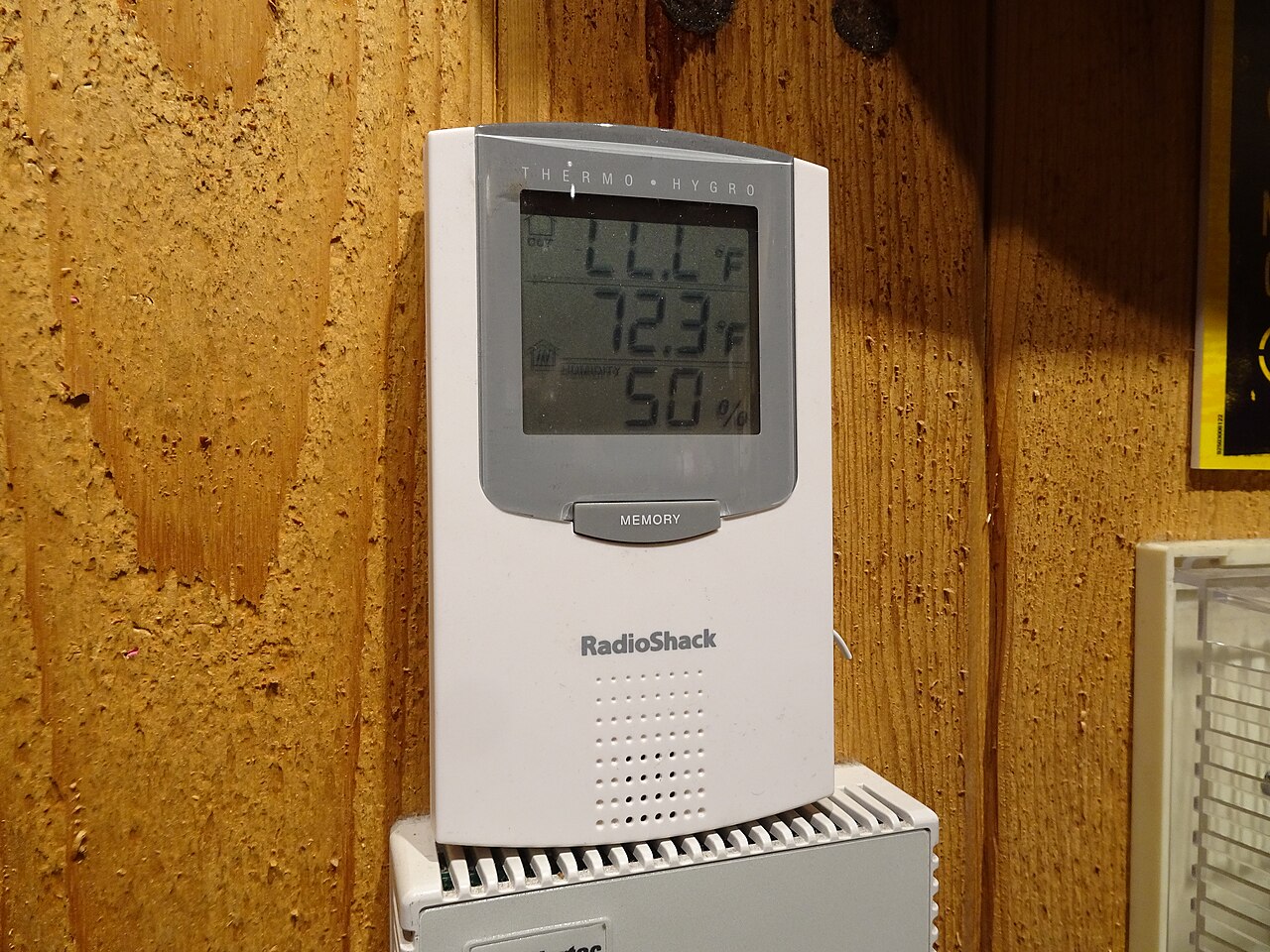
Digital hygrometer: Jacek Halicki, Wikimedia Commons, CC BY SA 4.0. Acoustic guitar in case: Henry Zbyszynski, Wikimedia Commons, CC BY 2.0. Guitar room at 50 percent humidity: B137, Wikimedia Commons, CC BY SA 4.0. Care log preview: Maxim’s Guitar Workshop.