A stolen guitar is a gut punch, and the first few hours matter. If it has just happened, start with the action plan below: report it to police, register it as stolen, and start watching the places it is likely to turn up. If your gear is still safe, use the free register on this page to record serial numbers, marks and photos now, so you are ready if it ever happens. In 20 years of teaching, the students who got a stolen guitar back were the ones who could prove exactly which guitar it was.
Quick answer
If your guitar was stolen: call 000 if it is happening now or anyone is in danger. Otherwise report it to police (in the Northern Territory, call 131 444 or use the NT Police online report form) and get a report number. Mark it stolen on SerialCheck and Immobilise, which are both free. Then watch Marketplace, Gumtree, pawn and second hand shops and local music stores, and contact your insurer. If you find it for sale, do not try to get it back yourself: give police the listing. Checked 20 November 2026.
If your guitar was stolen: the first things to do
- Stay safe. If the theft is happening now, or someone is threatened or hurt, call 000.
- Report it to police. In the Northern Territory, call the 24 hour police line on 131 444 or use the NT Police online non emergency report form. In other states and territories, use the local police non urgent line or online report. Give the make, model, serial number, colour, marks and photos. Write down the report number.
- Mark it stolen on registries. If it is registered on SerialCheck or Immobilise, mark it stolen and add the police report number. If it is not, you can still register it with your details and photos.
- Tell your insurer. Have the police report number, proof of ownership and the value ready.
- Start watching. Check Marketplace, Gumtree, pawn and second hand shops and local music stores, and tell local teachers and repairers. Details are below.
- Information about who did it? Crime Stoppers takes tips on 1800 333 000, and you can stay anonymous.
Move quickly, but do not confront anyone. SerialCheck’s own advice for a stolen guitar or any other item you spot for sale online is not to retrieve it yourself, but to give police the listing details and report the listing to the platform.
The free gear register (set it up before you need it)
The register below keeps a record of every guitar, amp and pedal you own: make, model, serial number, colour, distinguishing marks, purchase date and price, where you bought it, which photos you have taken, and where it is registered. It exports to a CSV file and prints as a table for police or your insurer.
Two important limits. First, it saves only in this browser on this device. Nothing is sent to us, and clearing your browser data can wipe it, so export or print a copy and keep it somewhere away from the gear, such as your email. Second, it is not a registry police can search. Use it beside SerialCheck or Immobilise, not instead of them.
Free gear register
Record each guitar, amp and pedal now, while you still have it. Everything stays in this browser on this device only; nothing is sent to us or anyone else. Clearing your browser data can wipe it, so export a CSV or print a copy and keep it somewhere safe, away from the gear. This is not a police registry: register serials on SerialCheck or Immobilise as well.
Photos taken and stored safely
Also registered on
My register
Serial numbers, marks and photos that actually help
A stolen guitar is hard to return if nobody can prove whose it is. Three things do that best:
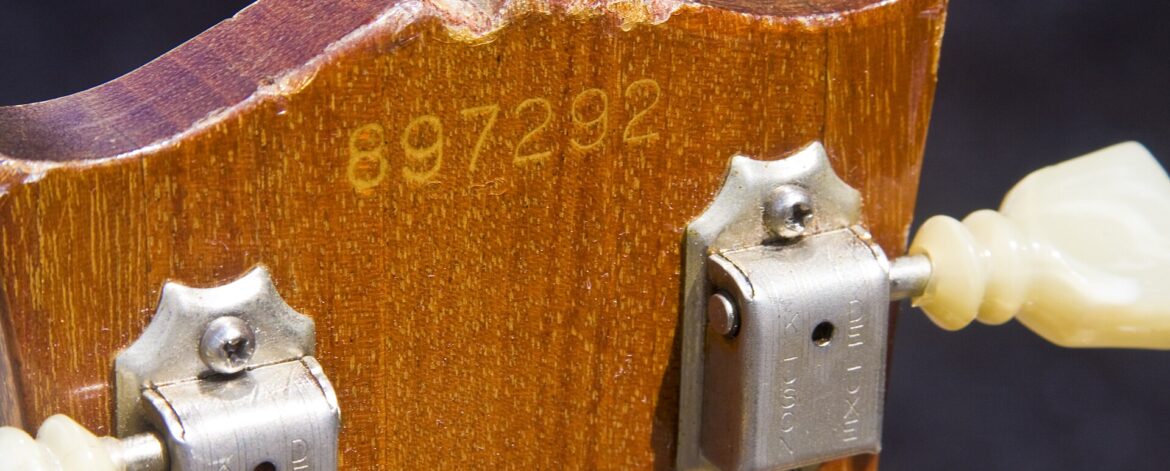
- The serial number. On most electrics it is on the back of the headstock or the neck plate. On most acoustics it is on a label inside the sound hole or stamped on the neck block. Write it down exactly, including letters.
- Distinguishing marks. Chips, dings, wear patterns, repairs, changed parts and stickers. Note the position, such as “chip on the lower horn”. These help when a serial has been removed.
- Photos. Front, back, headstock, the serial close up, every mark, and the receipt. Store them somewhere other than the phone that might be stolen with the guitar.
Some players add a hidden mark of their own, such as their name and phone number written inside a control cavity or under a pickguard. That is a personal choice, and it never replaces the serial and photos.
Where to list and look: police, registries, Marketplace, Gumtree, pawn shops, local stores
Registries. SerialCheck is a free Australian community registry. It says it is not connected to police or government databases, but anyone who searches a serial you have marked stolen sees a warning, and you are notified of the match. Immobilise is a free property register; it says property updates are immediately available to police nationally, and that loss and theft alerts are visible on police systems. Register on both if you can.
Marketplace and Gumtree. Search for the make and model in your area and nearby cities for several weeks. Save searches where the platform allows it. Thieves often use vague titles, so also search simply for “guitar” and sort by newest.
Pawn and second hand shops. Visit or call with your photos and serial number, and leave a description and your police report number. Tell police which shops you have contacted.
Music stores, teachers and repairers. A stolen guitar sometimes comes in for a setup or a trade in. Ask local stores and workshops to keep an eye out, and share a short post with photos in local musician groups.
Prevention matters too. Most guitar thefts we hear about happen from cars and venues. Do not leave gear unattended in a car or at the side of a stage, and plan your load in and pack up. Our guides on how to prepare for your first gig and how to run a band rehearsal cover the night and the rehearsal room. Before you travel, note your serials as part of your packing for flying with a guitar in Australia.
Download the free Stolen Guitar Action Plan (PDF)
The one page plan has the steps above with tick boxes, space for your report and claim numbers, a log of where you have looked, and the insurance questions below.
Insurance questions: contents, portable cover, specialist cover
If you want to insure guitar Australia wide, there are three common routes, and the right one depends on where the guitar goes and how much it is worth. Moneysmart explains that portable contents cover protects some belongings away from the house, that there is usually a per item value cap, and that portable cover may be an optional extra. Ask your insurer:
- Is my guitar covered at home under contents, and is there a limit for a single item or for musical instruments?
- Is it covered away from home, such as in my car, at lessons, at rehearsals or at gigs? Do I need to list it as a specified portable item?
- Is it covered if I earn money playing it, or is paid gigging treated as business use?
- Is theft from an unlocked car or an unattended venue excluded?
- Will you pay replacement value or market value, and what proof of ownership do you need?
- Would specialist musical instrument insurance suit me better if I gig often or own valuable gear?
Get the answers in writing and read the product disclosure statement. We do not recommend any insurer. This is general information, not financial advice.
If you are buying used: a short serial check note
Run a guitar serial number check before you pay. SerialCheck says its check is free, instant and does not need an account. Ask the seller how they got it and whether they have a receipt, and walk away if the serial has been removed or the story changes. Our guide to buying a second hand guitar covers the rest of the inspection. If you believe a guitar for sale is stolen, contact police rather than the seller.
FAQ
What should I do first if my guitar is stolen?
If it is happening now or anyone is in danger, call 000. Otherwise report it to police and get a report number. In the Northern Territory, call 131 444 or report online. Then mark it stolen on SerialCheck and Immobilise.
Can police find a stolen guitar by its serial number?
A serial number is the strongest proof of ownership. Immobilise says theft alerts are visible on police systems, and a report with the serial gives police something to match. There is no guarantee of recovery, but without a serial it is much harder.
How do I do a guitar serial number check?
Search the serial on SerialCheck, which is free and needs no account. Also ask the seller for proof of purchase, and compare the serial with the guitar’s model and age.
I found my stolen guitar on Marketplace. What now?
Do not arrange to collect it yourself. Screenshot the listing, give it to police with your report number, and report the listing to the platform.
Where is the data in the gear register stored?
Only in your browser on this device. Nothing is sent to us. Export a CSV or print it and keep a copy somewhere safe, because clearing browser data can delete it.
No one plans for a stolen guitar, but ten minutes with the register today makes a real difference if it happens. Fill it in, export it, register your serials, and then get back to playing. If you are new and still building your first rig, our online beginner course is a good place to start.
Sources (checked 20 November 2026)
- NT.GOV.AU, About reporting a crime (000, 131 444, Crime Stoppers 1800 333 000)
- NT Police, Fire and Emergency Services, Online non emergency police report form
- SerialCheck, How it works and FAQ
- Immobilise, home page and police information
- Moneysmart, Contents insurance
Featured image: “Gibson Les Paul Deluxe Serial Number (SN 897292)” by Nicole Hensley, Wikimedia Commons, licensed CC BY SA 2.0.