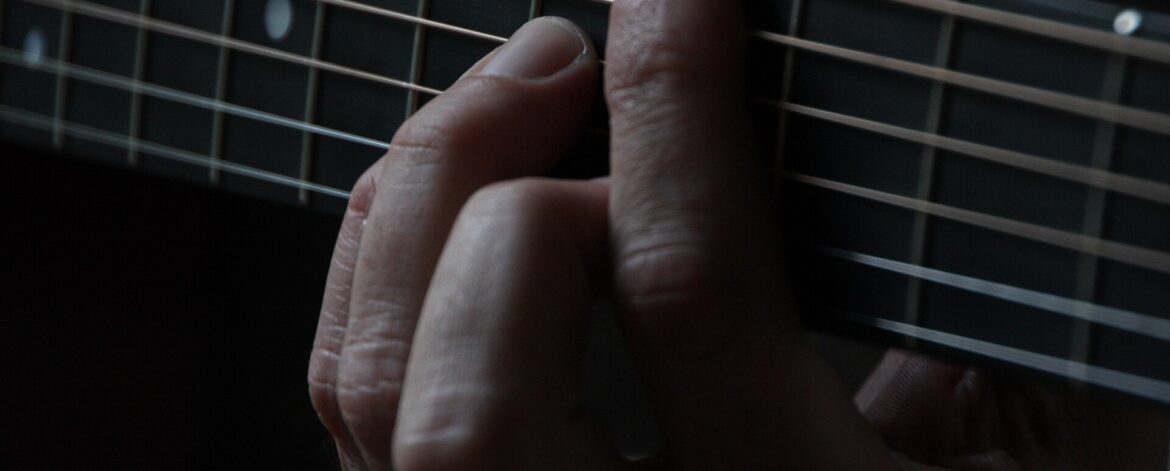
If you have small hands, someone has probably told you that guitar is not for you, or that you will never manage barre chords. In our 20 years of teaching, we have taught plenty of players with small hands, and that advice is wrong. What does change is how you set up the guitar and which shapes you choose. This guide to guitar for small hands gives you a printable hand span card, a chart of easier swaps for hard chords and a comfort setup checklist.
Quick answer
Yes, you can play guitar with small hands. The biggest wins are a low action and lighter strings set by a tech, smart chord shapes such as partial barres, triads and a capo, and a guitar with a shorter scale or a slimmer neck if your current one is a struggle. Frets get closer together as you move up the neck, so the same shape is easier at fret 5 than at fret 1. Measure your span with our card, then try the reach check on a real guitar before you buy.
Can you play guitar with small hands? (yes, and what actually helps)
Hand sizes vary far more than most people think. An Australian study by Rhonda Boyle, Robin Boyle and Erica Booker measured 473 adult pianists. Their thumb to little finger span ran from 16.3 cm to 27.4 cm, with an average of 22.6 cm for men and 20.1 cm for women. Every one of those people was playing piano, an instrument where the keys are one fixed size (Boyle, Boyle and Booker, 2015).
Guitar is kinder than that. Guitars come in many scale lengths, neck widths and body sizes, and most chords can be played in more than one way. Playing guitar with small hands is mostly a matter of choosing the right guitar for small hands, getting it set up well and learning shapes that suit your reach.
To be honest about the limits: some wide stretches, such as certain jazz voicings or classical pieces with big reaches, will stay harder for you than for someone with long fingers. Every player has shapes they avoid. The goal is a set of chords you can play cleanly and comfortably, not copying someone else’s fingering.
Measure your span: the printable card
Before you shop for a guitar for small hands, measure your span. Our printable Hand Span Card uses the same two measurements as the Boyle study, so you can compare your numbers with real data. Measure your fretting hand, which is the left hand for most right handed players:
- Full span (thumb to little finger): place your hand flat on the card, spread it as wide as is comfortable, and read the distance from the outside tip of your thumb to the outside tip of your little finger.
- Fretting span (index to little finger): do the same from the outside tip of your index finger to the outside tip of your little finger. This one matters more on guitar, because your thumb sits behind the neck.
Print the card at 100 percent (Actual size, not Fit to page) and check its 10 cm test line with a ruler before you measure. In the Boyle study, the average index to little finger span was 17.0 cm for men and 15.7 cm for women, with a range from 11.9 cm to 21.9 cm.
What does your number mean for a guitar for small hands? Here we need to be straight with you: no study links hand span to the right scale length, and a flat hand on a table is not the same as curved fingers on a fretboard. So instead of a made up chart, the card gives you real fret distances you can test against. The table below uses the scale lengths published by each maker. The reach figures are our own maths, using the standard fret formula, measured between fret wires.
| Guitar (maker’s spec) | Scale length | Nut width | Fret 1 to fret 4 | Fret 5 to fret 8 |
|---|---|---|---|---|
| Yamaha C40 (full size classical) | 650 mm | 52 mm | 9.8 cm | 7.7 cm |
| Fender Player II Stratocaster | 648 mm | 42 mm | 9.7 cm | 7.7 cm |
| Fender Player II Mustang | 610 mm | 42 mm | 9.2 cm | 7.3 cm |
| Taylor GS Mini | 597 mm (23.5 in) | 42.9 mm (1 11/16 in) | 9.0 cm | 7.1 cm |
| Martin LX1 Little Martin | 584 mm (23 in) | 42.9 mm (1 11/16 in) | 8.8 cm | 7.0 cm |
| Yamaha CS40 (3/4 classical) | 580 mm | 48 mm | 8.7 cm | 6.9 cm |
| Squier Mini Stratocaster | 578 mm | 40.6 mm | 8.7 cm | 6.9 cm |
| Yamaha JR1 | 540 mm | 43 mm | 8.1 cm | 6.4 cm |
Two things stand out. A short scale guitar like the Squier Mini Stratocaster shaves about 1 cm off a four fret stretch at the nut compared with a Stratocaster. But moving the same shape from fret 1 up to fret 5 on the Stratocaster saves 2 cm, which is twice as much. That is why a capo and playing further up the neck help so much, on any guitar.
The reach check on the card turns this into a test. On your guitar, put your index finger behind fret 1 and your little finger behind fret 4 on the thickest string, with fingers curved. If every note rings without strain, scale length is not your problem. If it only works from fret 3 or 5 up, a shorter scale may help, so try one in a shop before you buy.
Hard chords and easier swaps (partial barres, triads, capo)
Chord shapes below are written from the thickest string to the thinnest, with x meaning do not play that string and 0 meaning an open string. Some swaps change the chord’s colour slightly, so check them by ear in the song.
| Hard chord | Why it is hard | Easier swap | Notes |
|---|---|---|---|
| F (full barre) | Full barre at fret 1, the widest frets | Small F: x x 3 2 1 1, or Fmaj7: x x 3 2 1 0 | The small F uses a two string partial barre. Fmaj7 sounds softer and suits many pop and folk songs. |
| Bm (barre at fret 2) | Barre plus a stretch to fret 4 | Small Bm: x x 4 4 3 2, or Bm7: x 2 0 2 0 2 | Bm7 is easier still and works in most songs that use Bm. |
| B (barre at fret 2) | Barre plus three fingers squeezed in at fret 4 | B7: x 2 1 2 0 2, or a capo at fret 2 with A shapes | B7 works where B leads back to E. Otherwise use the capo. |
| Bb (barre at fret 1) | Barre at the widest frets | Small Bb: x x 3 3 3 1 | A three finger triad plus one note. Or capo 1 and play A. |
| G (wide version) | Big stretch from the thickest to the thinnest string | Small G: x x 0 0 0 3 | Great for beginners. Add the bass note later. |
| F#m and C#m | Barre chords | Capo 2 and play Em, or capo 4 and play Am | The capo does the barre for you. |
| A (barre at fret 5) | Full barre, all six strings | Top string triad: x x x 6 5 5 | Three strings only. Ideal for strumming in a band. |
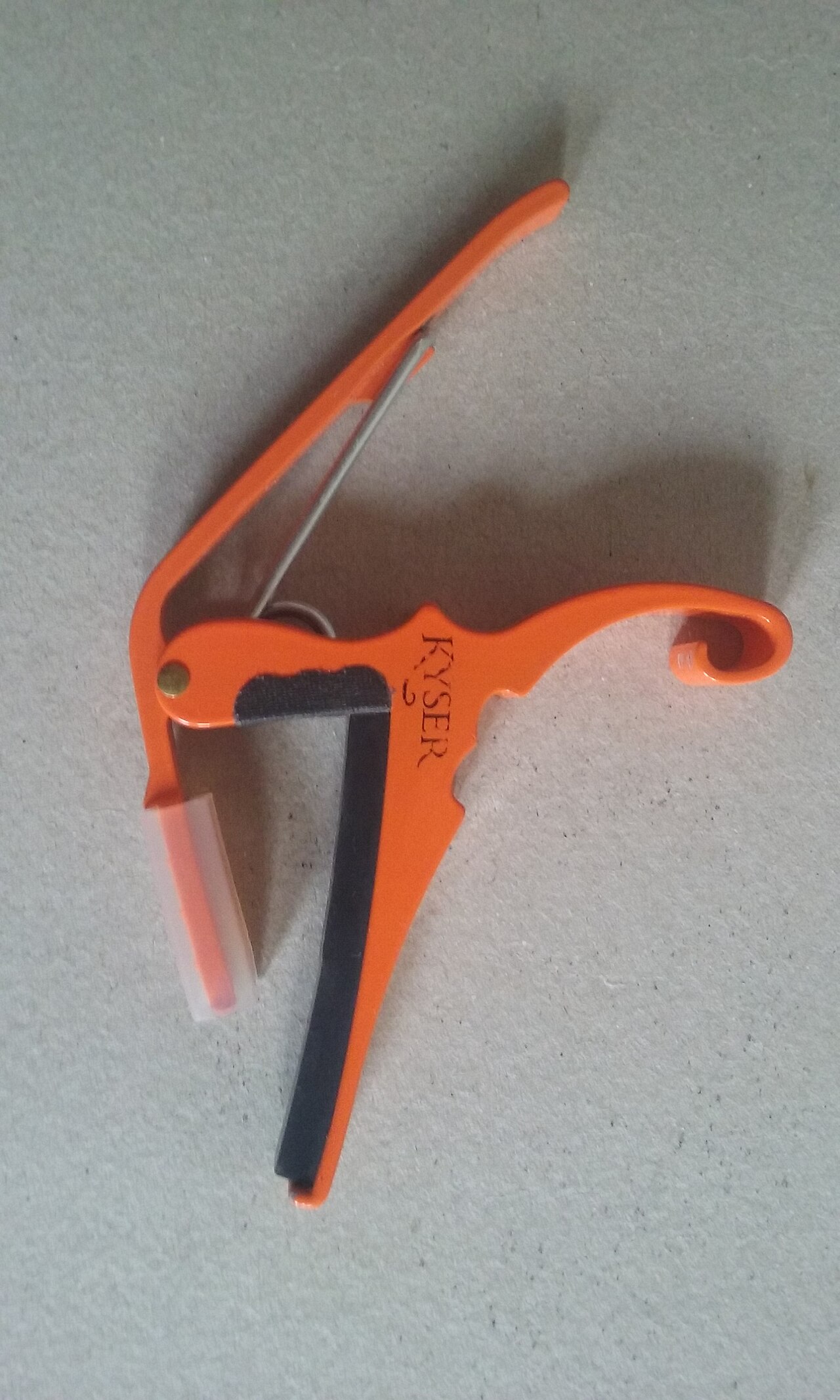
The capo is the best friend of a guitar for small hands setup. For a song in F, put a capo at fret 3 and play D, G and A shapes, which sound as F, Bb and C. For a song in Bb, put it at fret 3 and play G, C and D shapes, which sound as Bb, Eb and F. You still play open chords, the frets are closer together, and the song stays in the original key.
Comfort setup: lighter strings, short scale, slim neck, action
When students ask us about a guitar for small hands, we start with setup, because it matters more than hand size for most beginners we teach. Work through this checklist, ideally with a guitar tech:
- Low action, checked by a tech. Ask them to check the string height and the nut slots. High nut slots make first position chords hard work for anyone.
- Lighter strings. Fender’s Stratocaster, Mustang and Mini Stratocaster all ship with 9 to 42 gauge strings. Acoustics vary: Taylor lists its GS Mini with medium strings (13 to 56), and Taylor’s own advice for players who struggle is extra light strings or an action adjustment. Our guide to string gauge explains the trade off.
- Shorter scale. A short scale guitar brings every fret closer together. Electric examples include the 610 mm Fender Mustang and the 578 mm Squier Mini Stratocaster. Acoustic examples include the 597 mm Taylor GS Mini and the 584 mm Martin LX1.
- Nut width and neck shape. Steel string guitars are often around 42 to 43 mm at the nut, while a full size classical such as the Yamaha C40 is 52 mm. If a classical neck feels too wide, the 3/4 size Yamaha CS40 has a 48 mm nut. A slim C or low oval neck profile also helps your thumb reach.
- Body size and posture. A smaller body lets your arm sit naturally, and tilting the neck up brings the first frets closer to you. Strap height and a footstool both help.
- Thumb position. For stretches and barres, move your thumb lower on the back of the neck. For simple open chords, wrapping it over the top is fine.
Smaller and children’s sizes, such as the 540 mm Yamaha JR1, are also an option for adults with very small hands, though the sound is smaller too. Our learning guitar after 50 guide recommends a smaller bodied or short scale guitar for comfort, and the same thinking applies here.
Barre chords when your reach is short
Barre chords are where playing guitar with small hands feels hardest, but technique matters more than finger length. Roll your index finger slightly onto its bony side, keep it close to the fret, use the weight of your arm instead of squeezing with your thumb, and practise the shape at fret 5 first, where the frets are closer, before moving it down. Partial barres from the chart above are a real musical choice, not a cheat.
Our step by step guide on how to play barre chords covers setup checks, thumb position, buzzing and a four week practice plan. If your fingertips hurt while you build up, read our guide to sore fingertips from guitar.
Gentle stretching and finger independence work can improve how comfortable a stretch feels, and our stretches and hand exercises for guitar players are a good routine before practice. Never push through sharp pain, numbness or tingling. Our guide to guitar injuries and how to prevent them explains the warning signs.
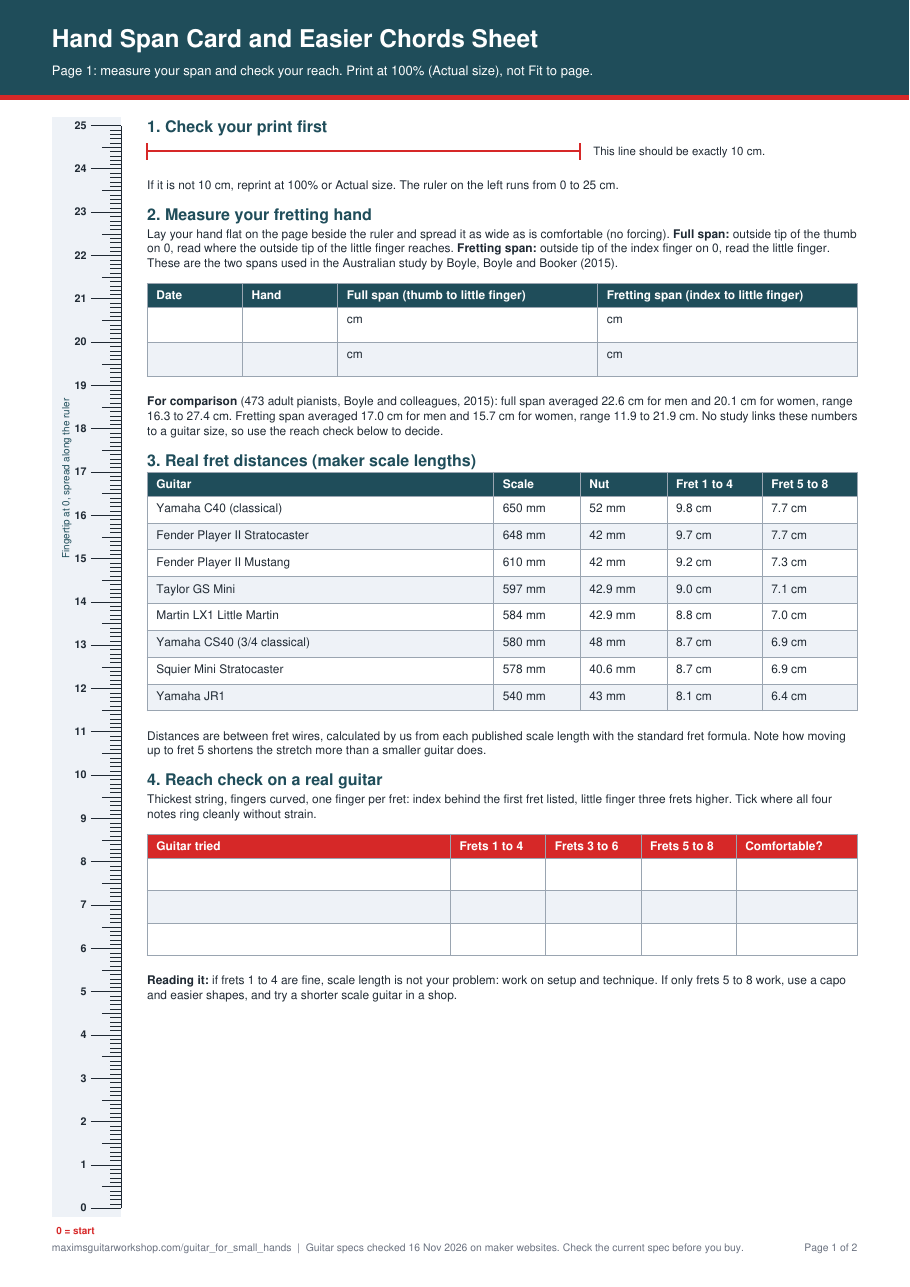
Download the free Hand Span Card and Easier Chords Sheet. It has the measuring card with a 10 cm check line, the fret reach table, the easier swaps chart and the comfort setup checklist on two printable pages.
Download the free Hand Span Card (PDF)
FAQ
I have small hands. Can I play guitar?
Yes. Hand size changes which shapes and which guitar suit you best, not whether you can play. A good setup, a capo and partial barres solve most problems, and a guitar for small hands with a shorter scale helps if your reach is very short.
What is the best guitar for small hands?
There is no single best one. Look for a shorter scale, a nut width that suits your hand, a slim neck profile and a body you can hold comfortably, then have it set up with a low action. Always try the reach check from our card in the shop.
Is a short scale guitar just a kids’ guitar?
No. Models such as the Taylor GS Mini, the Martin LX1 and the Fender Mustang are full instruments played by adults. Very small sizes, under about 550 mm, do give up some volume and depth of tone.
Will my hands stretch with practice?
Your bones will not grow, but your comfortable stretch usually improves as your fingers get more independent and your hand learns to relax. Most players find shapes that felt impossible in week one are fine a few months later. Build up gently and never force a stretch.
Is classical guitar harder with small hands?
The wide neck makes it harder for some players: a full size Yamaha C40 is 52 mm at the nut, against about 42 mm on many steel string guitars. Nylon strings are softer on your fingertips, though. A 3/4 classical or a crossover model with a narrower neck can be a good middle ground.
Small hands, full sound
A guitar for small hands is not a special instrument. It is any guitar that fits you, set up well, played with shapes that suit your reach. Measure your span, try the reach check, and swap the chords that fight you. Then get back to playing songs.
If you want a structured start with chords chosen to build up your reach gradually, our online beginner course takes you through it at your own pace.
Sources
- Boyle, R., Boyle, R. and Booker, E. (2015). Pianist hand spans: gender and ethnic differences and implications for piano playing. 12th Australasian Piano Pedagogy Conference Proceedings. PDF
- Fender Player II Stratocaster specifications. Fender
- Fender Player II Mustang specifications. Fender
- Squier Mini Stratocaster specifications. Fender
- Taylor GS Mini specifications and FAQ. Taylor Guitars
- Martin LX1 Little Martin specifications. Martin Guitar
- Yamaha C40 specifications. Yamaha
- Yamaha CS40 specifications. Yamaha
- Yamaha JR1 specifications. Yamaha
Specifications checked on 16 November 2026. Makers update models, so check the current spec before you buy. Fret reach figures are calculated by us from each published scale length, using the standard equal temperament fret formula.
Image credits
Fingers on frets by Scott Gruber, Wikimedia Commons, CC0. Orange guitar capo by Bizzarle, Wikimedia Commons, CC BY SA 4.0. Hand Span Card preview by Maxim’s Guitar Workshop.