
Choosing a string gauge for drop tunings is really about tension: when you tune a string down, it loses tension, and below a point it feels floppy, buzzes and drifts sharp when you pick hard. A heavier string tuned to the same low note brings that tension back. This guide sticks to gauge, tension and scale length, with figures calculated from D’Addario’s published data and a free printable chart.
If you want the tunings themselves, how to tune to them and what they are used for, see our guide to drop, open and alternate guitar tunings and our tunings article. Here we only cover which strings to put on once you have picked a tuning, from Drop D down to Drop A on 6 and 7 string guitars.
Quick answer
As a teacher rule of thumb for string gauge for drop tunings on a 25.5 inch scale: Drop D works on 10 to 46 or 10 to 52, Drop C sharp and Drop C suit 10 to 52 or 12 to 54, Drop B wants about 12 to 60, and Drop A suits a 7 string or a baritone. Longer scales add tension, shorter scales lose it. Check the chart below for calculated tensions per string.
Why drop tunings feel floppy
Three things set string tension: the string’s weight per inch, the scale length and the pitch. D’Addario explains this in its guide what is guitar string tension, which gives the formula T = UW x (2 x L x F) squared / 386.4. UW is unit weight in pounds per inch, L is scale length in inches and F is the note’s frequency.
The key part is that tension rises with the square of frequency. Drop a string by a whole tone and tension falls by about 20 percent; drop it by a fourth, as in Drop A on a 6 string, and it falls by about 44 percent. That is why a set that feels fine in standard tuning can feel like rubber bands in Drop B. The fix is a heavier string with a higher unit weight, a longer scale length, or both.
Tension is only part of feel. Pick attack, action and how hard you play also matter, so the bands in our chart are guides, not limits, and no single string gauge for drop tunings suits every player.
The chart: string gauge for drop tunings from Drop D to Drop A
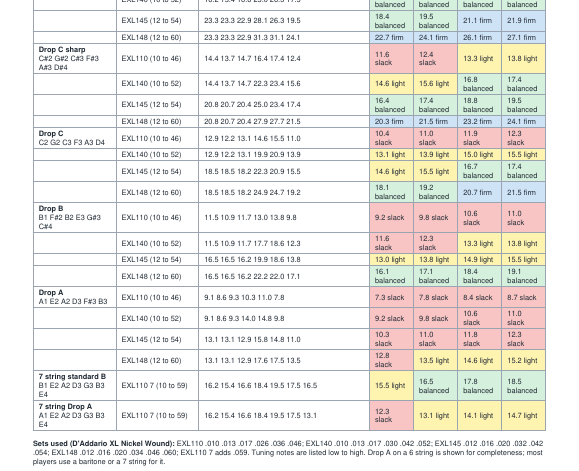
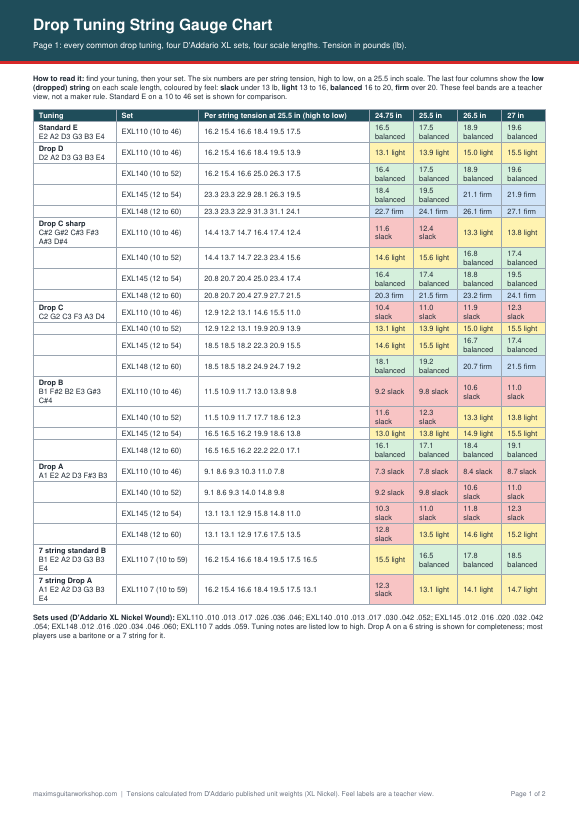
We calculated every number below with D’Addario’s formula and the unit weights in its String Tension Specifications brochure (a copy hosted by the Chrysalis Foundation). Figures are in pounds for D’Addario XL Nickel Wound sets on a 25.5 inch scale, low (dropped) string last. The feel label is our teacher view: under 13 lb slack, 13 to 16 light, 16 to 20 balanced, over 20 firm.
| Tuning | Set | Tension high to low (lb) | Low string feel |
|---|---|---|---|
| Standard E (for comparison) | EXL110, 10 to 46 | 16.2, 15.4, 16.6, 18.4, 19.5, 17.5 | balanced |
| Drop D | EXL110, 10 to 46 | 16.2, 15.4, 16.6, 18.4, 19.5, 13.9 | light |
| Drop D | EXL140, 10 to 52 | 16.2, 15.4, 16.6, 25.0, 26.3, 17.5 | balanced |
| Drop C sharp | EXL140, 10 to 52 | 14.4, 13.7, 14.7, 22.3, 23.4, 15.6 | light |
| Drop C sharp | EXL145, 12 to 54 | 20.8, 20.7, 20.4, 25.0, 23.4, 17.4 | balanced |
| Drop C | EXL145, 12 to 54 | 18.5, 18.5, 18.2, 22.3, 20.9, 15.5 | light |
| Drop C | EXL148, 12 to 60 | 18.5, 18.5, 18.2, 24.9, 24.7, 19.2 | balanced |
| Drop B | EXL145, 12 to 54 | 16.5, 16.5, 16.2, 19.9, 18.6, 13.8 | light |
| Drop B | EXL148, 12 to 60 | 16.5, 16.5, 16.2, 22.2, 22.0, 17.1 | balanced |
| Drop A (6 string) | EXL148, 12 to 60 | 13.1, 13.1, 12.9, 17.6, 17.5, 13.5 | light |
| 7 string Drop A | EXL110 7, 10 to 59 | 16.2, 15.4, 16.6, 18.4, 19.5, 17.5, 13.1 | light |

As a check, D’Addario’s own EXL148 page shows this 12 to 60 set in C standard, and its EXL110 page lists the low E at 16.9 lb against 17.5 lb in the older brochure. So treat every figure as accurate to within about 5 percent. The free PDF has all four sets for every tuning across four scale lengths, so you can pick a string gauge for drop tunings that matches your own guitar.
Scale length matters
Scale length is the distance from the nut to the saddle. Fender’s scale length explainer lists 25.5 inches for the Stratocaster and Telecaster, and Fender notes the 24.75 inch Gibson scale in its history of the Jaguar. PRS lists 25, 26.5 and 27.7 inch models among others, and 26.5 to 27 inches is common on baritone and extended range guitars.
Because length is squared in the formula, tension climbs quickly with scale. Using the same EXL148 set in Drop B, our calculations give the low B at about 16.1 lb on 24.75 inches, 17.1 lb on 25.5, 18.4 lb on 26.5 and 19.1 lb on 27. On a 24.75 inch guitar, go a step heavier than the chart suggests for 25.5; on a 27 inch baritone, you can often stay a step lighter.

Balanced vs heavy bottom sets
Most drop tuning problems are in the bottom three strings. Heavy bottom sets such as D’Addario’s EXL140, 10 to 52 keep light plain strings for bends and add thicker wound strings for the low end. In Drop D this brings the low D to about 17.5 lb, the same as the low E on a standard 10 to 46 set.
The trade off is uneven feel. On EXL140 in Drop C sharp, the D and A strings sit around 22 to 23 lb while the top three are under 15 lb. Some players love that; others find chords feel lopsided. Balanced or heavier sets, such as EXL145, 12 to 54, raise the top strings too. As a teacher view, pick by how you play: lead heavy players often prefer heavy bottom sets, riff and chord players often prefer balanced ones.
Single strings make fine tuning easy. A common teacher tip is to keep your usual set and swap only the low string for one gauge that lands in the balanced band on the chart, which is the cheapest way to try a new string gauge for drop tunings.
Setup after changing gauge
A big jump in gauge or tension changes how the guitar sits, so plan a setup check. Fender’s factory setup specs note that compensations may be needed if you change string gauges. Our checklist:
- Nut slots. Thicker low strings can bind or sit high. Pinging while tuning, or a string that will not settle, means the slot needs a tech.
- Neck relief. More tension pulls the neck forward; less lets it straighten. Adjust the truss rod only if you know how, in small steps.
- Action. Measure at the 12th fret before and after.
- Intonation. Compare the 12th fret note with the open string and move saddles to suit.
- Floating tremolo. Spring balance changes with tension, so the bridge may tilt.
Strings also last longer when kept clean and dry; our post on guitar care in humid weather covers string corrosion. If you are new to gauges in general, start with all you need to know about string gauge.
What famous heavy players use
We keep player gauges, with their sources, in one place: see famous guitarists’ string gauges. We have not repeated them here because gauges change over a career and many published lists are unsourced. If you want riffs to test a new set on, our Chuck Schuldiner riffs drills work well in low tunings, and you will feel quickly whether your string gauge for drop tunings is right.
Free string gauge for drop tunings chart (PDF)
Most resources are either calculators or single tuning pages. We wanted every common drop tuning and four scale lengths on one printable page, with the source of every number shown, so we made one. Page 1 covers Standard E, Drop D, Drop C sharp, Drop C, Drop B and Drop A with four D’Addario sets, plus 7 string standard and Drop A, at 24.75, 25.5, 26.5 and 27 inches. Page 2 shows the method, a setup checklist and a fill in row for your own guitar.
Download the free Drop Tuning String Gauge Chart (PDF)
FAQ
What string gauge for Drop C?
On a 25.5 inch scale, our calculations put a 12 to 54 set in the light band and 12 to 60 in the balanced band for the low C. A 10 to 52 set works if you like a slinkier feel.
What is a good Drop D string gauge?
A standard 10 to 46 set gives the low D about 13.9 lb, which many players find fine. A 10 to 52 set brings it to about 17.5 lb, matching standard tuning feel.
What gauge for Drop B?
About 12 to 60 on a 25.5 inch guitar, or lighter on a baritone. Smaller sets leave the low B under 13 lb on most scales.
What gauge for 7 string Drop A?
A 10 to 59 set leaves the low A at about 13.1 lb on 25.5 inches. Many players swap the seventh string for a heavier single string, or use a longer scale.
Do I need a setup after changing gauge?
Usually a quick one. Check the nut slots, neck relief, action and intonation, as listed above.
Picking a string gauge for drop tunings is easier once you know the numbers, and good technique in low tunings comes from steady practice. If you would like a guided start on the playing side, have a look at our online beginner course.
Image credits
String packs: Andrew King, Wikimedia Commons, CC BY SA 2.0. Standard, baritone and bass guitars: Danny Ayers, Wikimedia Commons, CC BY 2.0. Seven string guitar: Wikimedia Commons, public domain. Chart preview: Maxim’s Guitar Workshop.