

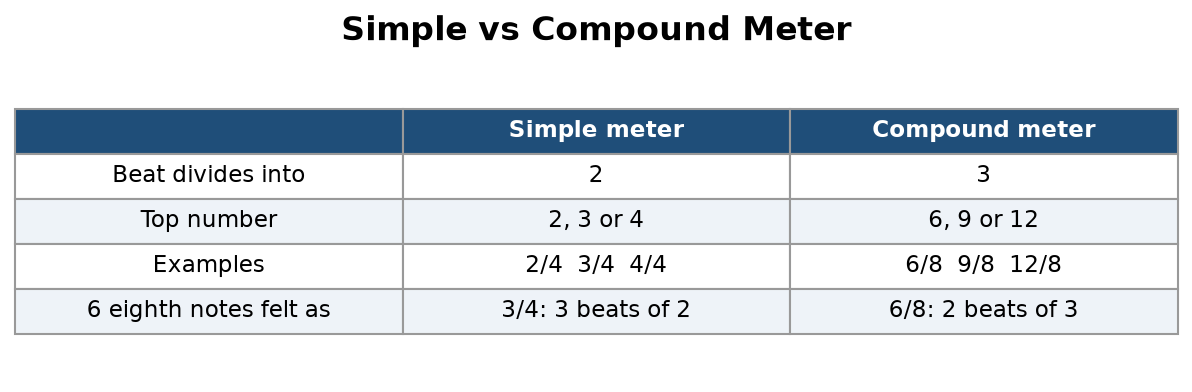
Simple vs compound meter in one line: in simple meter each beat divides into two equal parts; in compound meter each beat divides into three. That is why 6/8 is felt as two big beats, not six.
| Simple meter | Compound meter | |
|---|---|---|
| Beat divides into | Two | Three |
| Beat note | Plain note (for example a quarter note) | Dotted note (for example a dotted quarter) |
| Top number | 2, 3 or 4 | 6, 9 or 12 |
| Examples | 2/4, 3/4, 4/4, 2/2 | 6/8, 9/8, 12/8 |
| Felt beats per bar | Same as the top number | Top number divided by three |
For more detail, see Wikipedia on metre and Open Music Theory on meter and time signatures.
How to Hear Simple vs Compound Meter
The quickest way to hear simple vs compound meter is to count along with a song. If each beat splits naturally into "1 and 2 and", you are in simple meter. If each beat splits into "1 la li 2 la li", you are in compound meter.
Try clapping six even eighth notes. Accent notes 1, 3 and 5 and you get 3/4; accent notes 1 and 4 and you get 6/8. Same notes, different meter.
The Answer: How 9/8 Feels
A 9/8 bar is usually felt as three groups of three eighth notes, so it has three dotted quarter beats:
9/8  Count   1 2 3 4 5 6 7 8 9
9/8  Groove  1 2 3 1 2 3 1 2 3
Songs in 6/8, 9/8 and 12/8
| Meter | Song | What to listen for |
|---|---|---|
| 6/8 | The Animals, House of the Rising Sun | The arpeggiated guitar part rolls in two groups of three |
| 6/8 | Metallica, Nothing Else Matters | The fingerpicked intro is felt in two beats per bar |
| 9/8 | Debussy, Clair de lune | Three gentle beats, each split into three |
| 12/8 | Tears for Fears, Everybody Wants to Rule the World | Published sheet music writes it in 12/8, four beats each split into three |
A useful contrast is Dave Brubeck's Blue Rondo à la Turk. It is also in 9/8, but much of it is grouped 2+2+2+3, an uneven additive pattern, so it does not feel like compound meter at all.
Simple vs Compound Meter: FAQ
Is 6/8 the same as 3/4?
No. Both hold six eighth notes, but 3/4 is felt as three beats of two eighths, while 6/8 is felt as two beats of three eighths.
How do I tell simple vs compound meter by ear?
Tap the main beat, then count what fits inside each tap. If you hear "1 and", it is simple; if you hear "1 and a" in an even triple pattern, it is compound.
Is 12/8 the same as 4/4 with triplets?
They sound very similar, which is why some players chart a shuffle either way. Read more about triplets in music.
Once simple vs compound meter is clear, revisit beat, tempo, meter and pulse, the basics of time signatures and polyrhythm and polymeter.
To practise these grooves on guitar step by step, join our online beginner course.