
Tonal vs atonal music at a glance
Tonal music: music organised around a home note and key that the melody and chords keep returning to.
Atonal music: music that avoids a home note or key, so no single pitch feels like the place to rest.
For more detail, see Wikipedia on atonality and the Chamber Music Society profile of Arnold Schoenberg.
Tonal vs Atonal Music Compared
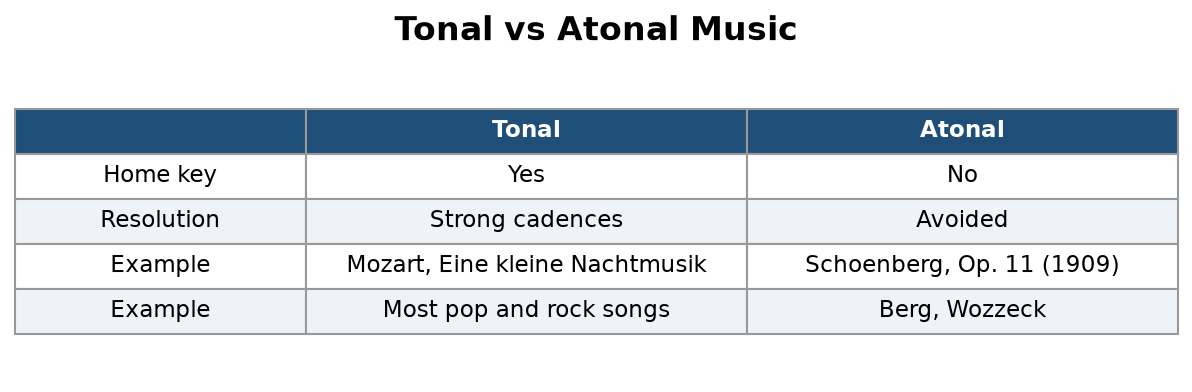
| Tonal music | Atonal music | |
|---|---|---|
| Home note or key | Yes, a clear tonal centre | No clear centre |
| Key signature | Usually | Often none |
| Sense of resolution | Strong, through cadences | Avoided or ambiguous |
| Where you hear it | Most classical, pop, rock and folk | Much early twentieth century concert music and many film scores for tension |
Famous Examples With Composers
Tonal: Mozart's Eine kleine Nachtmusik (1787) is firmly in G major, and almost every pop song you know is built around one key. When a song ends on its home chord and feels finished, that sense of arrival is tonality at work.
Atonal:
- Arnold Schoenberg, String Quartet No. 2, Op. 10 (1908): its finale steps away from a home key, which is the 1908 starting point mentioned above.
- Arnold Schoenberg, Three Piano Pieces, Op. 11 (1909).
- Arnold Schoenberg, Pierrot lunaire, Op. 21 (1912).
- Alban Berg, Wozzeck (written 1914 to 1922, first performed 1925), a landmark atonal opera.
Tonal vs Atonal Music: FAQ
Is atonal music the same as dissonant music?
No. Tonal music uses dissonance too; it just resolves it back to a home key. Atonal music treats dissonance freely. See consonant vs dissonant intervals.
Is most guitar music tonal?
Yes. Rock, blues, pop and folk guitar are built on keys, scales and cadences, which is why understanding scale degrees and the difference between major and minor scales helps so much with tonal vs atonal music.
When did atonal music begin?
Most histories date it to 1908 and 1909, when Arnold Schoenberg wrote the finale of his String Quartet No. 2 and his Three Piano Pieces, Op. 11. His pupils Alban Berg and Anton Webern soon followed.
In the early 1920s Schoenberg developed the twelve tone method, a more systematic way to organise atonal music. Most guitar music you hear today, by contrast, is firmly tonal.
If you want to learn how keys and chords work on the guitar from the ground up, start with our online beginner course.